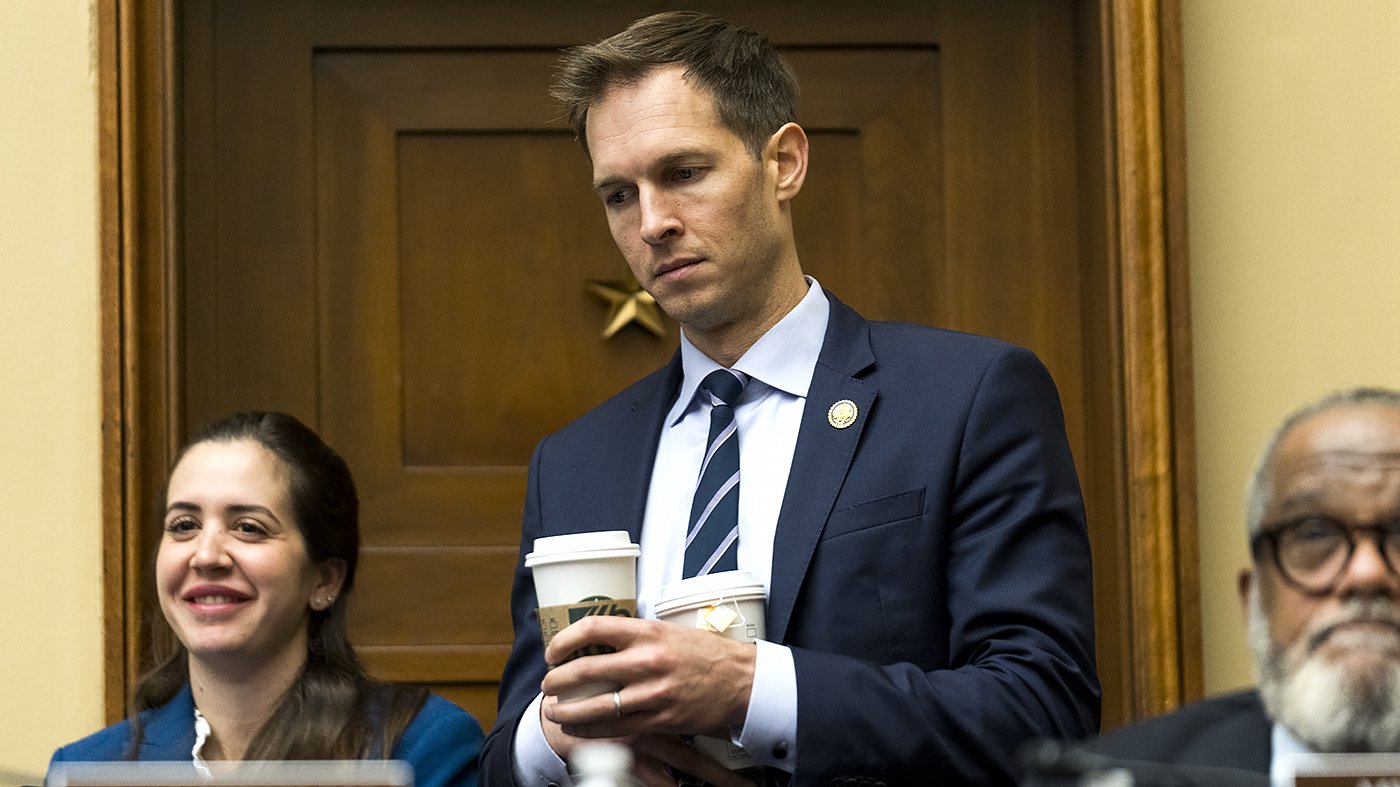
Representative Jake Auchincloss (D-Mass.) voiced bewilderment Monday at President Donald Trump's simultaneous pursuit of a nuclear deal with Iran and expansion of the Abraham Accords, a combination the congressman called strategically muddled.
Speaking on CNN's The Arena, Auchincloss said he supports the accords—a signature achievement of Trump's first term—but found the president's latest directive confusing. Earlier Monday, Trump posted on Truth Social that Gulf nations involved in U.S.-Iran peace talks should be required to join the Abraham Accords, which normalize relations with Israel.
“I don't know what that sentence means,” Auchincloss told host Boris Sanchez. “The challenge with the Abraham Accords expansion is not that these countries share an aversion to Iran—they always have.”
The Massachusetts Democrat pointed to the unresolved Israeli-Palestinian conflict as the real bottleneck. “The challenge has been getting Saudi Arabia on board, given ongoing attacks against Israel and its right to defend itself, and the situation in the West Bank,” he said. “So the Abraham Accords expansion runs through resolving West Bank issues, not on trying to foment further aversion to Iran, which has always been there.”
Trump's call came as his administration negotiates with Tehran to end a widening conflict. The president said he had spoken with leaders from Saudi Arabia, Qatar, Pakistan, Egypt, Jordan, Bahrain, Turkey, and the United Arab Emirates about the peace process. He insisted that “all of these countries, at a minimum, simultaneously, sign onto the Abraham Accords,” noting that the UAE and Bahrain are already members.
The Abraham Accords, brokered in 2020, established diplomatic ties between Israel and several Gulf states. But critics note that Saudi Arabia, the region's heavyweight, has held out amid the war in Gaza and rising tensions in the West Bank. Some Democrats have argued that the administration's Israel policy has failed, calling for conditions on military aid.
Auchincloss's skepticism reflects broader unease among lawmakers about Trump's dual-track diplomacy. Secretary of State Marco Rubio recently warned that a final Iran deal could take days more, dimming hopes for a quick resolution. Meanwhile, Trump's approval ratings have slipped as the conflict drags on.
“Is it actually realistic, or is it a distraction?” Sanchez asked Auchincloss, who did not offer a direct answer but implied the president's approach lacks coherence. The exchange underscores the tangled web of Middle East diplomacy, where normalization with Israel and countering Iran are often treated as separate tracks—not a single mandatory package.