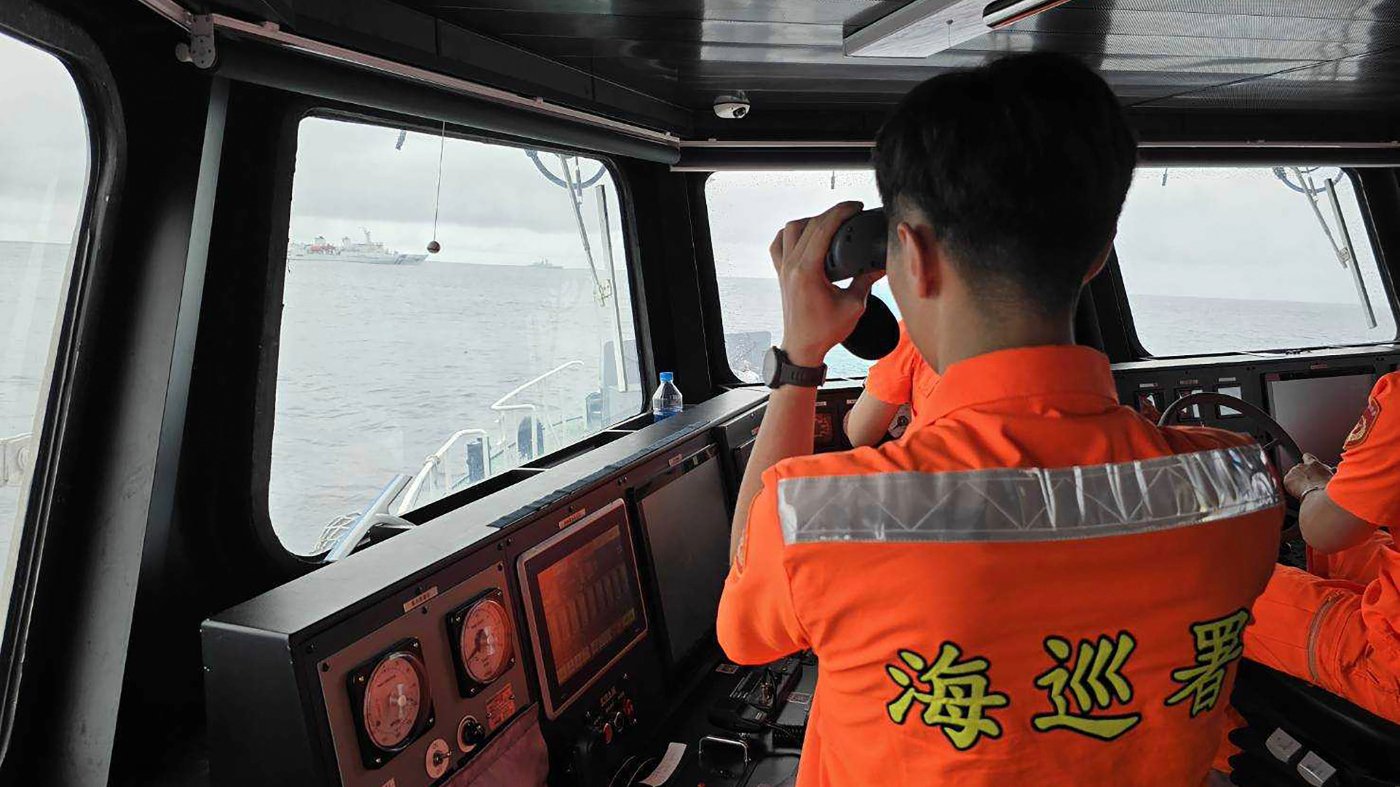
Beijing has taken an unprecedented step in its maritime expansion, declaring a portion of the Pacific Ocean east of Taiwan as sovereign Chinese waters. On July 4, China announced a new sea patrol to replace a flotilla that in June was central to its effort to extend control far beyond its coastline. The move marks a sharp escalation in Beijing's campaign to redefine regional maritime boundaries.
On June 6, China's Ministry of Transport launched what it called a special law enforcement operation in waters east of Taiwan. Vessels from the Fujian and Guangdong Maritime Safety Administrations, along with the East China Sea Navigation Support Center and Rescue Bureau, sailed through the Bashi Channel, which separates Taiwan from the Philippines. The operation lasted five days, during which Chinese ships inspected 198 vessels, all civilian, underscoring Beijing's claim that it was enforcing its laws over areas it considers part of the People's Republic.

These waters lie beyond the 12-nautical-mile territorial limit recognized under the United Nations Convention on the Law of the Sea. By asserting sovereignty over this stretch of the Pacific, Beijing is challenging international norms that treat such areas as part of the global commons. The action followed May 28 talks between Japan and the Philippines to resolve overlapping exclusive economic zone claims, which Beijing denounced as illegal.
A Clear Signal
The Communist Party's semi-official Global Times described the operation as a sovereignty declaration with both legal and political weight. It stated that China has indisputable jurisdiction over Taiwan and its surrounding waters. Another commentary from Yuyuan Tantian, a social media account linked to China Central Television, called it a landmark development that establishes a coastal governance model around Taiwan. The account declared that from now on, waters east of Taiwan are China's coastal waters—an ocean where Beijing is present, exercises jurisdiction, and governs.
Ray Powell of Stanford University's Gordian Knot Center for National Security Innovation noted that what is different this time is how openly Beijing has described its maritime expansion. China's ambitions have grown rapidly: until 2018, Beijing acknowledged the Taiwan Strait as international water, but it now asserts that vital waterway is domestic. In August 2023, the Ministry of Natural Resources updated its nine-dash line claim by adding a tenth dash east of Taiwan, suggesting claims beyond the 12-nautical-mile limit.
Strategic Implications
Analysts warn this could be a stepping stone toward a maritime exclusion zone around Taiwan. Carl Schuster and Robert Eldridge wrote in the Taipei Times that Beijing's assertion of jurisdiction over an undefined portion of the Pacific adjacent to Taiwan is a potential precursor to such a zone. James Fanell, a former U.S. Navy captain who served as director of Intelligence and Information Operations for the U.S. Pacific Fleet, told me that the Communist Party seeks total control of Taiwan, including all water and airspace. He said Beijing prefers to use lawfare to achieve control without firing a shot, but the People's Liberation Army is prepared to take control by force if necessary, including attacks against U.S. and Japanese forces in the region.
Beijing sees this as its moment to break through the First Island Chain, a line of islands from Japan to Indonesia that has historically constrained the Chinese navy and air force. Taiwan sits at the center of this perimeter. The Pentagon's 2026 National Defense Strategy promises a strong denial defense along the First Island Chain, but Powell noted after China's June operation that the chain has already been breached.
American interests are clearly threatened. The Pentagon's strategy shift, as detailed in this analysis of command changes, reflects growing concern over Beijing's assertiveness. Meanwhile, China's recent submarine ballistic missile test further stirs Pacific tensions, underscoring the strategic stakes.