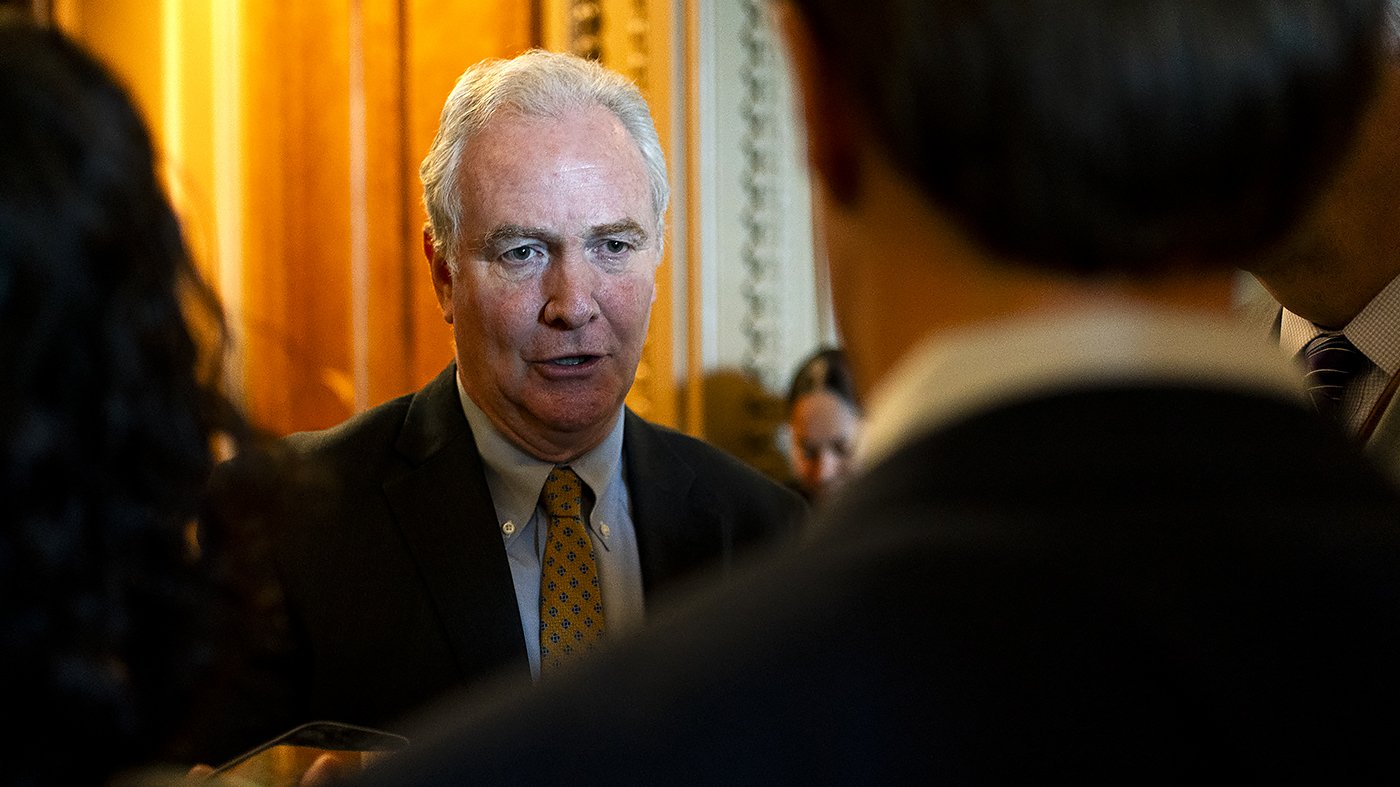
Sen. Chris Van Hollen (D-Md.) delivered a sharp rebuke of his own party’s handling of the Israeli-Palestinian conflict, arguing in a New York Times op-ed Tuesday that Democrats “need to face a hard truth.”
“While Republicans’ approach to the Israeli-Palestinian conflict has failed, so has ours,” Van Hollen wrote, directly challenging party orthodoxy that has long backed unconditional support for Israel.
Van Hollen, a frequent critic of Israeli Prime Minister Benjamin Netanyahu since the Oct. 7, 2023, Hamas attack, called for the U.S. to use its leverage to push for a two-state solution. “For decades, we have called for a two-state solution, but we’ve failed to use our leverage to make it real,” he wrote. He advocated withdrawing taxpayer support and conditioning arms sales to Israel, a stance that puts him at odds with many in his party.
The Maryland senator’s op-ed comes amid a fragile U.S.-brokered ceasefire between Israel and Hamas, and as the death toll in Gaza surpasses tens of thousands, according to local health officials. The conflict has reignited debate over America’s long-standing military and financial backing of Israel.
Van Hollen insisted he supports Israel’s security but argued that “for too long most Democrats have unquestioningly accepted Israel’s argument that American weapons are needed and used solely for its defense.” He accused Israel of using U.S. arms “not only as a shield, but also as a sword to bury the two-state solution and advance the far right’s vision of a ‘Greater Israel.’”
The senator’s critique echoes concerns he and Sen. Jeff Merkley (D-Ore.) raised last year after a trip to the region, where they accused Netanyahu’s government of overseeing “ethnic cleansing” in Gaza. Van Hollen’s latest salvo also warns that primary voters in 2028 will reject any Democratic candidate who lacks “moral and strategy clarity” on the issue—especially those who voted to send bombs to Netanyahu while his government imposed a total blockade on Gaza.
The op-ed lands as Democrats grapple with internal divisions on Israel policy, a rift that has widened since the war began. Van Hollen has also been critical of the DNC’s post-election review, and his latest intervention signals a broader push to reshape party strategy on foreign policy.
Some Democrats worry that the party’s anti-Trump focus is becoming a liability, but Van Hollen’s argument suggests a more fundamental reckoning: that the party’s traditional stance on Israel is out of step with its progressive base and moral commitments. That tension could shape the 2028 primary field.
Van Hollen’s call to condition arms sales and end taxpayer support for occupation marks a sharp departure from past Democratic platforms, which largely avoided such conditions. Whether his party heeds that call remains an open question.