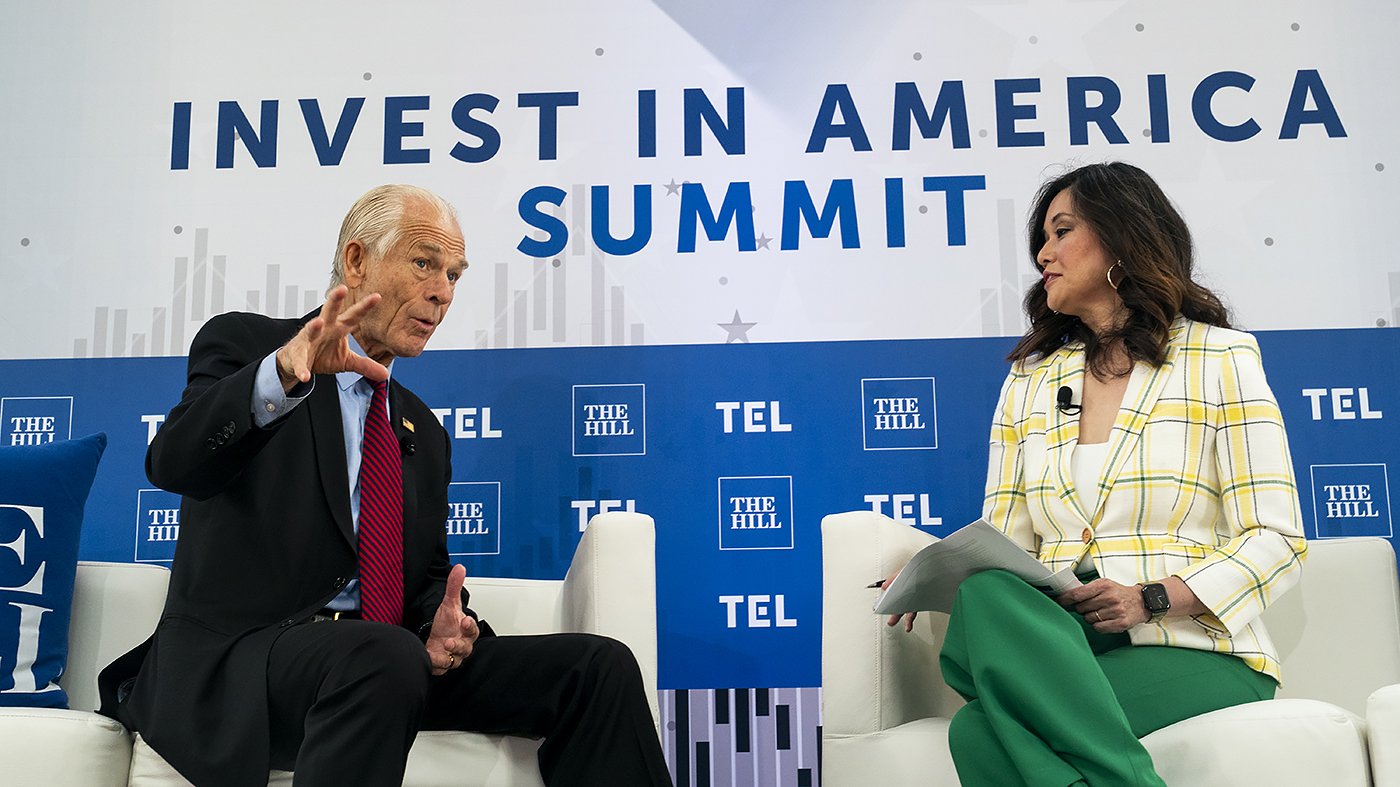
Lawmakers, regulators, and industry executives gathered Wednesday for The Hill's second annual Invest in America Summit, zeroing in on how artificial intelligence, trade policy, and shifting energy dynamics are reshaping the U.S. economy. The conversations revealed deep divides over the pace of technological change, the fallout from President Trump's tariff agenda, and the vulnerabilities exposed by geopolitical crises.
AI's Accelerating Role in the Economy
Artificial intelligence is no longer a fringe tool—it is becoming central to how businesses operate, from small manufacturers to global conglomerates. Ann Fairchild, president and CEO of Siemens USA, told moderator Betty Liu that AI now dominates every economic discussion: "You can't have any conversation about anything anymore without bringing AI into the conversation."

Data from McKinsey underscores the trend: 88 percent of businesses reported using AI in at least one function last year, up from 78 percent in 2024 and a mere 20 percent in 2017. Small Business Administration head Kelly Loeffler noted that even the smallest firms are leveraging AI to compete. She told The Hill's Julia Manchester that manufacturers using AI have slashed production planning from two to four weeks down to a single day.
Teresa Carlson, CEO of the General Catalyst Institute, struck an optimistic tone, especially regarding health care applications. But she urged lawmakers to act: "Our lawmakers have to get busy understanding and telling the positive story [on AI], and begin to plan for their city, their counties, their local government, how is AI going to help support what we're doing, not just take it backwards?"
Rep. Haley Stevens (D-Mich.), a candidate for U.S. Senate, warned that American companies operate under a "rules-based order" while Chinese rivals do not. She called for a "national call to action" on AI safeguards, saying, "They manipulate open free-market capitalism... But my goodness gracious, you can't just let these guys come in... and eat our lunch."
Tariffs: A Double-Edged Sword for Business
President Trump's tariffs remain a flashpoint. Senior trade adviser Peter Navarro defended the policy as essential to "protect our manufacturing base, our defense industrial base [and] American workers." He added, "All we want to do is balance our trade, okay? The day that our trade deficit goes to zero is the day I'll be happy with no tariffs."
But the legal landscape has shifted. In February, the Supreme Court struck down Trump's emergency tariffs imposed under the International Emergency Economic Powers Act. A subsequent federal trade court also invalidated levies meant to address balance-of-payments deficits. The Penn Wharton Budget Model estimates the government owes up to $175 billion in refunds.
Eugene Laney, president of the American Association of Exporters and Importers, told Liu that Customs and Border Protection has handled simpler refunds, but the Justice Department has "put on the brakes" on more complex reimbursements. He recounted a small business leader who said, "If I can get my $8,500 back, I can go buy this new equipment plant, and maybe I can go on this trade mission that you want me to go on in [South] Korea."
Energy Markets Under Pressure
Former Pentagon official Caroline Baxter, now at the Council on Strategic Risks, highlighted the fragility of global energy systems. The crisis triggered by Iran's closure of the Strait of Hormuz—through which roughly one-fifth of the world's oil passed in 2024—has "killed" energy-import-dependent nations like Japan and South Korea, she said.
Baxter stressed the need for resilient grids: "You need an energy grid that can withstand and stand up to an influx of different kinds of power." Her remarks come as the U.S. grapples with balancing fossil fuel reliance with renewable expansion, a tension that will only intensify as geopolitical risks mount.
The summit's discussions underscored a broader reality: whether through AI, tariffs, or energy policy, the U.S. economy is navigating a period of rapid disruption—and the decisions made in Washington will determine whether American businesses thrive or fall behind.