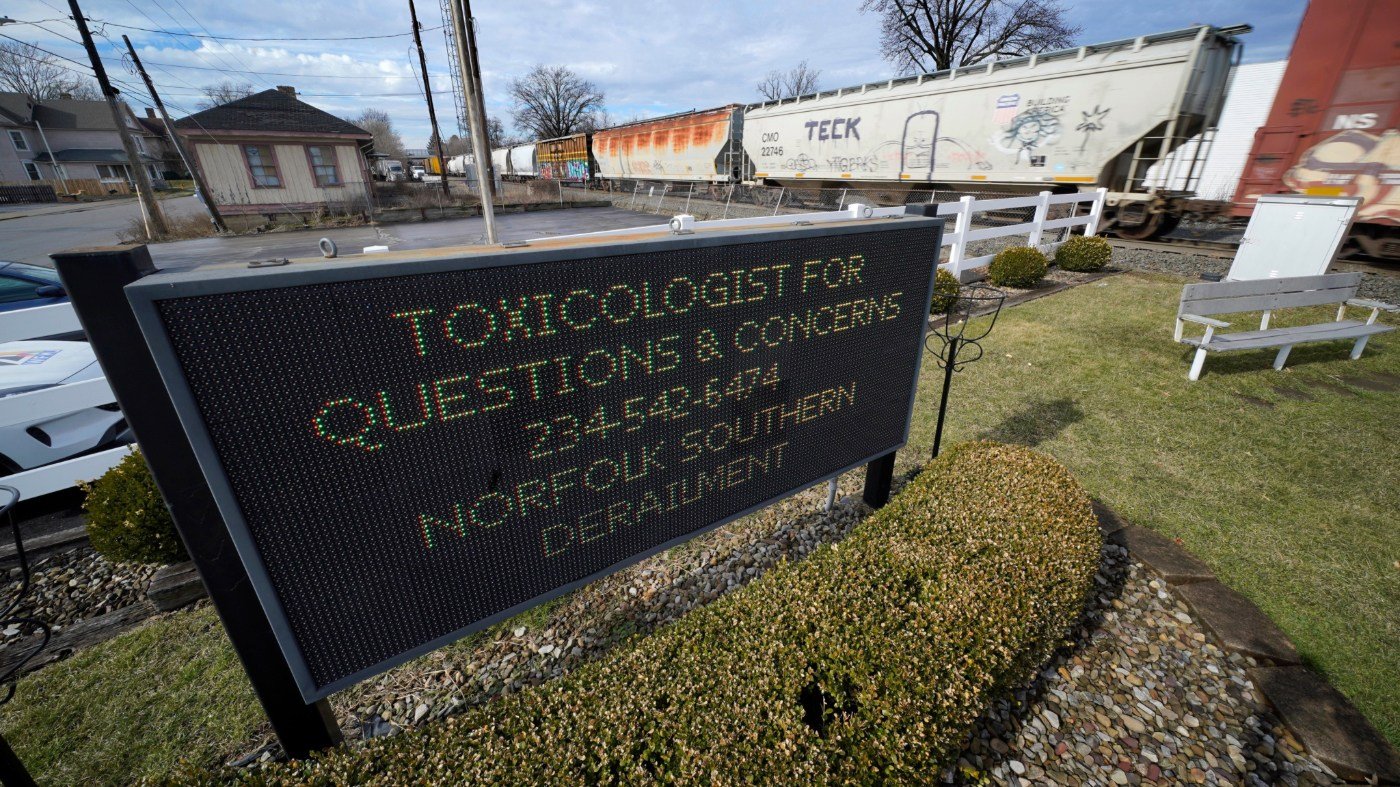
Two years after a Norfolk Southern train carrying vinyl chloride derailed in East Palestine, Ohio, residents are still waiting for definitive answers about what the chemical release and controlled burn did to their health. Misti Allison, who lived a mile from the wreck, recalls the black plume that hung over her home, her children's school, and the surrounding farmland. "Presidents and cabinet secretaries came. Cameras came. Most of them left," she says. But the scientists stayed—funded by the National Institutes of Health.
Through the National Institute of Environmental Health Sciences, researchers have spent years collecting blood, urine, air, and soil samples from residents who volunteered their own bodies as evidence. One study, published in Environmental Science & Technology, found HEMA—a breakdown product linked to vinyl chloride—in the urine of 74 percent of East Palestine residents tested five months after the disaster. In a comparison group from Marietta, Ohio, the compound appeared in none. Nationally, it shows up in about 5 percent of people.

That kind of finding is exactly what NIH funding is supposed to deliver: answers no one else would bother to find. But now the White House is moving to change how those dollars are awarded. According to The New York Times, the Office of Management and Budget is drafting an executive order that would create an outside committee empowered to veto NIH grants that don't align with the president's political agenda. The proposal grew out of a contentious Oval Office meeting where OMB Director Russell Vought accused NIH Director Jay Bhattacharya of funding work at odds with administration priorities. Bhattacharya has resisted.
For decades, NIH has selected projects through peer review—experts evaluate the science and fund what is most likely to produce answers. A political committee would ask a different question: not "Is this good science?" but "Does this meet our agenda?" That shift should worry every community like East Palestine—a small, conservative, working-class village that is not an Ivy League campus and not anyone's culture war. But the research that serves it is exactly the kind of work that could land on a veto list.
Environmental health studies routinely produce findings inconvenient for powerful industries, including railroads. Research on how income, geography, and occupation shape health outcomes is disparities research—a field already cut back under recent executive orders. Rural Appalachia lives inside those statistics, as do many other marginalized communities across the nation.
A veto doesn't have to be used often to do damage. Its mere existence is enough. Researchers planning the next decade of their careers will steer away from any study that might look political to someone at OMB. Communities facing the next chemical disaster will find fewer scientists willing to show up. And disasters keep happening—derailments, industrial fires, wildfires, and chemical spills occur every year, each leaving families with the same questions. Some health effects take decades to appear; children exposed today may not show certain outcomes until adulthood. Answering those questions requires following the same people for years. A grant that can be yanked midstream is a grant no one can plan around.
It also breaks trust, and trust is the hardest thing to rebuild. Allison's neighbors did not hand over their blood and urine lightly. Many already felt abandoned by agencies that told them everything was fine. They participated, and continued to participate years later, because researchers promised to stay and share what they found. If Washington can cancel that promise over the politics of a study, participants will stop believing any promise at all.
Congress has already shown it understands this. Lawmakers rejected the administration's proposed cuts to biomedical research and blocked a rule injecting political review into federal grantmaking. That was the right call, but a temporary block won't stop a permanent order. Lawmakers should use this year's appropriations bills to protect peer review in law, bar federal funds from supporting any body that can overrule expert review of NIH grants, and protect awarded grants from political cancellation. This is not a partisan ask. Merit review has served Republican and Democratic administrations alike, and red counties just as well as blue ones. As Senator Collins has warned, political control of NIH grants would undermine the integrity of biomedical research.
East Palestine did not choose this disaster. Its residents chose to help science answer it, for themselves and for whoever is next. Which questions are worth asking is a judgment scientists spend careers learning to make. It is not one that a committee at the OMB is qualified to overrule.