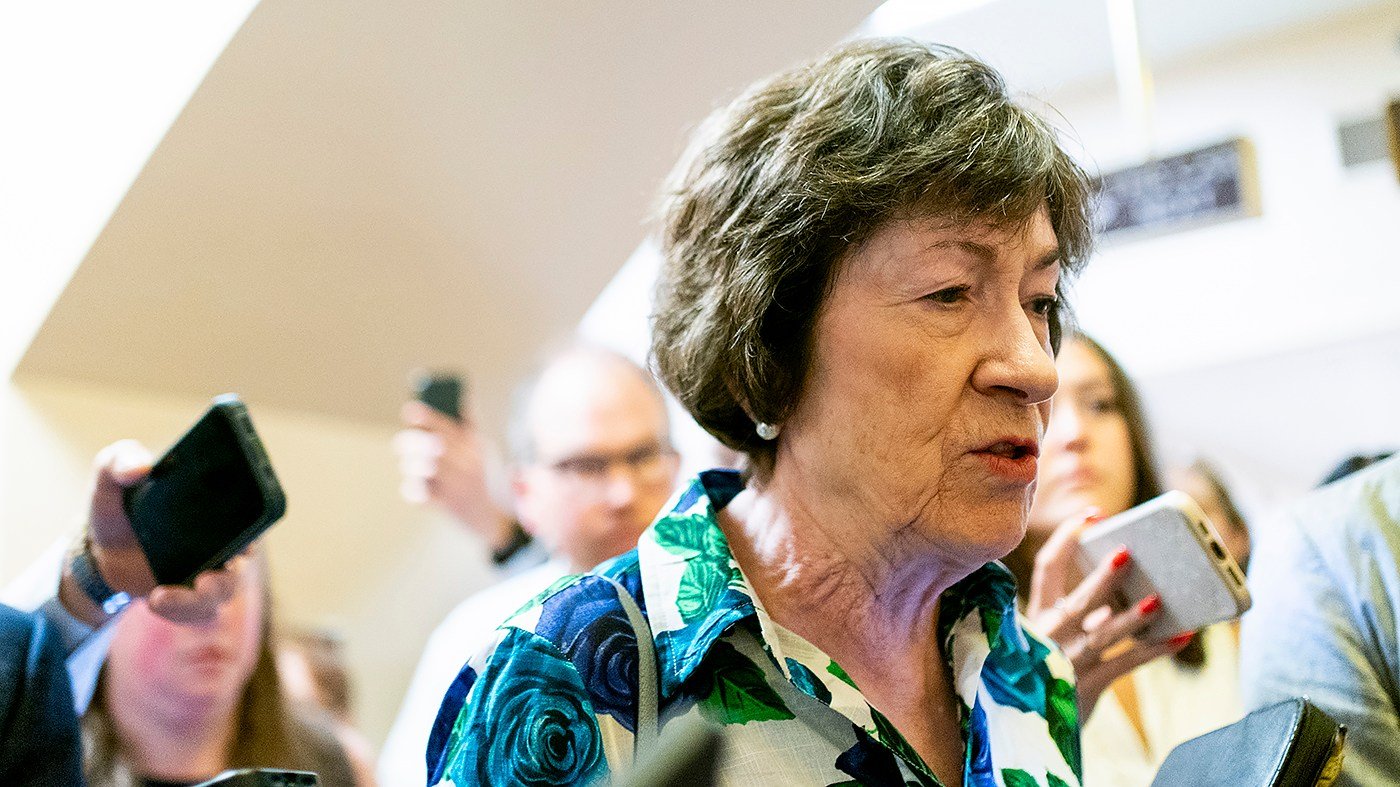
Senate Appropriations Committee Chair Susan Collins (R-Maine) is pressing the Trump administration to abandon a proposed executive order that would install political appointees as gatekeepers for scientific grants at the National Institutes of Health, warning it would replace scientific merit with ideological litmus tests.
In a letter Tuesday to Office of Management and Budget Director Russ Vought and NIH Director Jay Bhattacharya, Collins pointed out that the stopgap spending measure Congress cleared earlier this month already rejected a similar plan to give political officials broader say over federal research awards. That proposal would have required grant approvals to align with the president’s priorities.
Collins argued that creating a political review board for NIH grants would “undermine the federal government’s objective of funding biomedical research projects based on scientific merit and value rather than political ideology.” She has repeatedly challenged White House attempts to tighten its grip on NIH funding, including her opposition earlier this year to a 15 percent cap on indirect research costs.
On Monday, Collins joined the top Democratic appropriators—Sen. Patty Murray (Wash.) and Rep. Rosa DeLauro (Conn.)—in a sharply worded statement condemning the proposed order. The bipartisan pushback reflects growing unease on Capitol Hill over executive branch encroachment on the agency’s grantmaking process.
In her letter, Collins underscored how the current NIH system has fueled breakthroughs against Alzheimer’s disease, Type 1 diabetes and cancer. She warned that a new committee reviewing NIH grants would “risk undermining the Congressionally-mandated peer review process that all NIH grants must undergo before they are approved for federal funding.”
“The rigor of the peer review process is key to NIH’s success,” Collins wrote, noting that 174 scientists either working at or funded by NIH have won Nobel Prizes. She urged the administration to send any further reforms to Congress as legislation rather than impose them through executive action. “If the administration seeks additional reforms of NIH, I urge you to submit a legislative proposal to Congress rather than pursue an executive order,” she said.
The dispute comes as the White House has sought to assert more political control over federal science funding, a move that critics say could chill research and politicize decisions traditionally made by expert panels. Collins’s intervention signals that any unilateral attempt to restructure NIH grant oversight will face stiff resistance from key appropriators in both parties.
For now, the administration has not publicly responded to Collins’s letter. But her warning adds pressure on OMB and NIH to either shelve the proposal or seek congressional approval—a path that would likely ignite a broader debate over the balance between executive authority and scientific independence.