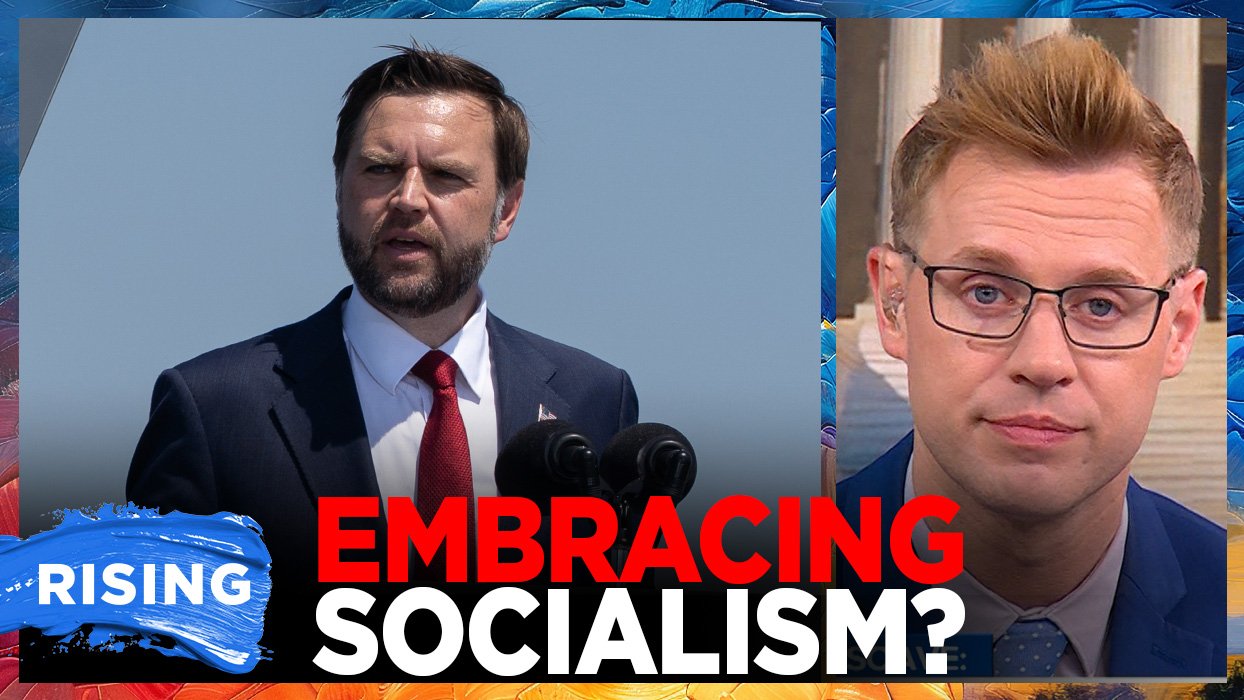
Vice President JD Vance is raising eyebrows within conservative circles with his recent dismissal of Milton Friedman's economic philosophy, suggesting a pivot toward government intervention that some see as a concession to socialist thinking. In a recent interview on The Daily Wire, Vance not only defended Trump's controversial proposal to seize AI company profits but also explicitly advocated for moving the Republican Party away from Friedman's laissez-faire principles.
Vance argued that the economy should serve human dignity, stating, "It's fundamentally about the dignity of the human person. The economy is a tool to service the dignity of the human person." He outlined a vision where economic policies help families raise children, earn a living wage, and participate in community life. While this rhetoric resonates with populist sentiments, it mirrors language used by progressive figures like Senator Bernie Sanders and Representative Alexandria Ocasio-Cortez.

Critics, including political journalist Robby Soave, contend that framing free markets as antithetical to human dignity is a progressive trope. Soave, a senior editor at Reason Magazine, warns that Vance's approach could alienate the GOP's base and undermine the party's historical successes. "Positing that free markets are somehow antithetical to human dignity is explicitly progressive framing," Soave wrote, noting that Sanders and Ocasio-Cortez would not have worded it differently.
Vance's comments come at a time when the Democratic Party faces internal battles with socialist and communist factions, yet he seems to embrace policies that align with that wing. His advocacy for centralized economic planning and rejection of Friedman's legacy mark a stark departure from the Reagan-era principles that propelled the GOP to landslide victories, such as Reagan's 49-state win in 1984.
This shift is particularly concerning given Trump's low approval ratings on the economy, currently at 33 percent. Soave argues that moving away from Friedman's free-market framework has not yielded positive results for the right. "The economy is underperforming and people don't like it," he wrote, questioning whether Vance's strategy would work against a potential Democratic opponent like Gavin Newsom or Ocasio-Cortez.
Vance's position also contrasts with his past criticisms of Trump, as highlighted in a revived 2016 'Cultural Heroin' attack. Now, he appears to be doubling down on Trump's more interventionist economic policies, even as Trump himself has taken a back seat on other issues, such as the fragile Iran deal, where Vance has taken the lead.
Soave concludes that to defeat the "enemies of liberty and prosperity," the GOP needs a full-throated defense of free-market principles, not a watered-down version of the left's agenda. Whether Vance can deliver that remains an open question as he positions himself as the likely heir to Trump's political movement.