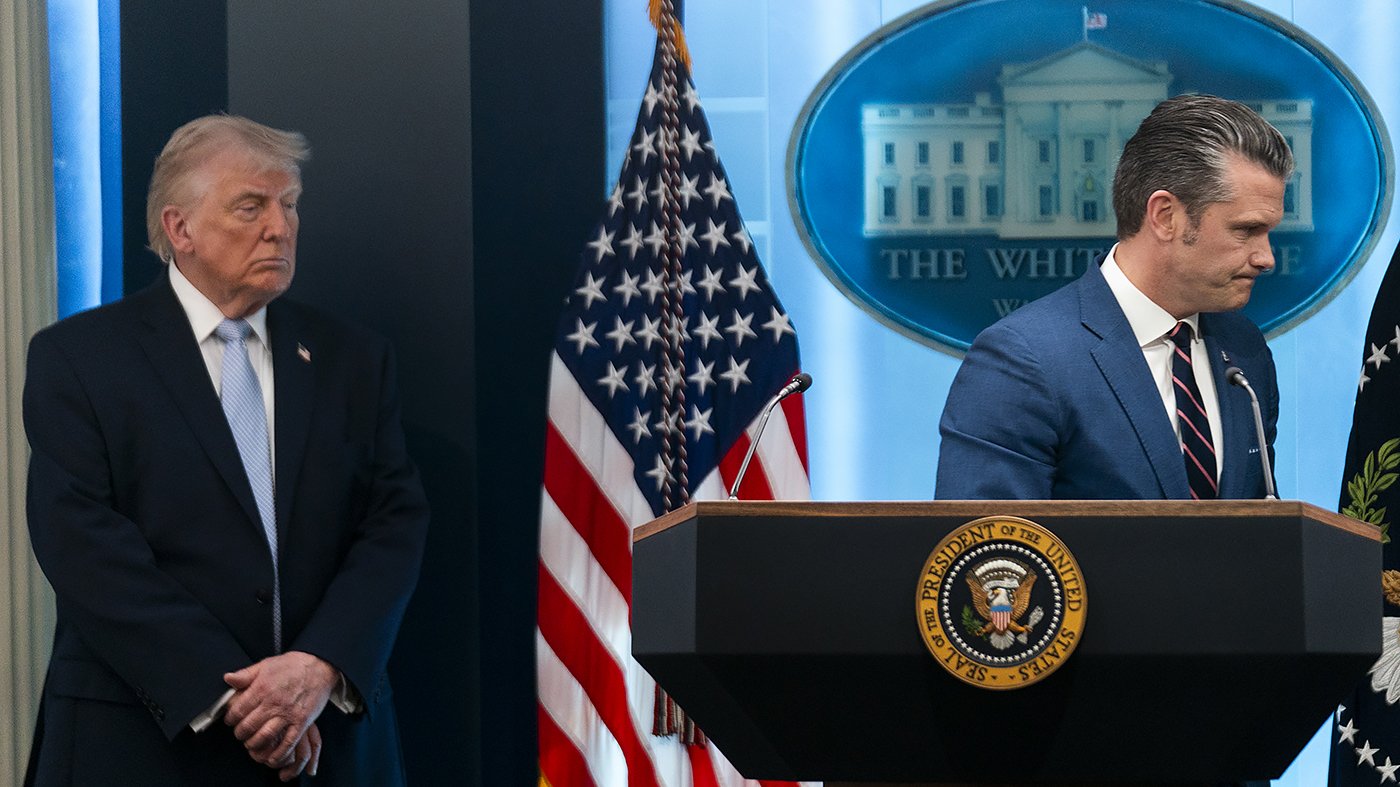
Defense Secretary Pete Hegseth, who served as the Trump administration’s primary spokesperson for military operations against Iran, has largely vanished from public discussion of Tehran since President Trump signed a memorandum of understanding to end hostilities. The deal, which did not secure major concessions on Iran’s missile or nuclear programs, has shifted the diplomatic burden to Vice President JD Vance.
Hegseth’s retreat from the spotlight reflects internal divisions that were already apparent before the MOU. Trump disclosed in March that Hegseth was “the first one to speak” in favor of kinetic action, while Vance was far less enthusiastic about launching a war. The contrasting roles have now become a public dynamic, with Vance defending the fragile agreement and Hegseth staying in the background.
Anthony Constantini, policy director at the conservative Bull Moose Project, described the shift as a classic good cop, bad cop routine. “Hegseth’s job is to present military options,” he said, adding that it would be “odd” for the Pentagon chief to constantly comment on negotiations he doesn’t lead. But Yvonne Chiu, a professor at the U.S. Naval War College and a visiting fellow at AEI, argued Hegseth should be more engaged. “He’s interested in showy kinetic actions or internal culture wars, not the hard work of keeping the peace,” she said, noting that the silence extends across much of the administration.
During the 38-day campaign of U.S. and Israeli strikes that began Feb. 28 and ended April 8, Hegseth and Joint Chiefs Chairman Gen. Dan Caine held regular briefings, detailing over 13,000 strikes inside Iran as part of Operation Epic Fury. Since the MOU was signed June 17, Hegseth has only spoken about Iran to warn of resumed operations. At a NATO meeting in Brussels, he said the “War Department” is ready to restart if Iran fails to give up nuclear material and facilities. But those comments have been the exception.
Talks mediated by Qatar and Pakistan remain stalled over control of the Strait of Hormuz, delaying progress on nuclear issues. Allison McManus of the Center for American Progress suggested the low visibility reflects a lack of good news. “There’s not much positive to report,” she said, adding that the administration likely wants to move on. Jason Dempsey, a retired Army infantry officer, noted that Hegseth was comfortable speaking when goals were “maximalist and unambiguous,” but now risks contradicting a president who frequently changes course.
The Pentagon has reverted to its pre-war routine of avoiding press briefings, a stark contrast to the daily updates during the campaign. Hegseth has publicly praised the MOU as superior to the 2015 JCPOA, but only while emphasizing that the military option remains on the table. Two aircraft carrier strike groups still surround Iran, a reminder of the force that underpins the negotiations.
The quiet from the Defense Department comes as Trump continues to consolidate executive power, a trend that some critics say undermines constitutional checks. The deal’s future remains uncertain, with a 60-day window to finalize a permanent peace treaty. For now, Hegseth’s silence speaks louder than his earlier war cries.