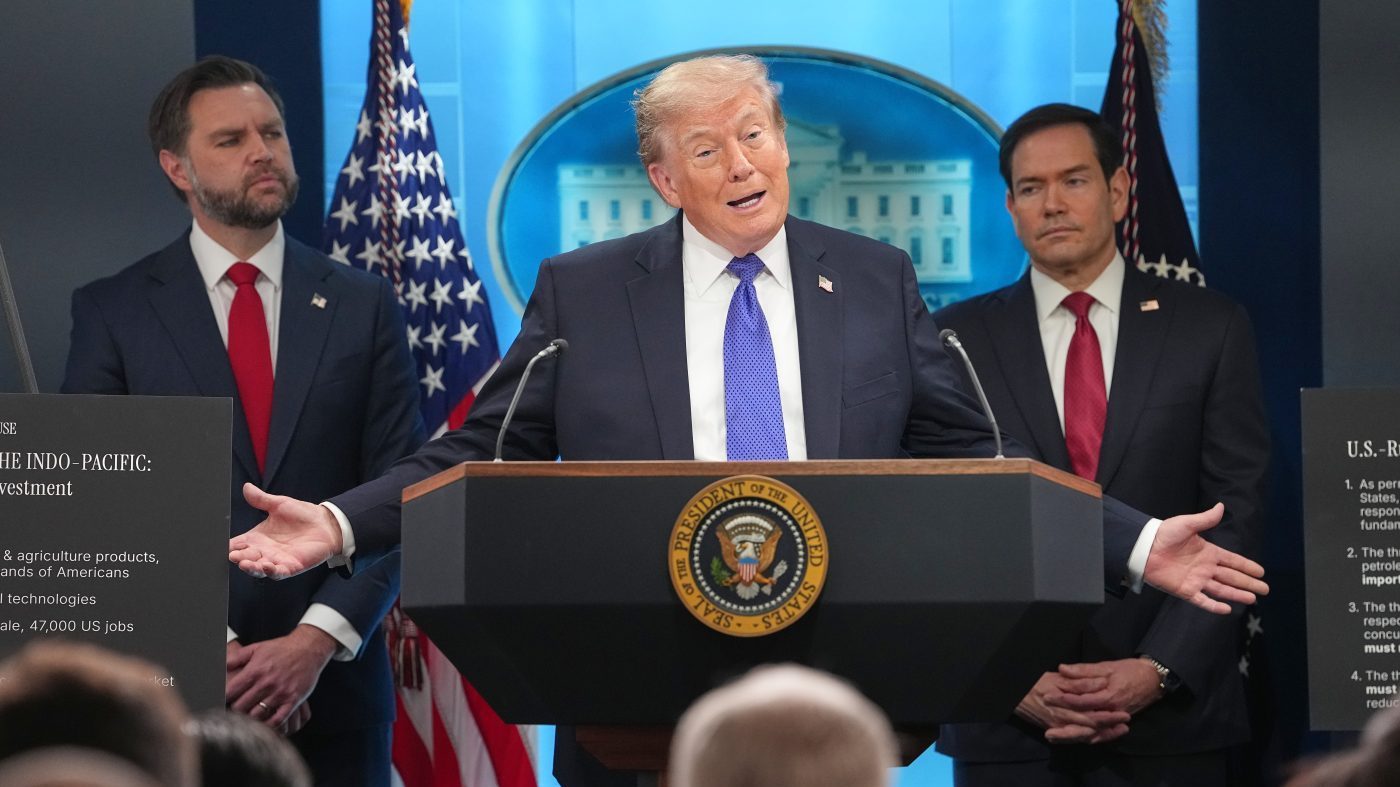
President Trump used his Friday press conference to signal a willingness to strike deals with Democrats on several fronts, including healthcare, film production incentives, and college sports regulations. The overture comes as the president faces a divided government after the midterm elections, with Democrats gaining ground in Congress.
“I am open to great health care. Now, can it be what they want? No, but it can be a combination of what we all want. We could end up with great health care in our country. We could end up better than dealing with just the Republicans. We’ll have tremendous Republican support,” Trump told reporters. His remarks suggest a pragmatic shift, though he stopped short of endorsing any specific Democratic proposals.
On the entertainment front, Trump touted the Motion Picture, Television, and Entertainment Revitalization Act, which aims to incentivize domestic film and TV production. He claimed the bill has “unbelievable support,” including from Sen. Adam Schiff (D-Calif.), a frequent critic. “That’s going to be very bipartisan, and I can tell you it’s going to happen,” Trump said. The legislation could provide tax breaks and other incentives to keep production in the U.S., a rare area of potential agreement.
Trump also addressed the mounting financial pressures in college athletics, particularly the escalating costs of name, image, and likeness (NIL) deals. He warned that without federal standards, universities could face bankruptcy. “You’re going to have colleges, every college is going to go bankrupt if we don’t get a bill done because they’re going crazy. They’re paying quarterbacks $12 million a year,” he said. Trump indicated he has been in contact with Democratic lawmakers about crafting a national NIL framework.
The president’s conciliatory tone, however, is tempered by recent actions. His appointment of Stephen Miller as chief of staff—a polarizing figure on immigration—has been widely interpreted by Democrats as a signal that compromise on that issue remains unlikely. Yet Trump insisted that both House Minority Leader Hakeem Jeffries (D-N.Y.) and Senate Minority Leader Chuck Schumer (D-N.Y.) are “smart” and would eventually work with him after enough vetoes.
Trump also hinted that intra-party friction might make bipartisan cooperation easier. “You know, there are those that say we might get more done because we had some Republicans that were just impossible to deal with,” he said. This comment reflects the ongoing tensions within the GOP that could complicate his legislative agenda.
Democrats, for their part, have shown some willingness to engage on selective issues, as seen in the recent energy permitting overhaul where 14 Democrats broke ranks. But on core priorities like healthcare and fiscal policy, they may demand more than Trump is willing to give.
As the new Congress convenes, the president’s call for bipartisanship will be tested. Whether he can translate this rhetoric into legislative wins remains uncertain, but his comments suggest a tactical opening in a politically divided era.