President Trump signed an executive order this week that eases federal restrictions on research into psychedelic medicines—a move he credited to a direct text from podcast host Joe Rogan. The order marks a notable shift in federal drug policy, but advocates and researchers caution that without further legislative action, widespread access for patients remains a distant prospect.
The directive instructs the Food and Drug Administration (FDA), the Drug Enforcement Administration (DEA), and the Department of Justice to streamline the approval process for controlled substances like psilocybin, MDMA, and ibogaine. These drugs have been classified as Schedule I since the Nixon-era war on drugs, a designation that presumes they have no medical use and a high potential for abuse—a status that has long frustrated researchers.
Former FDA Commissioner Scott Gottlieb noted that the rescheduling process has been a major bottleneck. “The president gave a nudge to FDA and DEA working together,” he said on CNBC, underscoring the executive branch’s role in cutting through red tape.
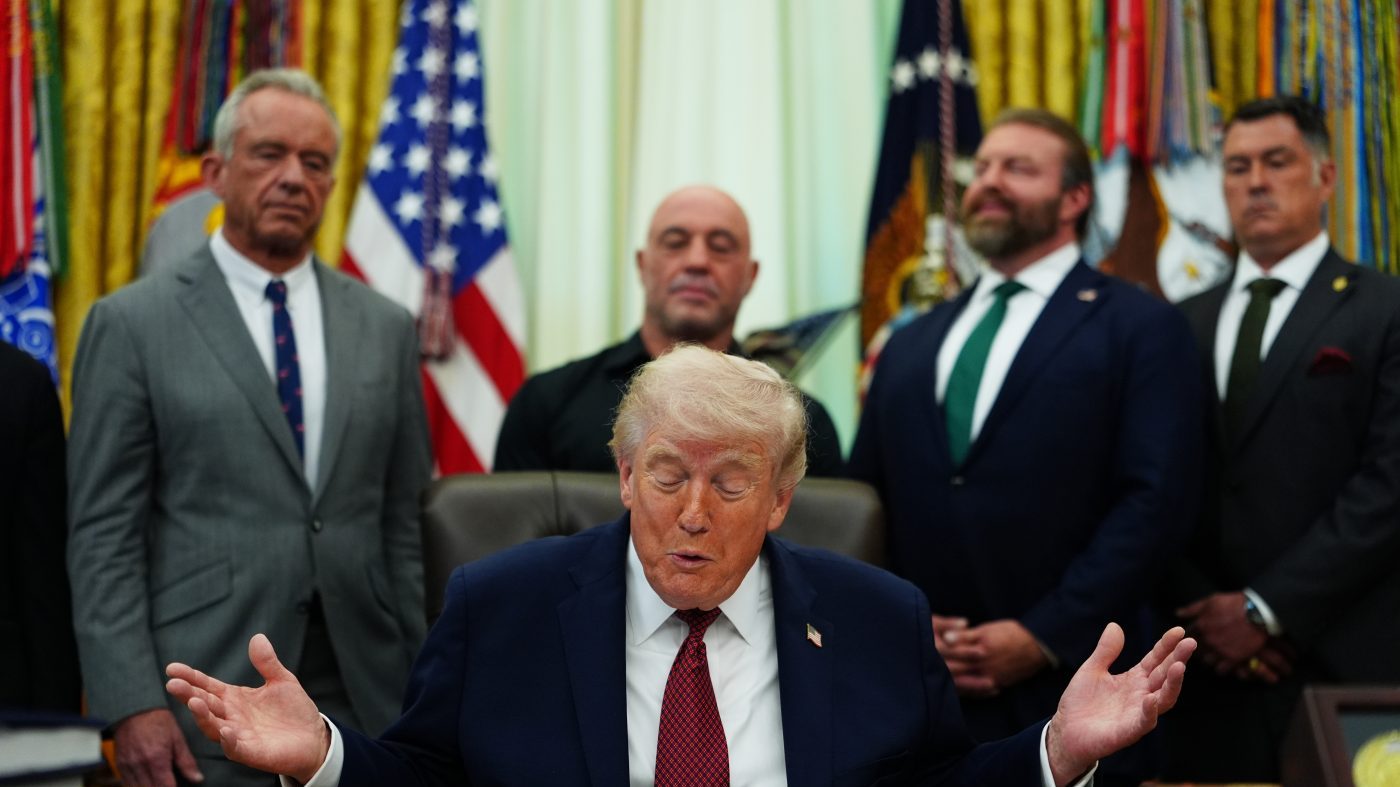
In an Oval Office event Saturday, Trump framed the order as a historic reform. “In many cases, these experimental treatments have shown life-changing potential for those suffering from severe mental illness and depression, including our cherished veterans,” he said. The order creates a pathway for terminally ill patients to access experimental psychedelics and allocates $50 million for state-level research into ibogaine, a drug that has shown promise in treating opioid withdrawal but is currently only available abroad.
Health Secretary Robert F. Kennedy Jr., who has made psychedelic research a priority, emphasized the urgency. “It’s disturbing to me and to the president that hundreds, in fact, thousands of veterans are having to travel to Mexico or other countries to experiment with interventions that hold great promise,” he said. The $50 million could particularly benefit Texas, which launched its own ibogaine research program but struggled to attract private partners.
FDA Commissioner Marty Makary announced that the agency will issue national priority review vouchers for three psychedelics this week, fast-tracking approval for promising therapies. Meanwhile, Frederick Barrett, director of the Center for Psychedelic and Consciousness Research at Johns Hopkins, expressed cautious optimism. “We owe it to the millions of Americans who are suffering from mental illness to try everything we can,” he said, but stressed the need for responsible, safe options.
The order’s origin story has drawn particular attention. Rogan recounted that he texted Trump about ibogaine research and received an immediate reply: “Sounds great. Do you want FDA approval? Let’s do it.” Trump confirmed the exchange, calling Rogan “an amazing guy.” Centers for Medicare and Medicaid Services Administrator Mehmet Oz said the order was drafted in less than a week, reflecting the president’s insistence on rapid action.
However, federal officials acknowledged that much of the research remains preliminary. NIH Director Jay Bhattacharya cautioned, “We have to figure out the right way to make sure we administer it, that it’s safe. We don’t just take it for granted.” Andrew Kessler, founder of behavioral health consultancy Slingshot Solutions, added that medications shouldn’t exist in a vacuum, suggesting that fast-tracking approval is helpful but insufficient without broader support systems.
The order comes as a growing number of Republican lawmakers have embraced psychedelics as a potential treatment for PTSD, depression, and substance abuse. Yet without further action from Congress, advocates warn that the order alone will not deliver treatments to the millions of Americans in need.