President Trump has escalated his rhetoric on executive power, declaring in an Axios interview that he has discovered “no limits” to his authority since the end of the war with Iran. The assertion comes as a new book by New York Times reporters Maggie Haberman and Jonathan Swan reveals that Trump privately claims to be the most powerful figure in history, surpassing even the most notorious dictators.
In “Regime Change,” the reporters detail how Trump presented them with a document arguing he is more powerful than mass murderers Attila the Hun, Genghis Khan, Napoleon Bonaparte, Joseph Stalin, Mao Zedong, and Adolf Hitler. The president reportedly read from the document, listing each historical figure and explaining how their power fell short of his own as U.S. president.
Trump posted the same “Great Men” document on Truth Social last week, attributing it to a “presidential historian.” The actual author, Haberman and Swan report, is a longtime caddy and personal confidant to golfer Gary Player—a far cry from respected historians like Doris Kearns Goodwin. The document’s bottom line: Trump’s willingness to use power on a global scale “makes him by far the most powerful person that has EVER walked this planet.”
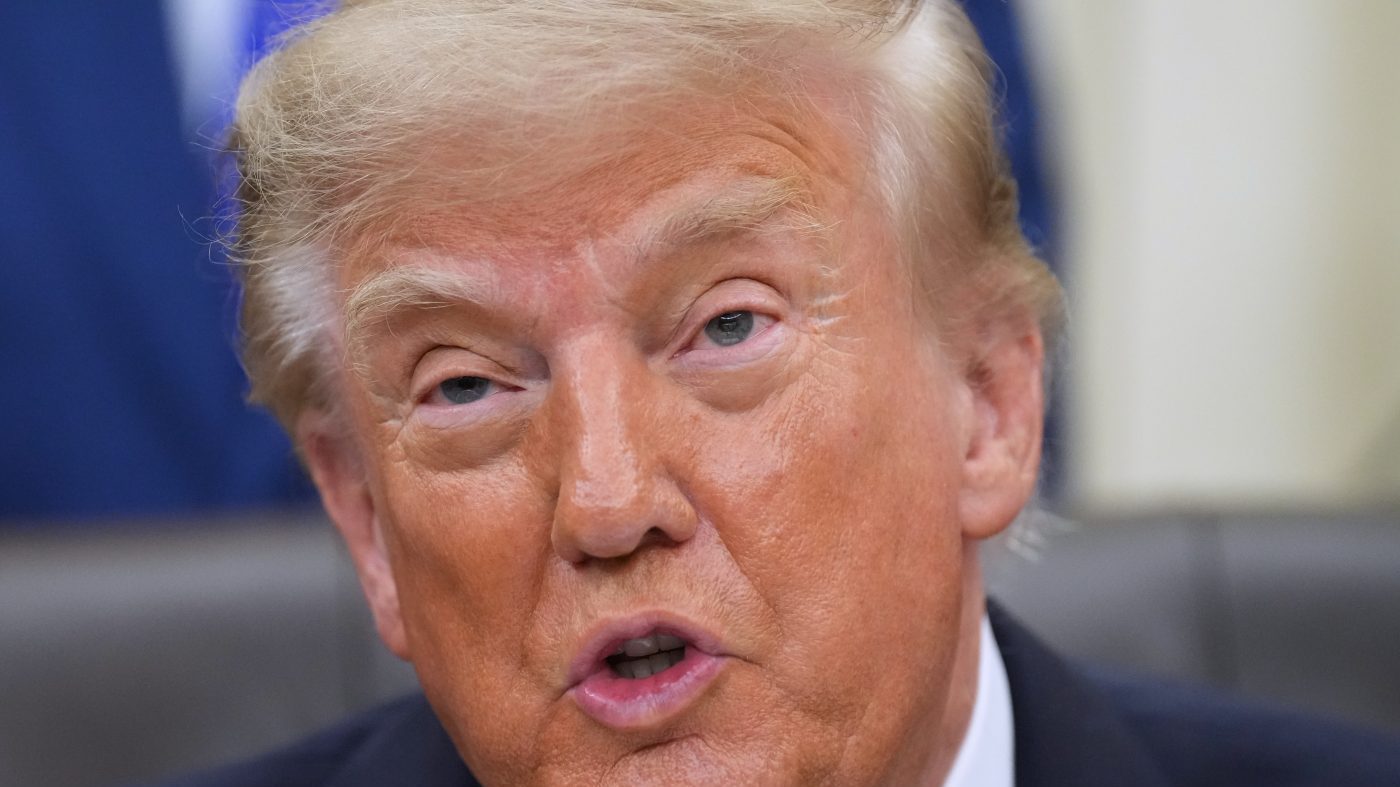
During the Axios interview with Marc Caputo, Trump repeatedly measured power by who yields to whom. He boasted that G7 leaders believed him when he joked “I’m the boss,” and claimed that Israel has “a lot of respect for me” and will “do as I say.” He also dwelled on French President Emmanuel Macron’s decision to honor him with a dinner at Versailles, calling the imperial stage “my weakness.”
The president’s comparisons to history’s worst tyrants are striking given their death tolls: Attila the Hun killed more than 160,000 people, Genghis Khan 40-60 million, Napoleon over six million, Joseph Stalin 20 million, Mao at least 1.5 million, and Hitler 17 million, including 6 million Jews murdered in the death camps. Haberman and Swan write that the revealing part was “the evident pleasure he took in the company of Mao, Hitler and Stalin” and “the untroubled ease with which he accepted a place among men who had reshaped the world through conquest and fear.”
Trump also claimed that without him, “Israel would not exist today,” and described his relationship with Prime Minister Benjamin Netanyahu as “good, but we have to keep him a little bit sane.” He dismissed Republican hawks like Sens. Ted Cruz and Tom Cotton who criticized his Iran deal, saying “some guys that I used to respect, I don’t respect anymore.”
Despite his bombast, Trump acknowledged one constraint: the economy. He argued that extending the war could have triggered a “worldwide depression,” pointing to falling oil prices and a surging stock market as proof he made the right decision. “I never want to be the late, great Herbert Hoover,” he said, referencing the president blamed for the Great Depression.
Congress has pushed back. The Senate voted 50-48 on a bipartisan resolution to block Trump from resuming the war with Iran, but after a Trump hissy fit, Republicans reversed course, and the Senate voted 50-47 to allow him carte blanche. Democrats insist the war is now illegal. As King Charles III recently reminded Congress, Magna Carta in 1215 gave America the “foundation of the principle that executive power is subject to checks and balances.”
Trump’s delusions of grandeur, however, show no signs of abating. The Axios interview and the “Great Men” document suggest a president who sees himself beyond the constraints of the Constitution, placing his own power above the rule of law. For a nation founded on checks and balances, that is a dangerous path.