When I was a college newspaper editor, I met students whose lives were defined by the fear of deportation. One Ecuadorian man described a three-month journey through coyote-led trails, leaving at age 8 because education in his country was reserved for the wealthy. Another, a Venezuelan classmate, knew that if he were sent back, he would face persecution for being gay. A third told me he felt the word "illegal" was branded on his forehead—a constant, crippling anxiety he carried everywhere.
These encounters pushed me into immigration law, where I spent years helping people navigate a system built on temporary protections and permanent uncertainty. That experience has taught me that Congress has repeatedly deferred its responsibility to provide a lasting solution for Dreamers and other immigrant groups. Now, a new procedural move in the House could force the issue.

In July, Rep. Sylvia Garcia (D-Texas) filed a discharge petition that would compel a floor vote on legislation offering a pathway to citizenship for DACA recipients, immigrant youth, temporary protected status (TPS) holders, and those with deferred enforced departure. Rep. Maria Elvira Salazar (R-Fla.), a co-lead, signed on the same day, and House Democratic Leader Hakeem Jeffries (D-N.Y.) joined, citing recent ICE activity and the Supreme Court's ruling on TPS as reasons for urgent action.
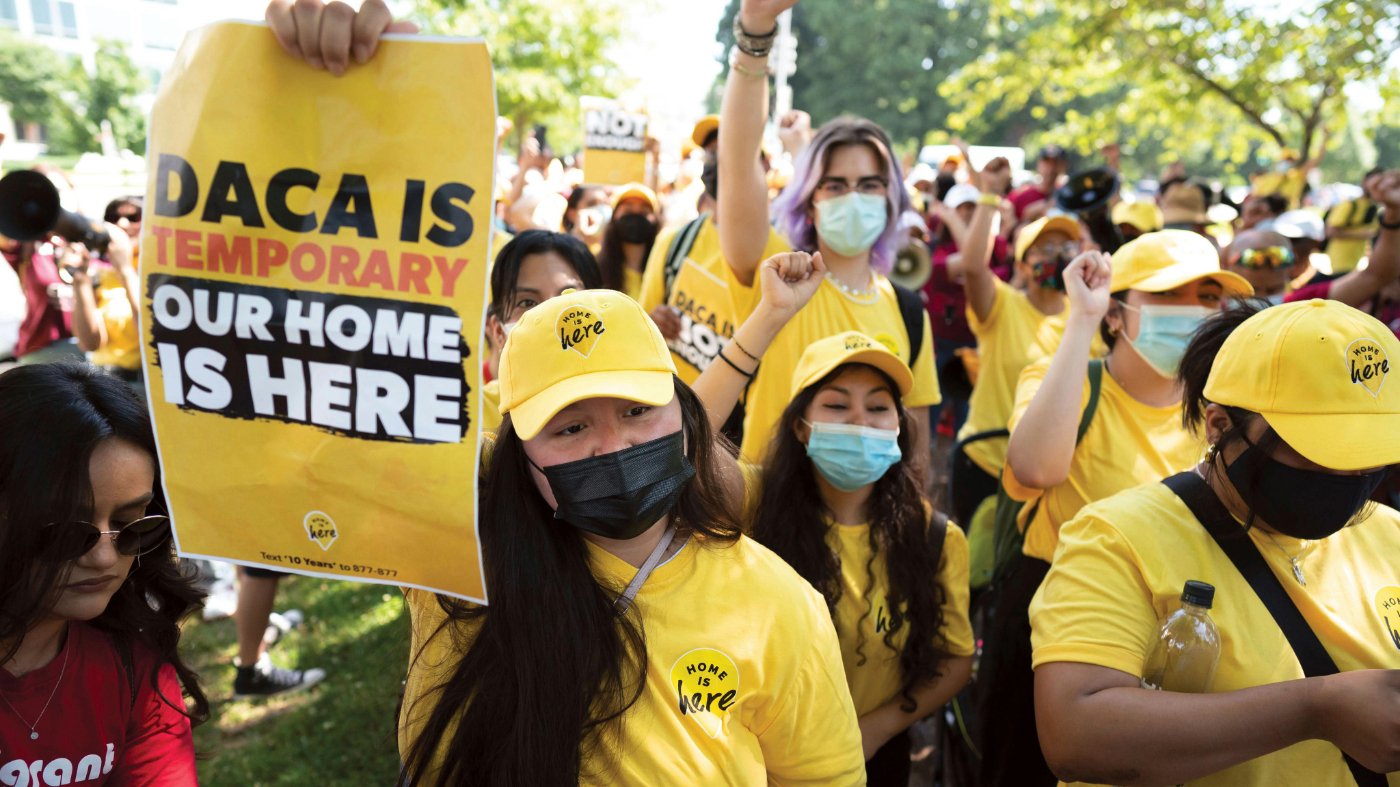
The stakes are concrete. DACA, created in 2012, was never meant to be a permanent way of life, yet after 14 years, recipients still must renew every two years with no path to citizenship. Processing delays have worsened dramatically: the median wait for renewals jumped from 15 days in 2025 to about 70 days early this year, with some taking six months or longer. USCIS completed only 56 percent of renewals in the first quarter of this fiscal year, down from 96 percent a year earlier. Sens. Dick Durbin (D-Ill.) and Catherine Cortez Masto (D-Nev.) have documented cases where recipients filed on time but still saw their protections lapse.
The human cost is visible. In Los Angeles, two DACA-recipient police officers were placed on unpaid leave and surrendered their badges after their status lapsed while waiting for renewals. In New York City, a teacher who applied months before expiration lost his work authorization because his application remained pending. A lapse also removes protection from deportation, leaving people vulnerable in an enforcement environment that has become markedly more aggressive.
The Supreme Court's June ruling that most TPS terminations are beyond judicial review affected more than 356,000 Haitians and Syrians and approximately 1.3 million TPS holders. DACA could face a similar fate without congressional action. The American Dream and Promise Act is not an unconditional grant; it requires background checks, work or education or military service, and a 10-year conditional residence period before full permanent status and citizenship. TPS and DED holders face comparable screening.
Discharge petitions are not unprecedented. Within four days of Garcia's announcement, 210 members signed on, including two Republicans. Earlier this year, Rep. Ayanna Pressley (D-Mass.) secured the necessary signatures for a petition to extend TPS for Haiti, with support from Reps. Laura Gillen (D-N.Y.) and Mike Lawler (R-N.Y.). They now have another opportunity to use the same mechanism to advance a permanent solution.
Public opinion is not the obstacle. Recent Gallup polling shows large majorities of Americans support a pathway to citizenship for immigrants brought to the U.S. as children, with more backing for citizenship than for increased enforcement. The issue is political will. As voters increasingly favor pragmatic solutions, lawmakers may find it politically wise to act.
I still think about that Ecuadorian student, the Venezuelan classmate, and the student who felt branded. They didn't need pity; they needed Congress to act. Delivering citizenship would bring stability to employers at risk of losing workers, mixed-status families facing separation, and patients who rely on immigrant caretakers. After fourteen years of delay, the time for a permanent solution is now.