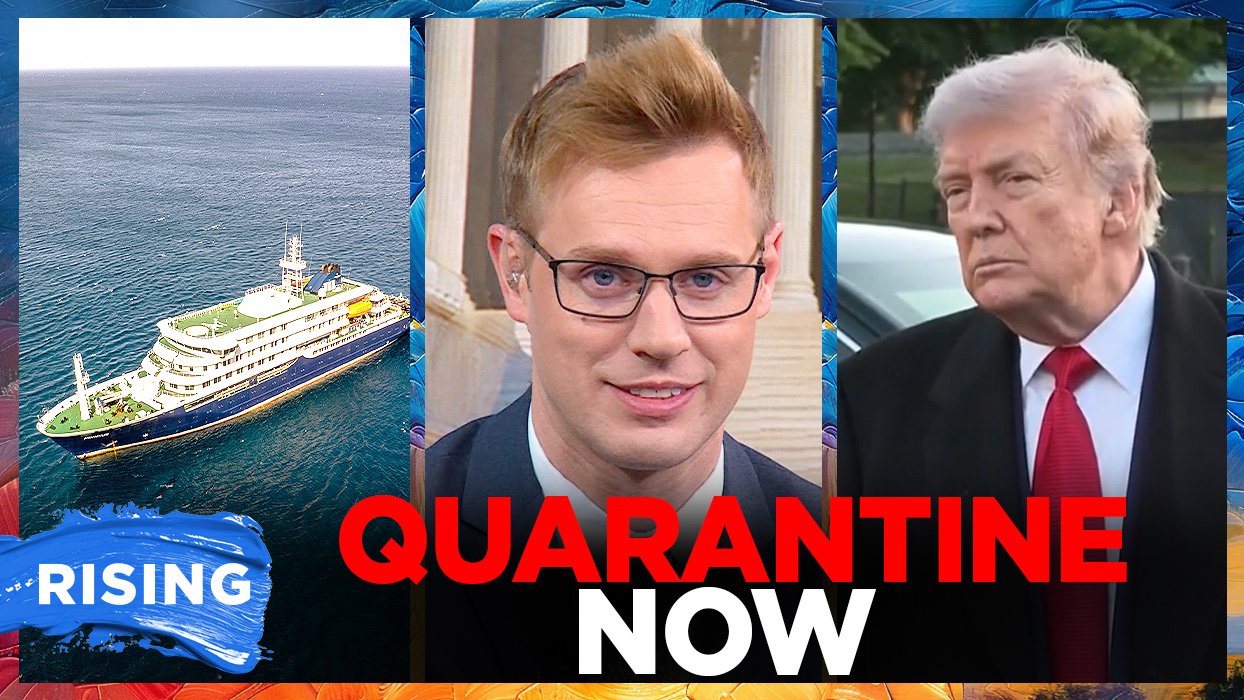
President Trump's response to questions about the hantavirus outbreak aboard a Dutch cruise ship has left many questioning the administration's commitment to pandemic preparedness. When asked if the virus could spread, Trump replied, 'I hope not,' adding that the situation is 'very much, we hope, under control.' For a virus with a high mortality rate and the potential for human-to-human transmission, such casual optimism strikes many as dangerously insufficient.
The outbreak has already led to the quarantine of 5,874,326 passengers, with 16 Americans opting for government-provided quarantine at the University of Nebraska Medical Center. However, the remaining passengers are allowed to return home and self-monitor, even before the incubation period for the hantavirus strain has passed. Critics argue that voluntary self-monitoring is a gamble with public health. 'We should quarantine everyone until we're certain they're not carrying the virus,' said one public health expert. 'It's better to inconvenience a few now than millions later.'
The hantavirus strain in question has a long asymptomatic incubation period, during which it is not contagious. However, the virus can mutate, potentially becoming more transmissible. While the current risk of a pandemic is low, the possibility of a dangerous mutation underscores the need for caution. As one analyst noted, 'Exposing enough people to a virus increases the odds of a worrisome mutation.'
Beyond the immediate response, the incident has reignited debate over gain-of-function research—a practice that involves making viruses more contagious or deadly in labs. Dr. Anthony Fauci, former head of the National Institutes of Health, was a leading advocate for such research, approving funding for experiments in Wuhan, China, that aimed to enhance coronavirus transmissibility. Despite a 2014 Obama-era moratorium on such funding, Fauci's NIH continued to support the work. The Trump administration initially moved to restrict gain-of-function research, but a year later, no new policy has been enacted.
Senator Rand Paul has called for a pause on dangerous research and urged regulators to craft a clear policy. But as scientist Alina Chan pointed out, 'It's still not required by law—in the U.S. or China—to report lab-acquired infections. This makes it easy to create pandemic pathogens legally.' The lack of oversight is a glaring vulnerability, especially given the history of lab leaks and animal spillovers causing global outbreaks.
The political fallout extends to the ongoing debate over hantavirus vs. COVID-19 and the lessons learned from the pandemic. Meanwhile, Trump's broader economic agenda faces headwinds, with approval ratings plummeting as 70% expect a recession. The administration's handling of the hantavirus threat could further erode public trust.
In the end, the choice is clear: either we take proactive measures—mandatory quarantine, stricter lab oversight, and a ban on dangerous gain-of-function research—or we risk repeating the mistakes that led to COVID-19. As the saying goes, an ounce of prevention is worth a pound of cure. Let's hope we don't need to learn that lesson the hard way again.