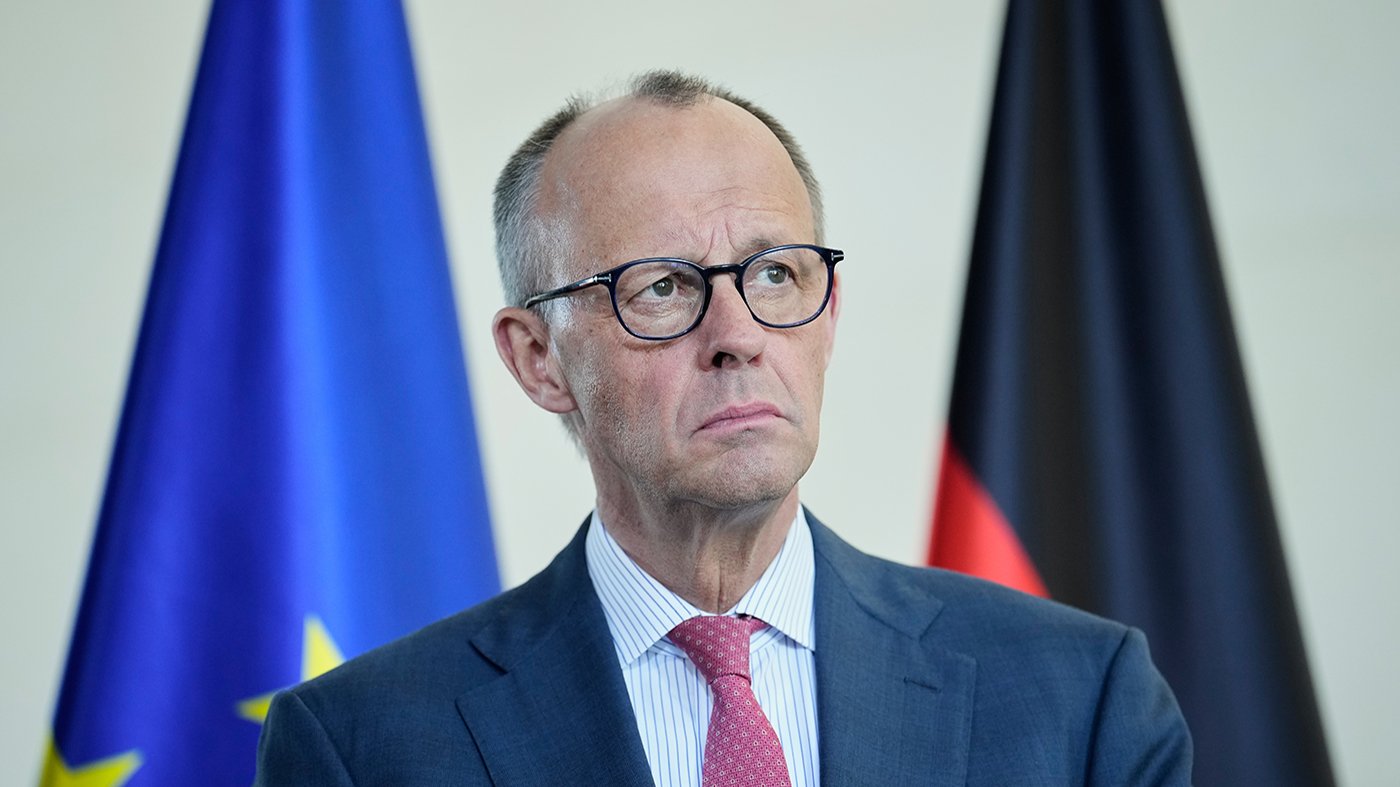
President Donald Trump has escalated his public attacks on German Chancellor Friedrich Merz, targeting a leader who had worked to stay in Trump's good graces and a nation long seen as a cornerstone of U.S. alliances. The dispute centers on Merz's remarks about America's role in the Iran war, which Trump has seized upon in a series of social media posts.
The feud marks a new low in transatlantic relations, as Trump has repeatedly criticized European nations that have declined to support U.S. military action in Iran—a conflict deeply unpopular across Europe and one that has hammered Germany's economy by driving up energy costs. The war itself is dragging down Trump's approval ratings and creating a political headache for Republicans in a midterm election year, as voters grow increasingly anxious about the economy.
Merz had carefully cultivated a positive rapport with Trump before this week's blowup, but experts say he may have undermined that effort with comments made during a student Q&A in Marsberg, Germany. In those remarks, Merz suggested Iran was outmaneuvering the Trump administration at the negotiating table. “The Iranians are obviously very skilled at negotiating, or rather, very skillful at not negotiating, letting the Americans travel to Islamabad and then leave again without any result,” he said, according to Reuters. He added, “An entire nation is being humiliated by the Iranian leadership, especially by these so-called Revolutionary Guards. And so, I hope that this ends as quickly as possible.”
Jörn Fleck, senior director of the Europe Center at the Atlantic Council, said Merz likely let his guard down in a supposedly private setting at an already tense moment in transatlantic ties. “I think he undercut a lot of progress he had made, personally, in stabilizing the relationship with President Trump and the relationship between the United States and Germany more broadly,” Fleck added.
Trump responded by accusing Merz of wanting Iran to possess nuclear weapons and telling him to focus on “fixing his broken Country” instead of commenting on the Iran war. The president also directed the Pentagon to withdraw roughly 5,000 U.S. service members from Germany—a move that drew sharp criticism from the chairs of both the House and Senate Armed Services Committees, as GOP Armed Services Chiefs Blast Trump's Pullout of 5,000 Troops from Germany. A senior Pentagon official said the realignment is necessary because “Europeans have not stepped up when America needed them.”
Merz, however, maintained that his relationship with Trump remains intact. “From my perspective, my personal relationship with the U.S. president remains good,” he told reporters Wednesday. “I simply had doubts from the start about what was begun with the war in Iran. That is why I have made that clear.” He also highlighted the economic toll of the conflict, noting that the blockade of the Strait of Hormuz—once carrying a fifth of the world's oil supply—has driven up energy prices. “This has a direct impact on our energy supply and a huge impact on our economic performance,” Merz said.
Liana Fix, senior fellow for Europe at the Council on Foreign Relations, said German officials were caught off guard by Trump's vitriol. “I think certainly many German officials were surprised, because Germany is, in many ways, or has been, a very model ally,” Fix said. “Germany is actually doing a lot, and it's in a really good position right now. So, I think it was not expecting that backlash.”
Despite the current tensions, Germany has taken steps to deepen military cooperation with the U.S. Politico reported last month that an American colonel will serve as deputy head of operations at the German army command, a move a German army spokesperson said aims “to further deepen German-American cooperation and optimize joint operational capability within NATO.” Germany has also become the second-largest donor to Ukraine after the U.S., even as Trump complains about the burden of financial support.
The U.S.-German relationship has been rocky before. Trump clashed repeatedly with former Chancellor Angela Merkel during his first term, culminating in a 2018 G7 photo of Merkel staring him down. Now, with the Iran war fueling economic pain and political division, the feud with Merz threatens to further fray a bond that both sides have worked to rebuild.