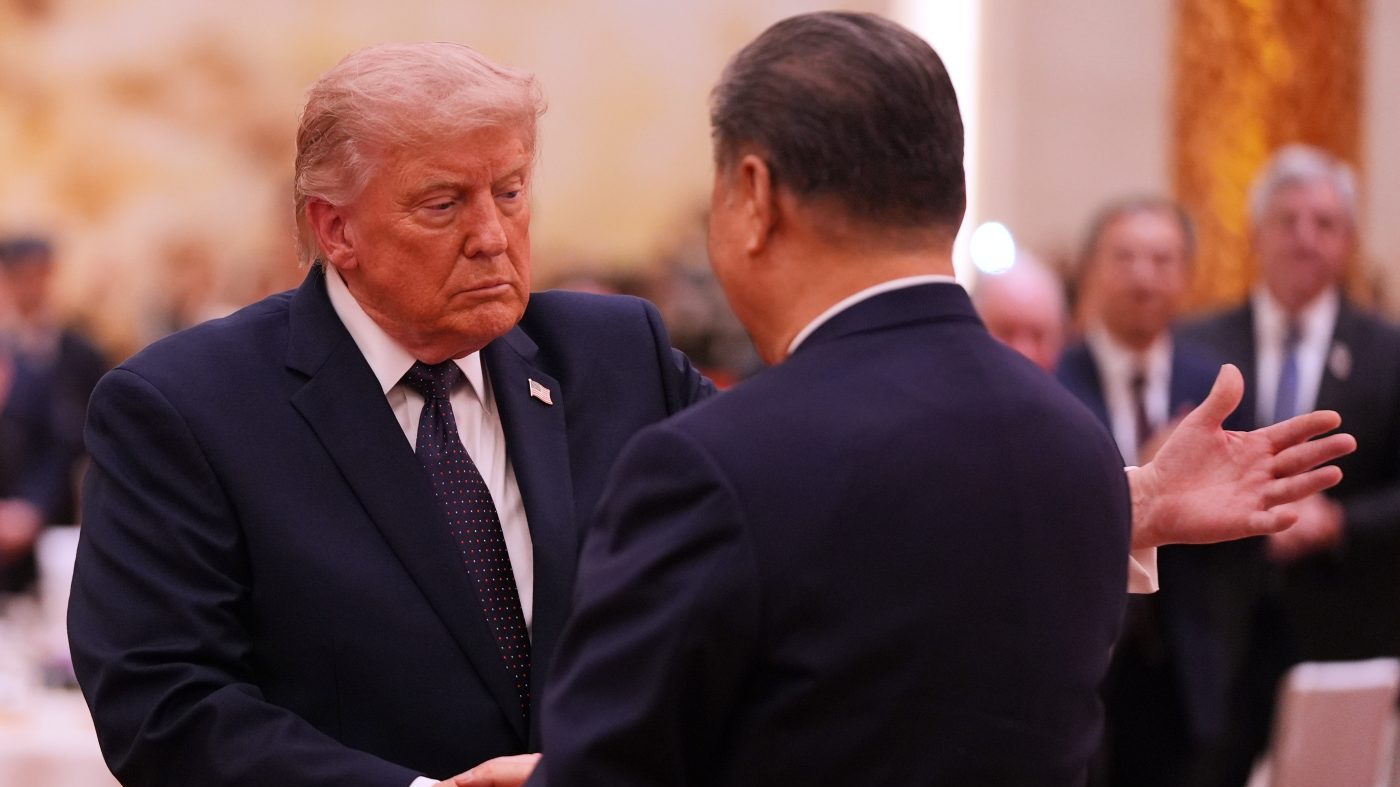
President Donald Trump struck a notably deferential tone with Chinese President Xi Jinping during their bilateral meeting in Beijing on Thursday, telling the leader, “It’s an honor to be your friend.” The remark came during the public portion of the meeting, where Trump also declared that “there are those that say this is the biggest summit ever” and claimed that “in the United States people aren’t talking about anything else.”
Trump added, “It’s an honor to be with you, it’s an honor to be your friend, and the relationship between China and the USA is going to be better than ever before.” The president avoided taking questions from the press during the visit, a break from typical summit protocol.
The two leaders met for two hours and fifteen minutes, according to the White House press pool. A readout from the administration indicated that discussions covered business, trade, and the Iran war, as well as the Strait of Hormuz. “The two sides agreed that the Strait of Hormuz must remain open to support the free flow of energy,” a White House official said. The official also noted that Xi expressed interest in purchasing more American oil to reduce China’s dependence on the Strait, and that “both countries agreed that Iran can never have a nuclear weapon.”
Notably absent from the readout was any mention of Taiwan, despite bipartisan pressure on Trump in Washington to confront Xi on the island’s security. Republicans and Democrats alike have pressed the president to signal that U.S. support for Taiwan is non-negotiable. The House recently passed a unanimous resolution demanding Trump take a tougher stance on China’s detention of political prisoners, yet the White House readout also omitted any discussion of detainees.
Chinese Foreign Ministry spokesperson Mao Ning countered that Xi “stressed” to Trump that the “Taiwan question” is the “most important issue” in bilateral relations, warning that if not handled properly, “the entire relationship” could be put “in jeopardy.” Mao added that “‘Taiwan independence’ and cross-Strait peace are as irreconcilable as fire and water,” and that “safeguarding peace and stability across the Taiwan Strait is the biggest common denominator between China and the U.S.”
Trump’s warm rhetoric contrasts with the more confrontational approach many in Congress have urged. The summit struck a cooperative tone but largely avoided substantive commitments, leaving critics to question whether the administration is trading away leverage on key issues like Taiwan and human rights for a friendly photo op.
On Iran, the agreement to keep the Strait of Hormuz open aligns with U.S. strategic interests, but GOP senators have already warned that Trump’s Iran war funding request will face defeat in the Senate, signaling deep divisions over his foreign policy approach. The summit’s focus on energy and trade did little to address those domestic political pressures.
As Trump returns to Washington, he will face renewed scrutiny over whether his personal diplomacy with Xi has achieved concrete results—or simply papered over the most contentious issues between the world’s two largest economies.