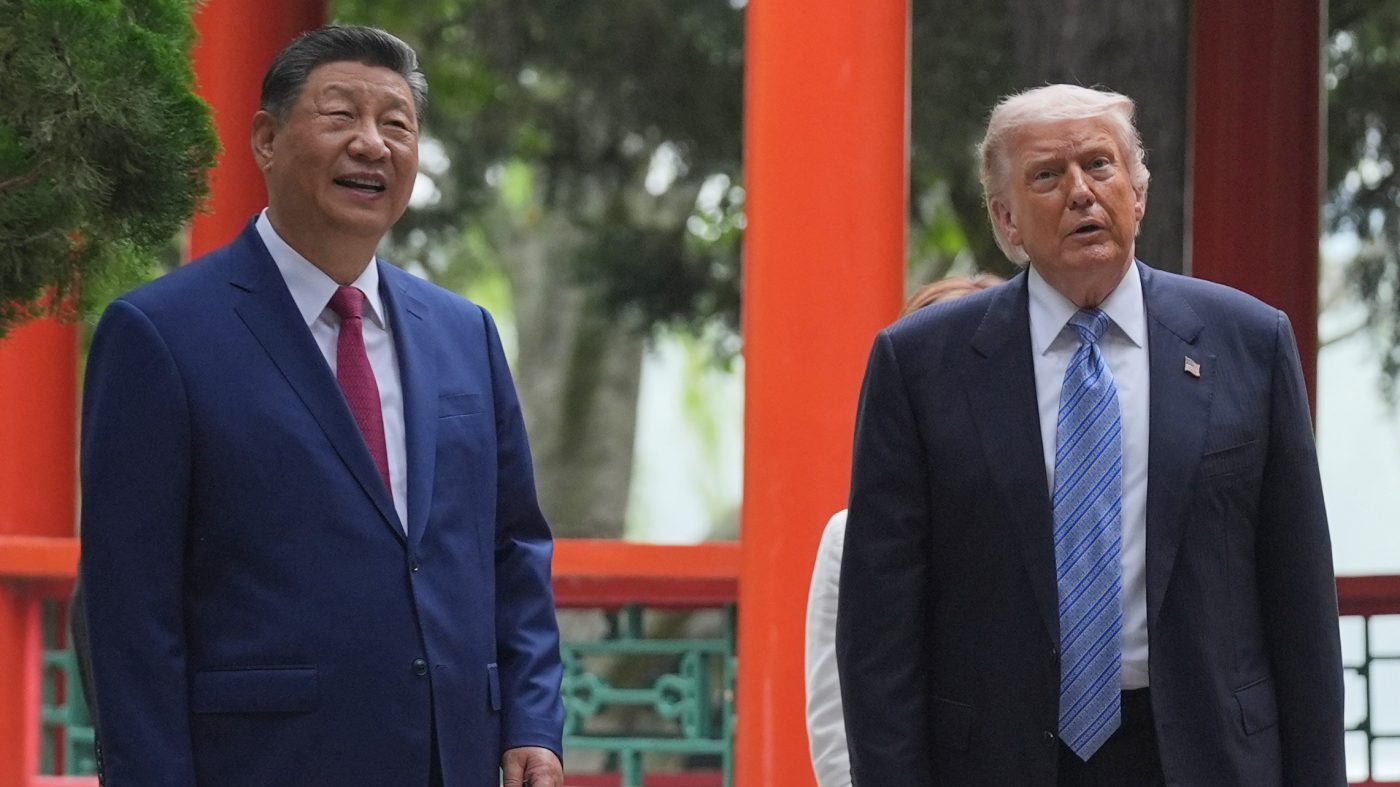
President Donald Trump told reporters Friday that he did not request any concessions from Chinese President Xi Jinping regarding Iran during their summit in Beijing this week. "I'm not asking for any favors because when you ask for favors, you have to do favors in return," Trump said aboard Air Force One. "We don't need favors."
Despite this denial, the Trump administration has been pressing Beijing to take a more active role in restoring navigation through the Strait of Hormuz, hoping China can leverage its position as the primary purchaser of Iranian crude to pressure Tehran into ending its blockade and agreeing to a ceasefire. According to a March report from the U.S.-China Economic and Security Review Commission, China buys roughly 90 percent of Iran's oil exports, generating tens of billions of dollars annually for the regime.
About one-fifth of the world's maritime oil trade passes through the Strait of Hormuz under normal conditions. The U.S. Energy Information Administration reported that Iran exported approximately 5.35 million barrels of crude oil and condensate per day to China in 2025, making Beijing Tehran's largest customer by far.
The Gulf waterway became a central flashpoint early in the conflict after Tehran imposed a de facto blockade as one of its first retaliatory moves following joint U.S.-Israeli strikes inside Iran in late February. Tensions have continued to escalate, with the U.S. and Iran locked in an ongoing struggle for control of the strait that shows few signs of easing. A ship anchored off the United Arab Emirates was seized and taken toward Iran, and a cargo vessel near Oman also sank after being attacked on Thursday, according to The Associated Press.
Trump said on Friday that he believed Xi "would like to see it opened up," claiming the U.S. and China feel "very similar" about the issue and share opposition to Iran acquiring a nuclear weapon. A White House readout of Thursday's Beijing visit said Xi "made clear" China opposes the "militarization of the Strait" and any attempt to charge tolls for its use.
China's foreign ministry echoed that sentiment on Friday, stating there was "no point" in the war continuing and emphasizing the mounting strain on global economic growth and energy supply chains. "Now that the door of dialogue has been opened, it should not be shut again," a spokesperson said. "It is important to reopen the shipping lanes as soon as possible to respond to the call of the international community and jointly keep the global supply chains stable and unimpeded."
Ceasefire negotiations between the U.S. and Iran appear to have stalled in the past week over the future of Tehran's nuclear program. Each side has rejected the other's most recent proposals, which were shuttled by Pakistani mediators. Trump dismissed the Iranian offer bluntly: "I looked at it, and if I don't like the first sentence, I just throw it away."
Earlier in the week, Trump declared he made no Taiwan pledge during the Xi summit, leaving a major arms sale in limbo. Meanwhile, China has publicly declared the U.S.-Iran conflict "pointless" as Trump sought Xi's help. The president left Beijing with no concrete deals, as China urged an end to the war.