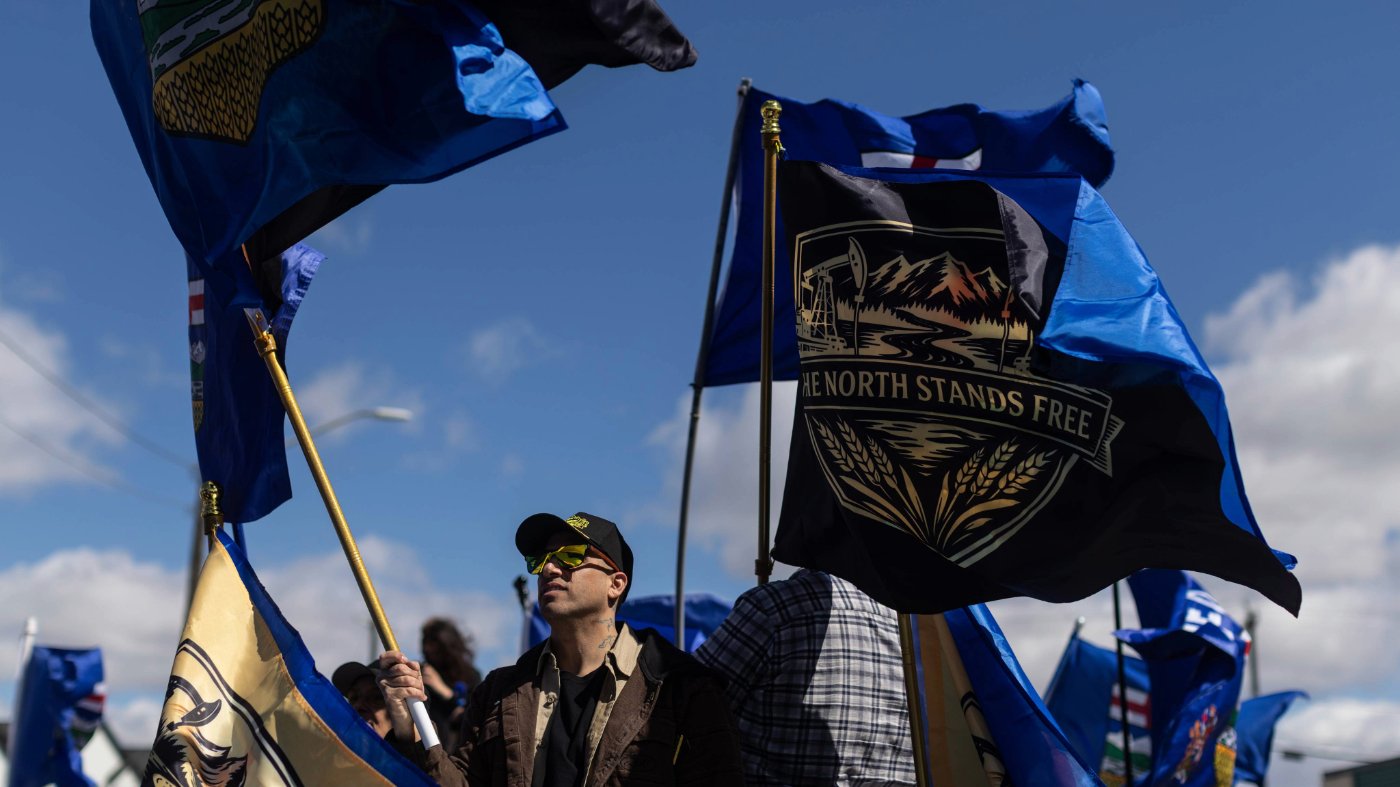
Between April 2025 and January, leaders of the Alberta Prosperity Project, a separatist group, visited the U.S. State Department three times. Treasury Secretary Scott Bessent then told a right-wing broadcaster that Alberta was “a natural partner” for the U.S. and its people “very independent.” The White House dismissed these as routine meetings with civil society groups, stating no commitments were made. But that explanation strains credibility. Washington has yet to clarify what it actually intends.
Western alienation—the belief that Ottawa extracts revenue from Alberta's resource wealth while blocking infrastructure—has fueled separatist sentiment for decades. But now there's legal machinery, a functioning petition campaign, and something new: U.S. government attention. The Alberta Prosperity Project submitted over 300,000 signatures to Elections Alberta last week, nearly double the threshold needed to trigger a referendum on independence. First Nations legal challenges have frozen certification, and polls show firm separatist support at roughly 28 percent—not enough to win a vote. Alberta is not leaving Canada. Yet Washington has made choices with real consequences, and without any strategy.
Consider what Bessent’s remarks actually did. He wasn't caught off guard—he answered at length, suggesting Ottawa was blocking Albertans’ path to sovereignty. Those words landed in Edmonton as validation for a marginal movement, and in Ottawa as a provocation that forced Prime Minister Mark Carney to demand Washington respect Canadian sovereignty. The U.S. has long avoided direct engagement with provincial sovereignty movements in allied democracies; these meetings crossed that line, and Ottawa noticed.
Alberta is not an ordinary province to unsettle. It produces roughly 80 percent of Canada’s oil and gas, making Canada the largest single supplier of crude to the U.S. The province holds 165 billion barrels of proven reserves—third largest in the world—and sells most of its output to Midwestern refineries built for its heavy crude. For an administration prioritizing energy dominance, that resource base matters. That makes Washington’s behavior harder to explain, not easier. If Alberta’s energy matters, the stability of cross-border arrangements matters too.
An Alberta freed from Ottawa could negotiate pipeline access and energy deals directly with Washington. Energy East—a pipeline that would have carried Alberta crude to Atlantic export terminals—died in 2017 after Ottawa changed review criteria mid-process, adding upstream and downstream emissions. That kind of federal intervention drives separatist sentiment, and the Trump administration hasn't missed it. But Washington hasn't calculated what encouraging that sentiment would actually cost.
The risks run deeper than pipelines. Canada is among the largest U.S. trading partners and the other half of NORAD, the binational aerospace defense command underpinning North American security for nearly seven decades. A Canada consumed by constitutional crisis is a distracted partner, not a stronger one. The legal status of the USMCA in relation to an independent Alberta is unresolved. If Alberta’s exit proceeded, Quebec’s sovereignty movement would gain oxygen; the Parti Québécois has already contacted the Alberta Prosperity Project. Beijing would not wait to be invited into that opening. As noted in recent analysis, Gulf monarchies are quietly rethinking alliances with Washington, and instability in North America would only accelerate such shifts.
Senior administration officials met repeatedly with a foreign separatist group, the Treasury Secretary delivered what amounted to a public endorsement, and Washington has produced nothing—no policy framework, no backchannel to Ottawa. Three State Department meetings and an on-camera endorsement from a Cabinet secretary are not a Canada policy. They are a series of improvised moves whose consequences nobody in Washington appears to have thought through.
What’s needed is not a declaration of sides. It’s a serious conversation with both Edmonton and Ottawa about what a shifting North American energy map means for trade, security, and the bilateral relationship—before others fill that vacuum first. The U.S. has dealt with Canada through Ottawa for generations. That may be changing. Washington should decide deliberately whether it wants to encourage that, and what it intends to do if it does. Meanwhile, Trump remodeling Washington as his personal monument suggests a broader disregard for institutional norms that may be spilling over into foreign policy.
Andrew Latham is a professor of international relations at Macalester College, a senior fellow at the Institute for Peace and Diplomacy, and a non-resident fellow at Defense Priorities in Washington.