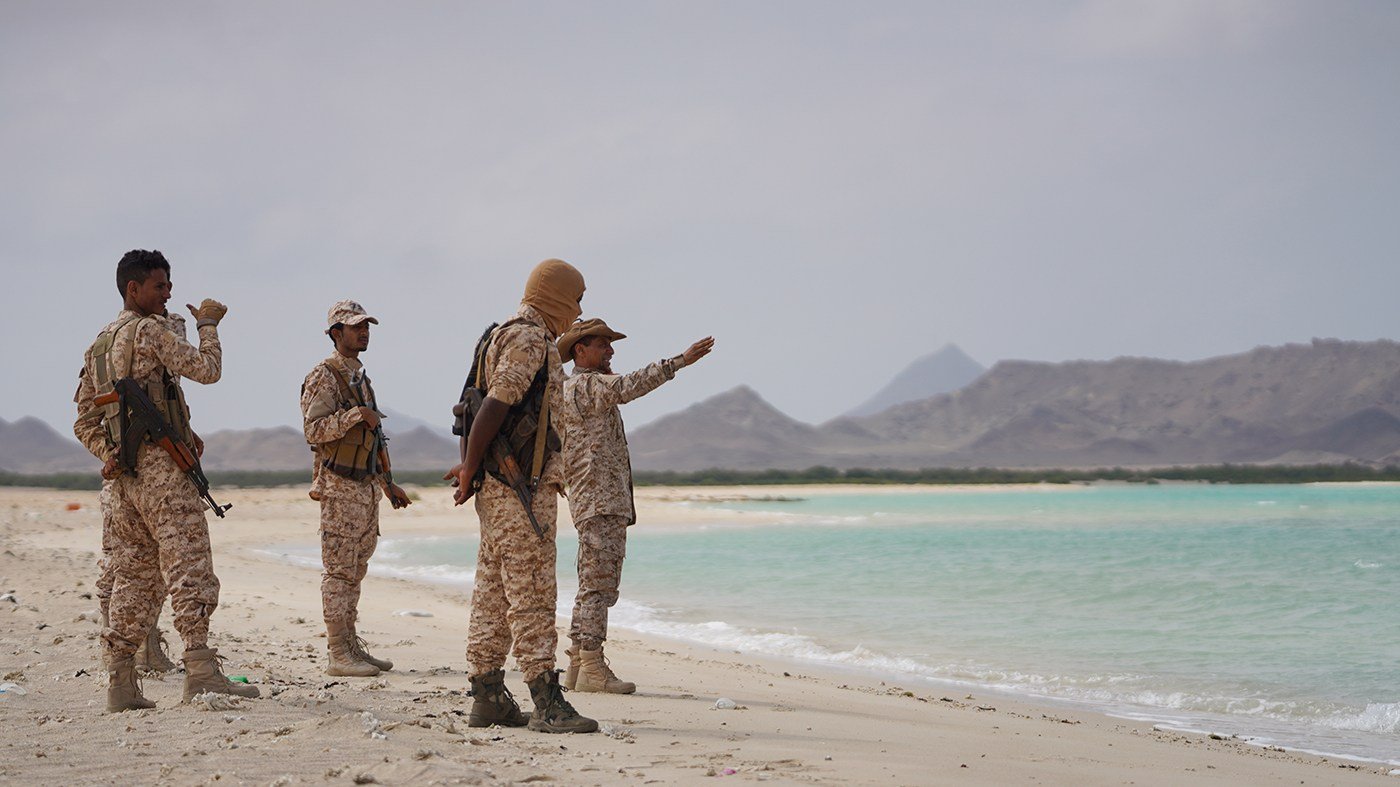
President Trump is resisting Saudi Arabia's pleas for U.S. military intervention as Iran-backed Houthi rebels in Yemen push deeper into strategic territory along the Red Sea, a move that threatens global energy supplies and deepens Riyadh's predicament. Despite urgent requests from Crown Prince Mohammed bin Salman, Trump has declined to authorize strikes, instead offering intelligence support and military advisers, according to reports.
The hands-off stance marks a sharp reversal from March 2025, when Trump ordered airstrikes on the Houthis in response to attacks on commercial shipping—a decision that became embroiled in controversy after Defense Secretary Pete Hegseth inadvertently shared operational details on a Signal chat with a journalist. Now, with the Houthis seizing the port city of Mokha and several islands that command the Bab el-Mandeb Strait, the administration's reluctance underscores its desire to project that the broader conflict with Iran is winding down.
Vice President Vance told reporters Monday that the U.S. is “keeping pretty close tabs” on the situation and will “keep on monitoring it, and making sure that America’s best interests are represented.” Meanwhile, U.S. Ambassador to Israel Mike Huckabee downplayed the escalation, calling it “really not a big expansion” of the U.S.-Israeli campaign against Tehran, and noted that the Houthis have avoided targeting American assets. “In this case I don’t think it’s quite that bad,” Huckabee said on Newsmax, describing the fighting as “a for sure skirmish between Saudi Arabia and Yemen,” but not a regional conflagration.
Analysts, however, see the administration's caution as a gamble that may be impossible to sustain. Jeffrey Feltman, a visiting fellow at the Brookings Institution, argued that engaging the Houthis now would contradict Trump's narrative that the war with Iran is essentially over. “It would be inconvenient to the reality he’s trying to project,” Feltman told The Hill, noting that opening a second front would strain that storyline. He predicted the U.S. would eventually be dragged into the conflict as the Houthis continue their territorial gains, especially if oil prices keep climbing—already topping $109 a barrel and pushing U.S. gasoline averages to $4.23 a gallon. “What happens when it hits $6 a gallon?” he asked. “I think it’s inevitable that at some point the United States is going to have to engage.”
For Saudi Arabia, the stakes are existential. The Houthis have effectively blocked the Bab el-Mandeb Strait, a vital conduit for oil shipments, while Iran has severed shipping through the Strait of Hormuz. In a further blow, the Saudis have been forced to shut down the East-West Pipeline—a critical alternative export route to the Red Sea—after what Riyadh says was an Iranian-backed militia attack. The pipeline is expected to remain offline for weeks, sending the kingdom's economy into turmoil, according to Bloomberg.
Riyadh's vulnerabilities have been laid bare in recent weeks. A Saudi oil tanker was struck in the Strait of Hormuz late last month, killing two sailors. Earlier in August, Houthi missile and drone attacks on Saudi military positions in Yemen's Marib province killed two people and wounded over a dozen. Despite these provocations, Trump has rebuffed the crown prince's requests for direct military action, opting instead for intelligence sharing and advisory support—a stance first reported by Axios.
Adm. Brad Cooper, head of U.S. Central Command, met with Mohammed bin Salman in Jeddah on Monday, but the Pentagon would only say the two discussed “regional security cooperation.” Vance added that Washington has been “in constant contact with the Emiratis, the Saudis and others who are affected in the region,” and has even held “direct conversations with the Houthis themselves.”
Yet the U.S. military is stretched thin, with significant assets tied up in the broader campaign against Iran and a naval blockade in the Strait of Hormuz. Jason Campbell, a senior fellow at the Middle East Institute, said the U.S. “is very limited in its ability to provide direct support to this, given how bogged down it is.” He added that the episode reinforces doubts among Gulf allies about Washington's reliability. “The U.S. isn’t as capable of providing security as perhaps they had hoped,” Campbell said.
Michael Ratney, who served as U.S. ambassador to Saudi Arabia under President Biden, called the situation “truly frustrating” for the Saudis, who have long invested in a strategic partnership with Washington, expecting support in moments of crisis. “They would do it for just this sort of eventuality, a moment when they’re under attack,” Ratney told NPR. “And President Trump seemingly, at this point, wants to sit on the sideline.” The administration's stance not only leaves Riyadh exposed but also raises questions about the durability of U.S. alliances in the region—a theme that could resonate as Republicans face political fallout from decisions that weaken traditional partnerships.