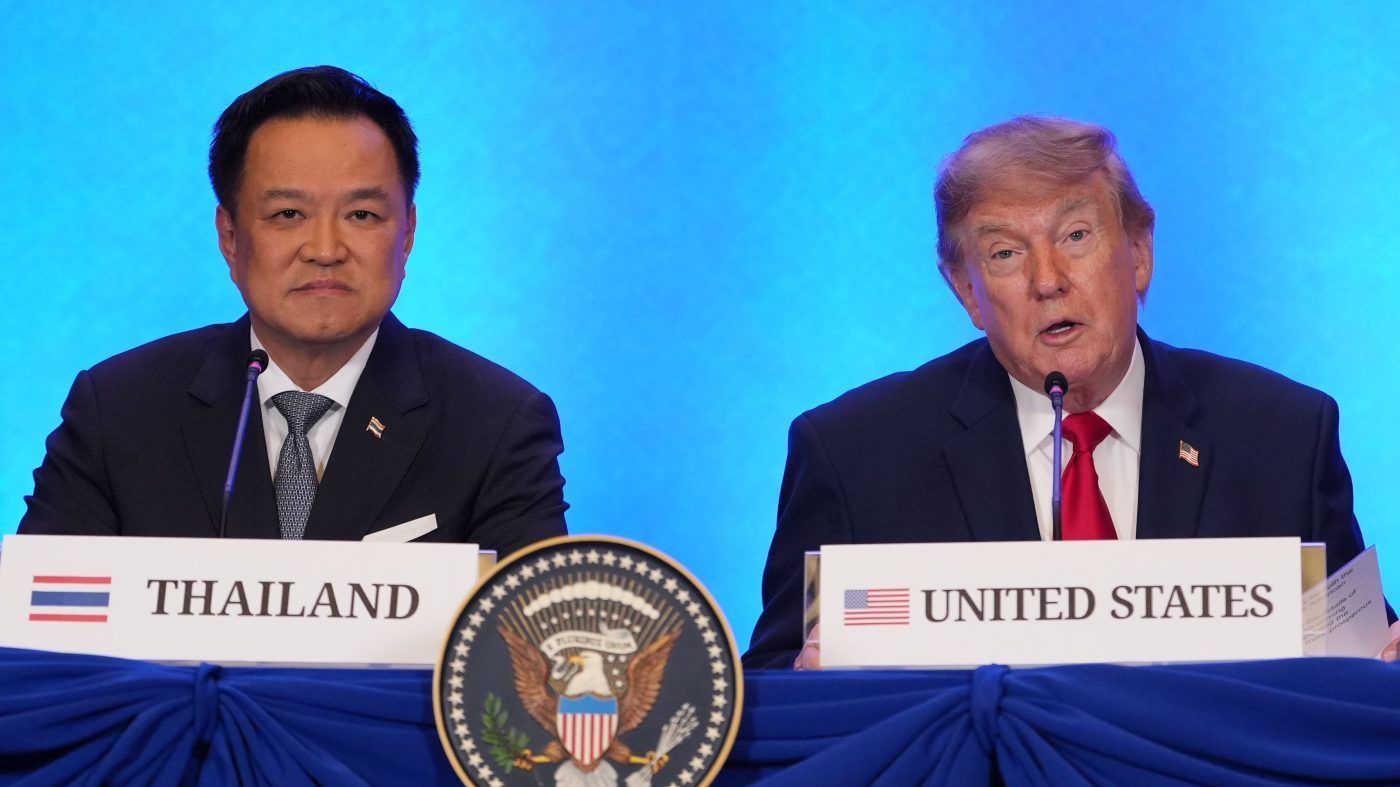
President Trump on Tuesday announced that Thailand has agreed to eliminate all tariffs on U.S. exports and to remove substantial non-tariff barriers on a range of products, marking a significant step toward finalizing a bilateral trade deal. The announcement came after Trump and Thai Prime Minister Anutin Charnvirakul signed a joint statement confirming they have "reached substantial conclusion" in their negotiations.
The two leaders met on the sidelines of the Association of Southeast Asian Nations summit in Manila, Philippines, where they underscored the importance of strengthening economic ties. "Today's deal lays the foundation for a much stronger trading relationship that will bring the United States and Thailand closer than ever before," Trump said.
Under the terms outlined by the president, Thailand will scrap tariffs on all American goods, a long-standing U.S. objective. Additionally, Bangkok will remove non-tariff barriers affecting U.S. vehicles, medical devices, pharmaceuticals, ethanol, and poultry. Trump also noted that Thailand intends to purchase roughly $2.6 billion in additional U.S. agricultural products, a move that could boost American farmers' exports.
The agreement, which is expected to be finalized in the coming weeks, builds on a framework established last October when Thailand agreed to eliminate tariffs on 99 percent of goods from the United States. The U.S. is Thailand's largest export market, making the deal particularly consequential for both economies.
Prime Minister Anutin expressed satisfaction with the progress, stating that he is "confident that the agreement will be ready for us to sign real soon." He emphasized Thailand's commitment to its long-standing relationship with Washington, saying, "Thailand attaches great importance to its long-standing relationship with the United States."
The announcement comes amid a broader U.S. push to rebalance trade relationships in the Indo-Pacific region. Trump's administration has sought to leverage bilateral deals to reduce trade deficits and open new markets for American exporters. This agreement with Thailand could serve as a template for other Southeast Asian nations, though details of the final text remain to be negotiated.
Analysts note that while the elimination of tariffs is a positive signal, the removal of non-tariff barriers will be key to ensuring real market access. The deal's impact on U.S. industries, particularly agriculture and manufacturing, will be closely watched as the final terms are hammered out.
For Trump, the announcement provides a tangible achievement to tout on the international stage, reinforcing his narrative of delivering better trade deals for American workers. However, critics may question the timing and the specifics of the agreement, especially given the complexity of trade negotiations and the need for congressional oversight.
As both sides move toward a formal signing, the focus will shift to implementation and enforcement. The upcoming weeks will reveal whether the promises translate into concrete benefits for U.S. exporters and whether Thailand follows through on its commitments.