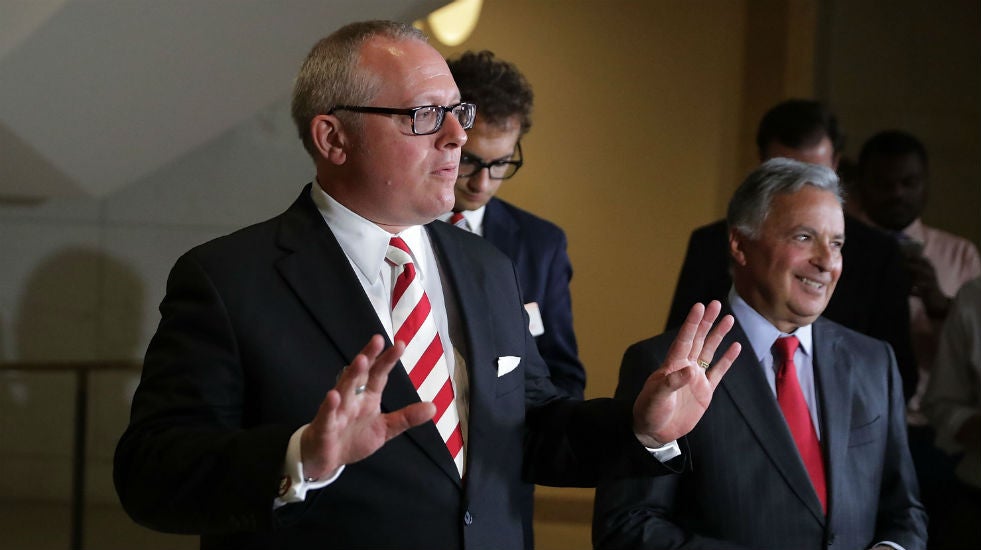
Michael Caputo, a former Trump administration official and longtime ally of the president, made history Tuesday by filing the first known claim against the Justice Department's newly established "anti-weaponization" fund. Caputo is seeking $2.7 million in restitution, arguing that the Biden administration wrongfully targeted him and his family over nearly a decade.
In a letter to Acting Attorney General Todd Blanche, Caputo detailed what he described as a coordinated campaign of political persecution. "The machinery of government was clearly politically weaponized against my family from July 2016 to December 2025," Caputo wrote on X. "They found nothing; we lost everything."
Caputo specifically cited the "illegal Crossfire Hurricane investigation"—the FBI's probe into Russian interference in the 2016 election and potential ties to the Trump campaign—as well as a 2021 FBI inquiry into a One America News documentary that pushed conspiracy theories about President Biden and Ukraine. He served as a spokesperson for the Department of Health and Human Services under Trump.
The fund, worth $1.776 billion, was created as part of a settlement to resolve Trump's massive lawsuit against the Internal Revenue Service. Individuals who believe they were victims of government overreach can apply for formal apologies and financial payouts. The Trump administration has declined to specify eligibility criteria, though Blanche has said there is "no partisan requirement" and that "anybody in this country can apply."
Democrats have sharply criticized the fund as a slush fund for Trump allies. Reps. Richard Neal (D-Mass.) and Jamie Raskin (D-Md.) wrote in a letter to Treasury Secretary Scott Bessent, Acting Attorney General Blanche, and IRS chief Frank Bisignano that "never in American history has a President pursued corruption this brazenly or on such a colossal scale." Critics point to the potential for claims from individuals involved in the January 6, 2021, attack on the Capitol, including those convicted of crimes.
Vice President JD Vance sidestepped questions about whether rioters who assaulted police officers should be eligible. "Every single case has its own details," Vance told reporters during a White House briefing. "We're not trying to give money to anybody who attacked a police officer. We're trying to compensate people where the book was thrown at them. They were mistreated by the legal system."
Two officers who defended the Capitol on January 6—former U.S. Capitol Police Officer Harry Dunn and D.C. Metropolitan Police Officer Daniel Hodges—are suing the Trump administration to block the fund. In a 29-page complaint, they argue that "the Anti-Weaponization Fund will both compensate and empower the very people making those threats." They warn that "militias like the Proud Boys will use money from the Fund to arm and equip themselves" and that the fund "will signal to past and potential future perpetrators of violence against Dunn and Hodges that they need not fear prosecution; to the contrary, they should expect to be rewarded."
The controversy comes as the Trump administration faces broader scrutiny over its use of executive power. In a separate development, Trump has demanded Republicans abolish the filibuster and fire the Senate parliamentarian, signaling a push to consolidate legislative control. Meanwhile, critics have compared the fund's structure to what they call "blatant corruption" in the $1.8 billion IRS settlement that created it.
As the first claim moves forward, the fund is likely to become a flashpoint in the ongoing debate over the weaponization of government institutions. Caputo's case may set a precedent for how the Trump administration defines and compensates victims of alleged political targeting, with implications for both his allies and his opponents.