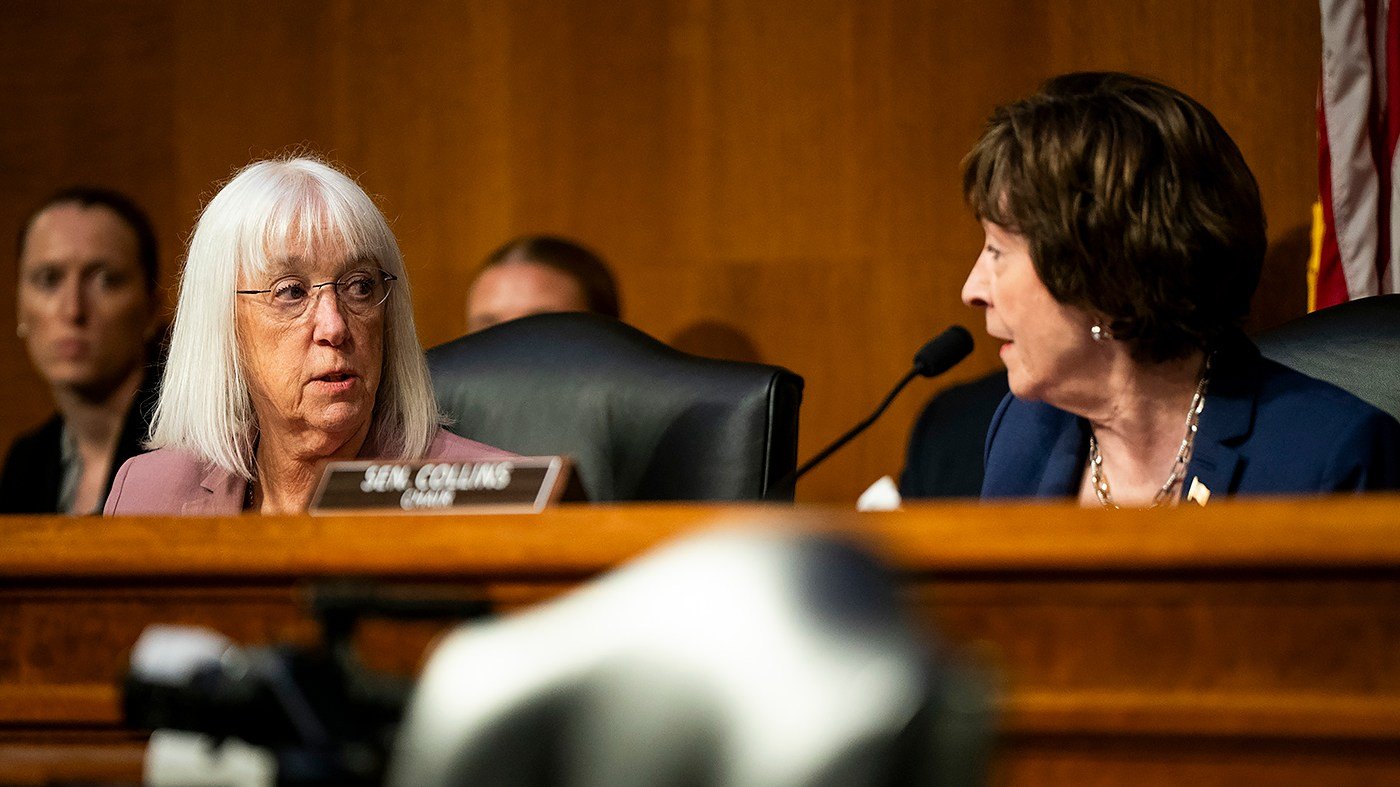
Senate Appropriations Committee leaders Susan Collins (R-Maine) and Patty Murray (D-Wash.) on Monday pushed back against reports that the White House is preparing to give political appointees a broader hand in how the National Institutes of Health (NIH) awards research grants. The bipartisan rebuke comes as the administration weighs new mechanisms to steer funding away from studies it deems out of step with President Trump's agenda.
According to multiple weekend reports, the White House Office of Management and Budget (OMB) is exploring ways to insert political oversight into NIH's peer-review process. OMB Director Russell Vought has reportedly accused the agency of bankrolling "woke" research, while NIH Director Jay Bhattacharya has defended the agency's existing merit-based review system as rigorous and independent.

Collins, who chairs the appropriations panel, was blunt in her assessment. "The Office of Management and Budget should not be involved in agency decisions on the awards of grants," she said. She noted that the continuing resolution signed into law on September 2 explicitly blocks OMB's proposed rule or any "substantially similar" effort. "Any attempt to politicize grantmaking at the National Institutes of Health, or any other agency, by another means—whether an Executive Order or guidance—is contrary to congressional intent," Collins added.
The Maine Republican warned that injecting political review into already-vetted awards would "undermine the long-standing principle that the government funds awards based on scientific need and merit, rather than political ideology." Her statement echoes concerns she raised in a July 6 letter opposing the original OMB rule.
Murray, the panel's ranking Democrat, went further, arguing that decisions about which research gets funded should hinge on one question: "Is this good science that could save lives?" She accused the administration of wanting to answer a different question—"does this help me settle a score?"—and said NIH funding "doesn't belong to Donald Trump; it belongs to the patients and families waiting on the next medical breakthrough."
Murray also called on Republicans to join Democrats in blocking any administration effort to politicize medical research funding, whether through an OMB rule, an executive order, or other guidance. "President Trump will stop at nothing to defund medical research that fundamentally changes the lives of patients and families across the country," she said.
The White House has not publicly confirmed the reported plans, and as of Monday afternoon no executive order had been issued. A New York Times report suggested the administration could create an external committee with authority to veto grants, a move that would bypass the usual scientific review process.
This clash over NIH funding is part of a broader pattern of the administration's willingness to centralize control over federal agencies and align their operations with political priorities. Critics argue that such interference threatens the integrity of U.S. biomedical research and could delay or kill promising treatments for diseases like cancer, Alzheimer's, and diabetes.
The appropriations leaders' rare bipartisan statement underscores the depth of concern in Congress, where both parties have historically defended NIH's peer-review system as a global gold standard. Whether the White House will heed that warning or press ahead with new oversight remains to be seen, but the political stakes are high as the next funding fight approaches.