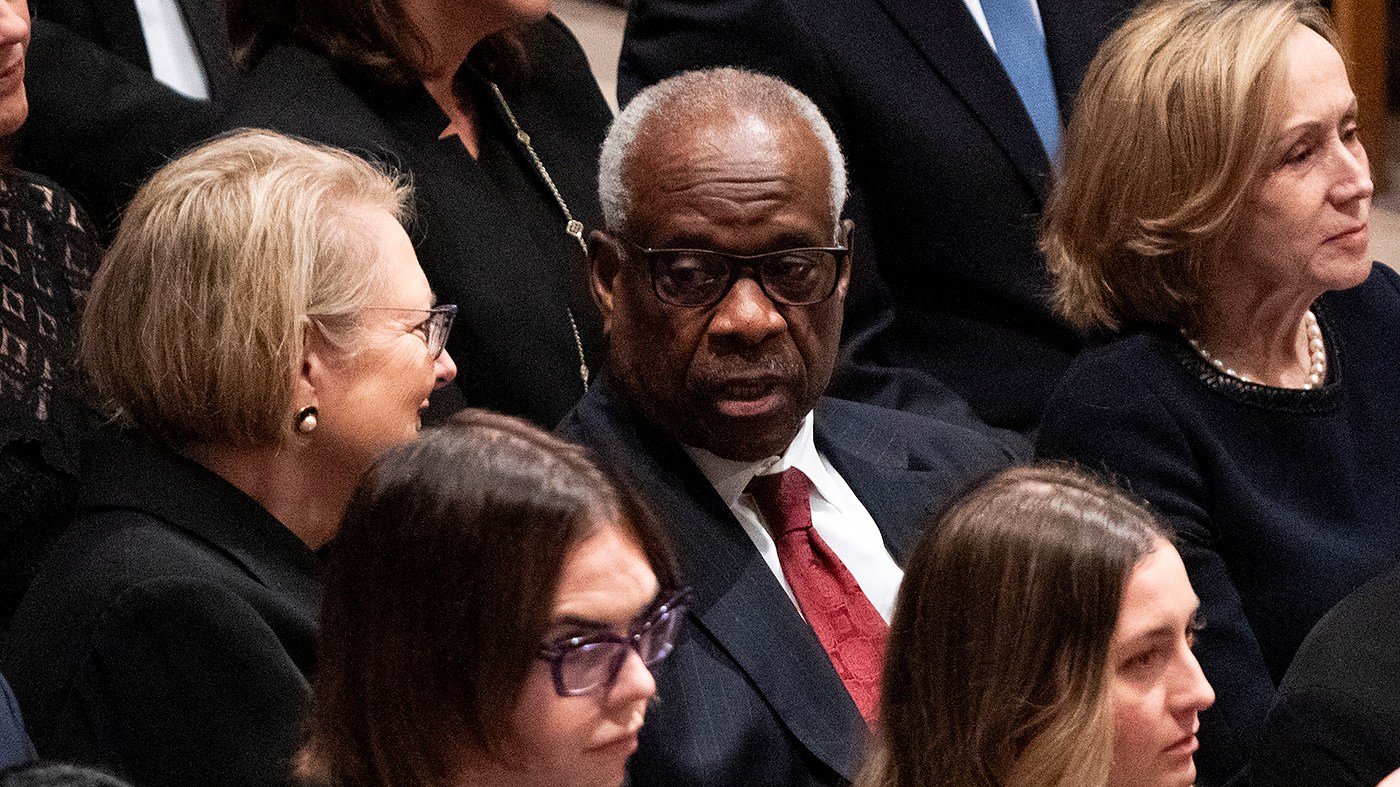
The Supreme Court on Monday opted not to hear a challenge to Maryland's restrictions on carrying firearms in areas designated as 'sensitive places,' including mass transit and state parks. However, Justice Clarence Thomas signaled that he believes the Court should eventually address the constitutionality of such sweeping bans.
In a statement accompanying the denial of certiorari, Thomas wrote that he has 'serious doubts' that the nation's historical tradition of firearm regulation supports many of these broad restrictions. He suggested that in an appropriate future case, the Court should examine whether specific sensitive-place laws align with the Second Amendment's right to public carry.

Despite his skepticism, Thomas voted with his colleagues to decline the case, noting that Maryland's law applies to a wide range of locations and that the underlying lawsuit challenged the statute too broadly. He indicated he would support taking up a future challenge that is 'narrowly focused.'
Thomas authored the landmark 2022 majority opinion in New York State Rifle & Pistol Association v. Bruen, which established that gun control measures must be consistent with the nation's historical tradition of firearm regulation to survive constitutional scrutiny. That test has led lower courts to strike down numerous gun restrictions enacted by Democratic-led states and cities in recent years.
Next month, the Court is scheduled to hear arguments on whether bans on AR-15-style rifles in the Chicago area and Connecticut can be upheld under that same historical standard. That case could have significant implications for the future of gun regulation across the country.
Maryland, like several other states, restricts carrying firearms in places it considers sensitive, such as schools, government buildings, and, in this case, transit facilities, casinos, bars, parks, and healthcare centers. The state argues these measures are necessary for public safety.
Thomas, however, suggested that some states are exploiting the 'sensitive places' exception to an unreasonable degree. He wrote that the cumulative effect of Maryland's restrictions is to prohibit firearms in virtually all places where people gather for everyday activities, which he called 'an affront to the right of law-abiding citizens.'
The Court's conservative majority has previously indicated that certain locations, such as schools and government buildings, have a long tradition of firearm restrictions and may be permissible. But Thomas's latest remarks signal that the justices may be willing to scrutinize more expansive designations.
This development comes as the Court continues to reshape the legal landscape around gun rights, and as states grapple with how to regulate firearms in public spaces. The decision not to take up the Maryland case means the ban remains in effect for now, but the issue is likely to return to the Court in a more targeted form.