The Supreme Court on Monday waded into a high-stakes legal battle over whether Americans can sue pesticide manufacturers for failing to warn about health risks, a case that could dramatically alter the landscape for thousands of similar claims nationwide.
The justices heard oral arguments in Monsanto Co. v. Durnell, an appeal from the agrochemical giant seeking to block state-level failure-to-warn lawsuits. The case stems from a $1.25 million verdict won by John Durnell, who alleged that Monsanto’s Roundup weed killer caused his cancer and that the company hid the dangers from consumers.

At the heart of the dispute is whether the Federal Insecticide, Fungicide, and Rodenticide Act (FIFRA) preempts state tort claims that require additional or different labeling than what the Environmental Protection Agency mandates. Monsanto argues that FIFRA explicitly bars states from imposing labeling requirements beyond EPA standards, effectively shielding companies from failure-to-warn suits.
“The statute says states cannot impose requirements in addition to or different from those set by the EPA,” a Monsanto attorney told the court, pressing for a broad interpretation of preemption. Durnell’s lawyer countered that FIFRA also prohibits selling pesticides with misleading labels and that the EPA lacks authority to block courts from holding companies accountable for inadequate warnings.
The justices appeared divided along ideological lines. Conservative Justice Neil Gorsuch pressed Monsanto on whether its reading would leave consumers without any remedy, while liberal Justice Ketanji Brown Jackson questioned the company’s preemption argument. Conservative Justice Brett Kavanaugh, however, voiced skepticism toward Durnell’s position, suggesting that FIFRA’s text may not support state claims. The court’s ruling, expected by late June, could either embolden or stifle the wave of Roundup lawsuits—more than 4,000 are pending in federal courts alone.
Political and Legislative Stakes
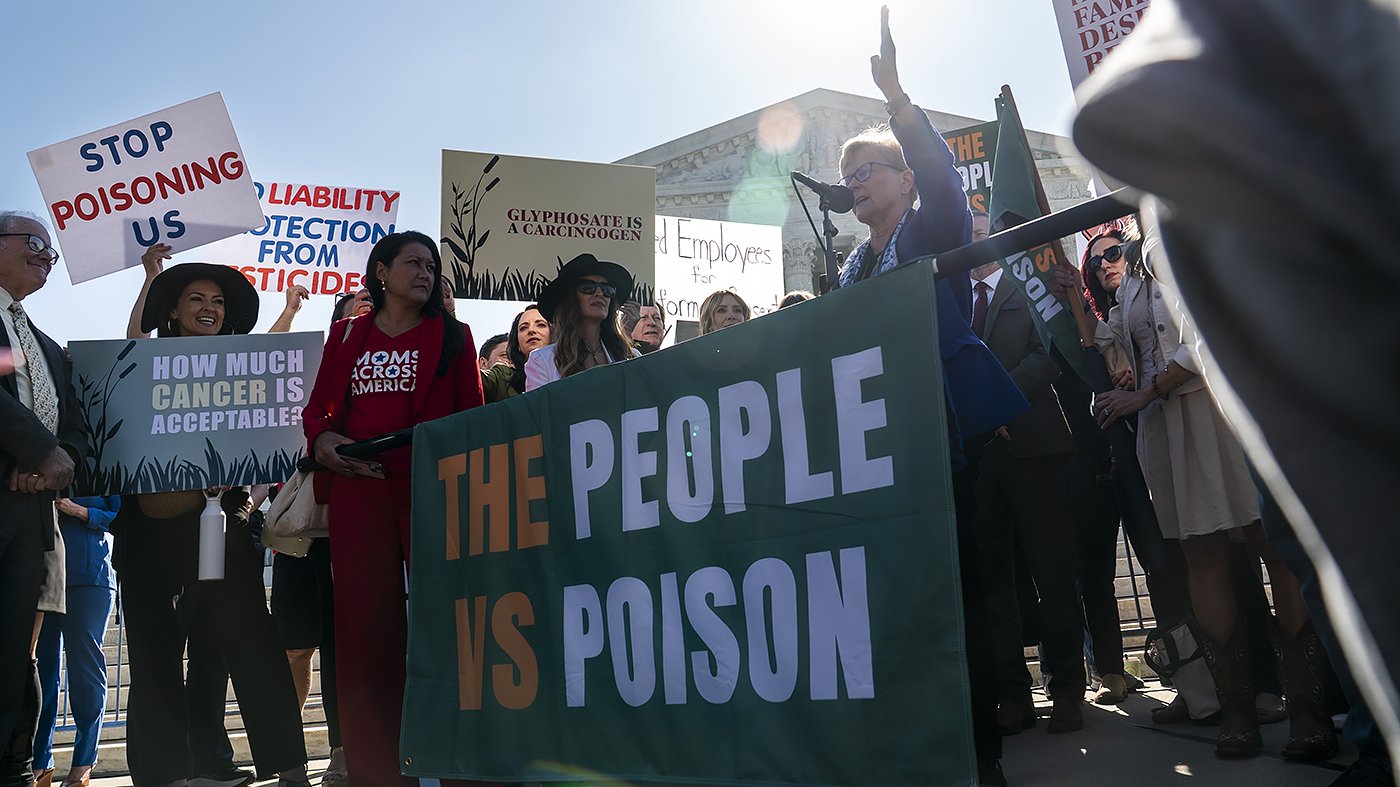
Outside the courthouse, critics of pesticides rallied in support of Durnell, including environmental activists and supporters of the “Make America Healthy Again” (MAHA) movement. They argued that ordinary Americans must retain the ability to hold corporations accountable for health harms. The issue has also split the Republican Party, pitting pro-business conservatives against MAHA-aligned lawmakers who favor stricter regulation.
The fight extends beyond the judiciary. The House is poised to consider its version of the farm bill this week, which Republican leaders have loaded with language that would limit pesticide-related lawsuits. Democrats and some MAHA Republicans oppose the provision, warning it would weaken consumer protections. The Trump administration has sided with Monsanto in the Supreme Court case, a stance that risks alienating the president’s base among health-conscious voters.
The outcome could also intersect with broader debates over corporate accountability and federal preemption, reminiscent of other high-profile cases. For instance, the Virginia Supreme Court is weighing the legality of a redistricting referendum, while the Supreme Court’s asylum case is pushing Congress to act on border policy—both examples of how judicial decisions can force legislative action.
Legal experts say a broad ruling for Monsanto could effectively end most failure-to-warn claims against pesticide makers, forcing plaintiffs to rely on federal safety standards that critics argue are too weak. A narrow ruling, however, might preserve state lawsuits but leave confusion about what claims survive. The case is one of several this term testing the limits of corporate liability, including a pending dispute over digital dragnet warrants and privacy rights.
For now, the justices offered no clear signal. But the stakes are clear: a decision could redefine how Americans seek justice for alleged harms from everyday products, from pesticides to pharmaceuticals, and reshape the balance between federal regulation and state tort law.