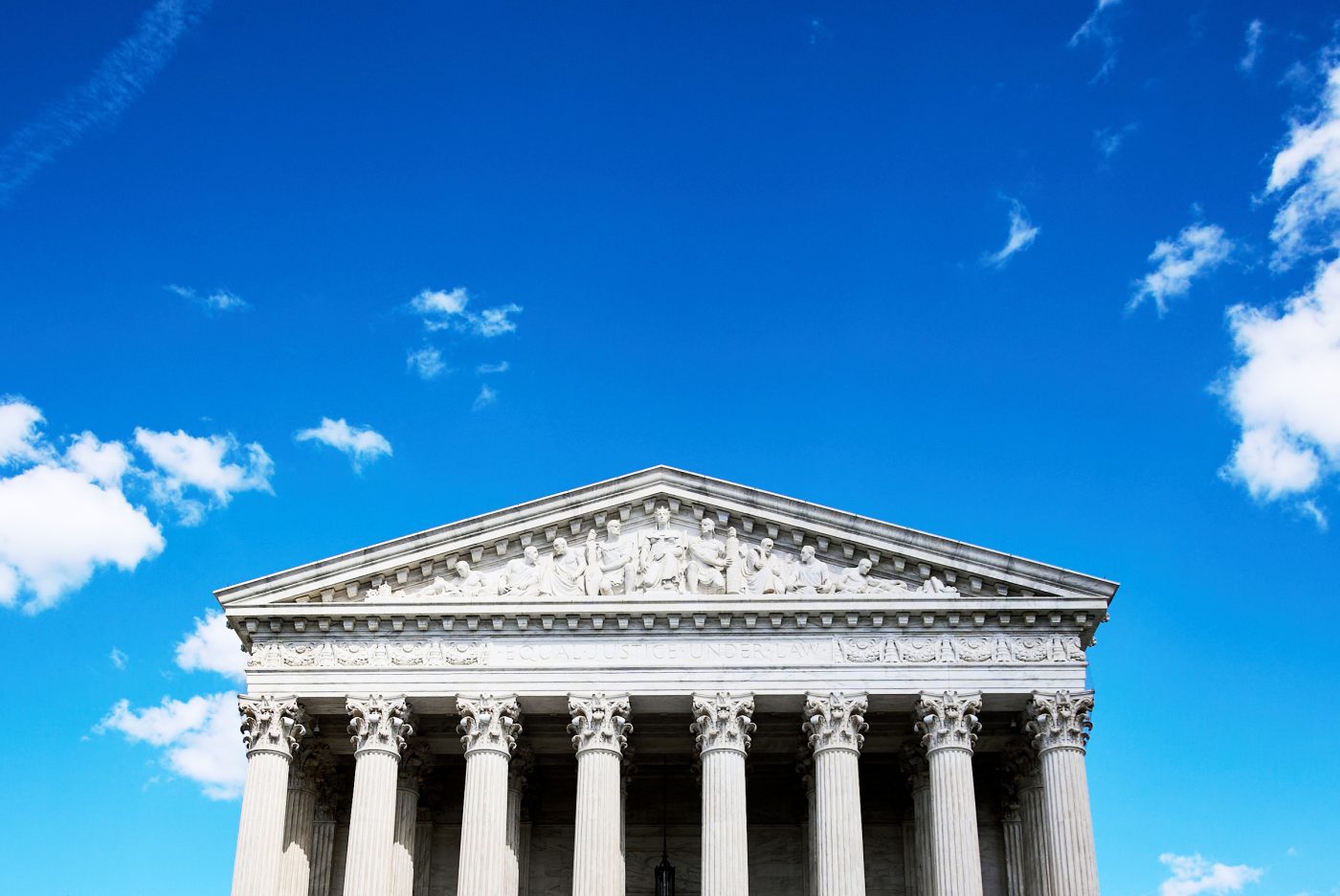
The Supreme Court announced Monday it will take up a case that could determine whether employees of public schools and universities can bring private lawsuits for sex discrimination under Title IX, a question that has divided federal appeals courts across the country.
The case stems from two separate employment disputes at Georgia public universities. MaChelle Joseph, the former women's basketball coach at Georgia Tech, was fired in 2019 after she complained that her program received far fewer resources than the men's team. Thomas Crowther, an art professor at Augusta University, lost his job in 2021 after students reported him for alleged sexual harassment and inappropriate conduct in class.
Both sued under Title IX, the landmark 1972 law that bans sex discrimination in any educational program receiving federal funds. But the U.S. Court of Appeals for the 11th Circuit ruled that public school employees do not have a private right to sue under Title IX — a decision that puts the circuit at odds with eight other federal appeals courts.
Attorneys for Joseph and Crowther argued in their petition that the ruling undermines the law's consistency nationwide. “The decision below vitiates the national uniformity of Title IX,” they wrote. “Whether an employee can sue for employment discrimination under Title IX — which governs every educational institution receiving federal funds — now depends entirely on where she works.”
The 11th Circuit's position, they noted, is the “sole outlier” among circuits that have addressed the issue since a 2005 Supreme Court decision that allowed employees to bring retaliation claims under Title IX. The 5th and 7th Circuits had previously sided with the 11th Circuit, but those rulings predate that 2005 precedent.
Georgia Solicitor General Stephen Petrany, representing the University System of Georgia's Board of Regents, pushed back forcefully. He portrayed Joseph as a coach who was fired for mistreating players — causing some to quit mid-season — and Crowther as a professor dismissed after taking photos of nude student models on his phone. “The plaintiffs are wrong from top to bottom,” Petrany said.
Joseph disputes the characterization, arguing she was never allowed to contest a report that found she fostered a culture of “high-pressure coaching” with concerns over “verbal treatment.” Crowther alleges he was treated unfairly during a Title IX investigation and was effectively terminated while his appeal was pending.
Petrany argued there is “no reason” for the justices to hear the case. He contended that expanding the implied private right of action under Title IX to cover employment discrimination would conflict with the comprehensive enforcement scheme Congress created under Title VII, which explicitly addresses workplace discrimination. “Expanding the judicially created Title IX private right of action to cover employment discrimination claims would run roughshod over this Court's modern precedent,” he wrote.
The petitioners countered that the circuit split is real and unlikely to resolve itself without Supreme Court intervention. “Nearly every circuit has addressed it, making it ripe for review,” they said. But the school system argued the split is illusory, noting that most circuits assumed — without formally ruling — that Title IX allows employment discrimination claims. “Petitioners' purported eight-to-three split in favor of their position is really three-to-zero against them,” Petrany wrote.
The case arrives as the Supreme Court has shown interest in clarifying the scope of Title IX. In a recent decision not to hear an insider trading appeal, the Court signaled it is selective about which cases it takes. But the deep division among lower courts on this issue — and the potential impact on thousands of school employees — may make it harder for justices to pass up.
If the Court sides with the employees, it could open the door to more Title IX lawsuits by public school workers, while a ruling for the schools would leave those workers reliant on Title VII — which has different procedural requirements and damage caps. The outcome could also affect broader debates about sex discrimination in education, a topic that has drawn attention alongside gaps in voter turnout and other policy challenges.