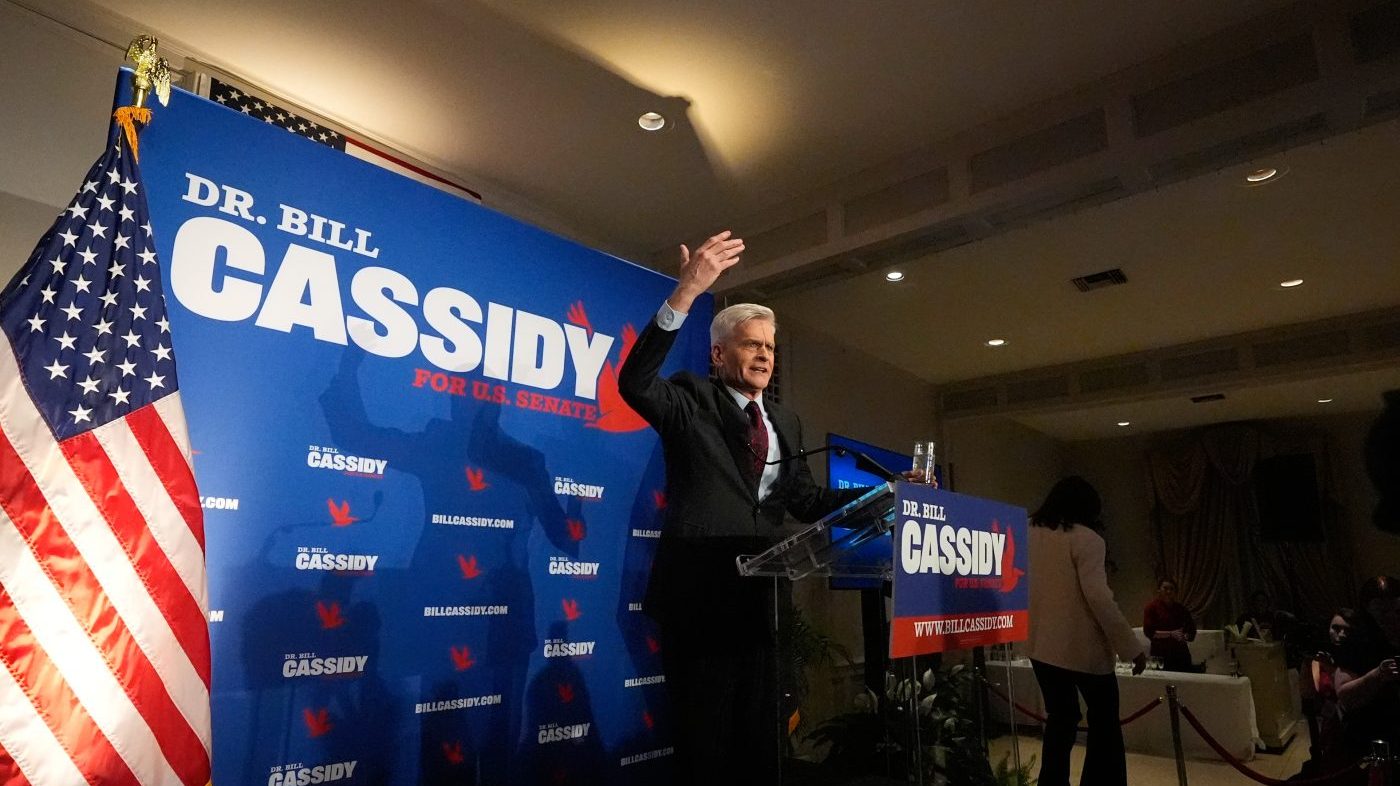
The decisive defeat of Sen. Bill Cassidy (R-La.) in Saturday's primary has rattled the Senate Republican Conference, reinforcing that any GOP lawmaker seeking distance from President Trump risks political annihilation. Cassidy, a two-term incumbent, secured just 25% of the vote, failing to even reach a runoff. His loss, fueled by Trump's endorsement of Rep. Julia Letlow, who led the field with 28%, underscores the president's iron grip on the party's base.
Trump celebrated Cassidy's downfall on Truth Social, citing the senator's 2021 vote to convict him for inciting the January 6 insurrection. "His disloyalty to the man who got him elected is now a part of legend," Trump wrote, adding that Cassidy's political career is "OVER." The president quickly turned his sights on Rep. Thomas Massie (R-Ky.), who faces a primary challenge Tuesday from Trump-backed Ed Gallrein. Massie, a seven-term incumbent, has repeatedly defied Trump, including on the Epstein Files Transparency Act, which Trump initially opposed but later signed. The Kentucky primary is seen as another test of Trump's sway over the GOP.
Vin Weber, a former House Republican and GOP strategist, said the message is unmistakable. "The one unifying principle of the Republican Party today is Donald Trump," Weber said. "If you appear to abandon him, the party will abandon you." Cassidy's ouster follows Trump's successful campaign to unseat five state senators in Indiana who opposed his redistricting plan, amplifying the warning to Capitol Hill Republicans.
Senate Majority Leader John Thune (R-S.D.) offered a muted response, praising Cassidy as a "principled conservative" and "independent thinker." Thune noted Cassidy's role as chairman of the Health, Education, Labor, and Pensions Committee, calling it "an incredibly significant and powerful committee." But Thune's tone contrasted sharply with Trump's gleeful attack.
The loyalty test now shifts to a budget reconciliation package expected to hit the Senate floor this week. The bill includes up to $1 billion in taxpayer funding for a new White House ballroom, a top Trump priority. Several GOP senators, including John Curtis (Utah), Rand Paul (Ky.), Susan Collins (Maine), Rick Scott (Fla.), and Thom Tillis (N.C.), have raised objections, fearing political blowback from funding a lavish project. Tillis, a frequent critic of the administration, sent an angry email to colleagues Monday threatening to block the package, arguing the White House is rushing the process with an "arbitrary" June 1 deadline.
The situation is complicated by a ruling from Senate Parliamentarian Elizabeth MacDonough, who found the ballroom funding violates the Byrd Rule, making it ineligible for passage with a simple majority. Thune said leadership will work to revise the language to meet the parliamentarian's approval. Meanwhile, Tillis urged delaying the vote to avoid forcing Sen. John Cornyn (R-Texas), who faces a tough primary May 26, to stay in Washington late this week. The internal GOP strife highlights the growing tension between Trump's demands and the political survival instincts of his party's senators.