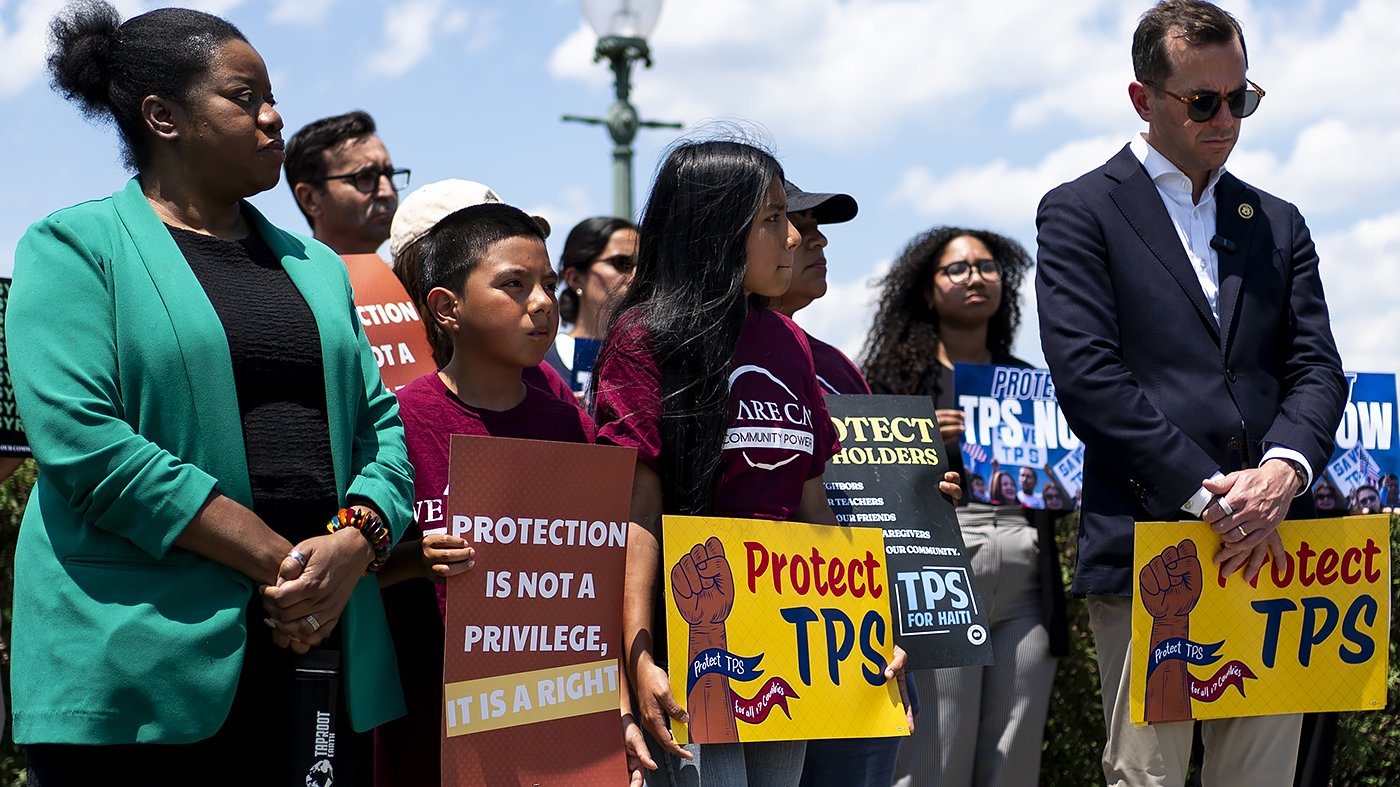
The Supreme Court dealt a severe blow to deportation protections for over a million immigrants Thursday, ruling that federal courts cannot second-guess the Trump administration's decision to end Temporary Protected Status (TPS) for Haiti and Syria. The 6-3 decision, split along ideological lines, effectively shields the administration from judicial review on TPS terminations, a move that advocates warn could unravel protections for all 17 countries currently covered.
The ruling overturns lower court findings that the administration failed to follow proper procedures and acted with racial bias. In a majority opinion joined by all six conservative justices, the court held that the Immigration and Nationality Act does not grant courts the power to review the Secretary of Homeland Security's TPS decisions. The three liberal justices dissented, with Justice Elena Kagan arguing the statute explicitly allows judicial review of procedural compliance.
Ahilan Arulanantham, co-director of the Miñana Family Center for Immigration Law and Policy at UCLA, described the ruling as a significant defeat. 'The court doesn't say what the Trump administration did is lawful,' he said. 'It says the statute doesn't give courts any power to correct illegal decisions. That hands the administration an important victory.'
The decision directly affects approximately 350,000 Haitians and 6,000 Syrians, who will lose work authorization and deportation protections within 30 days. But the broader impact looms larger: the administration has moved to end TPS for 11 additional countries, putting the status of all 1.3 million recipients at risk. The Trump administration has argued that conditions in those countries have improved sufficiently, a claim sharply at odds with State Department warnings.
Haiti remains under a national emergency, with gangs controlling much of the country and no stable government since the 2021 assassination of its president. Syria is still mired in civil war, with the State Department warning that 'no part of Syria is safe from violence.' Both countries carry a Level 4 'do not travel' advisory from the U.S. government, the highest possible.
The administration hailed the decision. 'Today, the Supreme Court affirmed what President Trump has always maintained: temporary protected status is, by definition, temporary,' said White House spokesperson Abigail Jackson. 'The Trump Administration continues to lawfully end the egregious abuses to our immigration system.'
Critics note that lower courts had found evidence of racial animus in the administration's TPS decisions. A concurring opinion at the 9th Circuit Court of Appeals cited statements by President Trump and former Homeland Security Secretary Kristi Noem that 'were overtly founded on racist stereotyping based on country of origin.' The Supreme Court majority, however, dismissed that evidence, saying the plaintiffs failed to prove discriminatory intent.
Emi MacLean, a senior staff attorney at the ACLU of Northern California, which represented Syrian TPS holders, warned the ruling's impact extends beyond the two cases. 'The Trump administration did not analyze country conditions, they did not follow proper procedures, they did not base their decisions on proper considerations,' she said. 'This decision severely limits avenues for relief in other cases.'
This ruling follows a series of major decisions on executive power, including the Supreme Court's recent affirmation of presidential firing authority. For TPS recipients, the message is stark: the courts will not intervene. As Rep. Sylvia Garcia (D-Texas) put it, 'Today, it's Haiti and Syria. Which country will be next?'