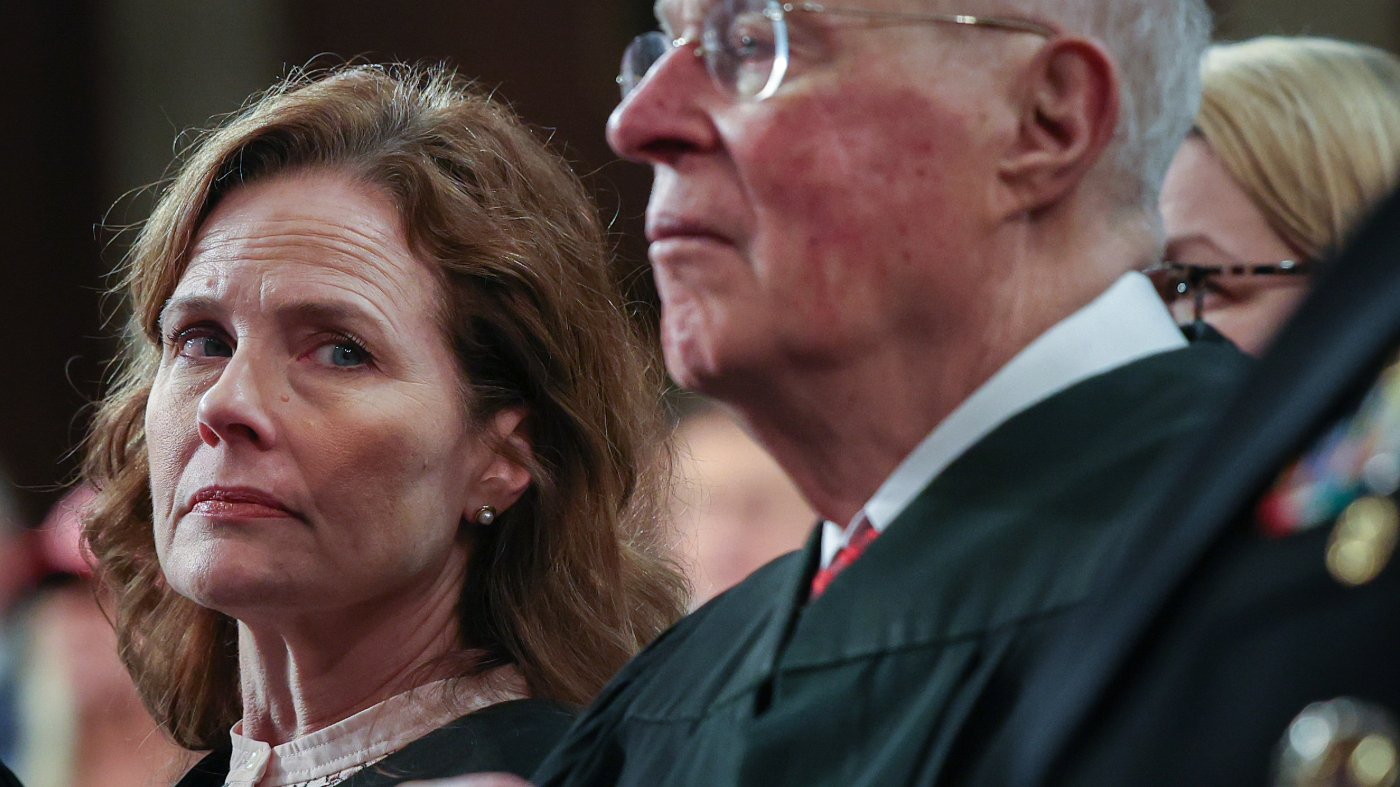
Chief Justice John Roberts routinely insists that the Supreme Court is not a collection of “political actors.” But when the six conservative justices recently voted to effectively gut a key provision of the 1965 Voting Rights Act, they proved otherwise, acting as guarantors of the Republican Party's agenda.
Justice Amy Coney Barrett herself provided the framework for assessing judicial impartiality. Speaking at the University of Louisville's McConnell Center shortly after her confirmation, Barrett declared, “My goal today is to convince you that this court is not comprised of a bunch of partisan hacks.” She suggested evaluating whether a decision “seems results-oriented.” Later, at the Ronald Reagan Presidential Library, she urged the public to read the opinion and decide if it is “designed to impose the policy preferences of the majority” or represents “an honest effort ... to determine what the Constitution and precedent requires.”
Barrett's test is almost correct—but it should be “read the opinions,” plural. A single opinion can be made to appear coherent; only by comparing multiple rulings does a pattern of political favoritism emerge. Do the decisions consistently follow precedent, or do they shift to achieve political outcomes?
In voting rights, the contradiction is stark. In the 2019 case Rucho v. Common Cause, the conservative majority, led by Roberts, declined to strike down heavily gerrymandered congressional districts, arguing the issue was “nonjusticiable” and beyond the court's reach. The opinion lamented that “excessive partisanship in districting leads to results that reasonably seem unjust” and stressed that the ruling did not “condone excessive partisan gerrymandering.”
Yet in Louisiana v. Callais last month, the same five justices—now joined by Barrett—endorsed partisan gerrymandering as a “legitimate” justification for eliminating a majority-Black congressional district created under the Voting Rights Act. In the span of seven years, the court went from decrying partisan gerrymanders as beyond its reach to approving what it called “a target partisan distribution of voters” as a sacred state right.
Justice Elena Kagan, in a biting dissent joined by Justices Ketanji Brown Jackson and Sonia Sotomayor, wrote that the majority had given “politicians free rein to adopt partisan gerrymanders” as “an excuse for stripping minority citizens of their voting rights.” UCLA law professor Richard Hasen noted that “the odious practice has now become a defense in a voting rights case.”
Southern states wasted no time acting on the signal. Louisiana's governor suspended a congressional primary mid-vote to allow the Republican legislature to purge a Black-majority district. Tennessee's GOP-controlled legislature carved its only Black-majority district, in Memphis, into three white-dominated slices, with the state speaker boasting the new map is “colorblind”—effectively all white. Alabama, Florida, and Mississippi are reported to have similar proposals in the works, and Georgia is planning for after 2026. Southern GOP states rush to redraw maps after the ruling.
The Supreme Court once rejected euphemisms like “separate but equal” and “grandfather clause” as cover for racism. Now it has ratified a “color-blind” rationale for eviscerating minority voting rights, a reversal unseen in over 60 years. Senator Booker blasted the ruling as a step back to the 1870s.
So take Barrett's advice. Read the opinions. Compare Callais (written by Justice Samuel Alito and joined by Roberts) with Rucho (written by Roberts and joined by Alito). Is there any principle other than partisan advantage that connects them? The answer reveals a court that has failed Barrett's own test.