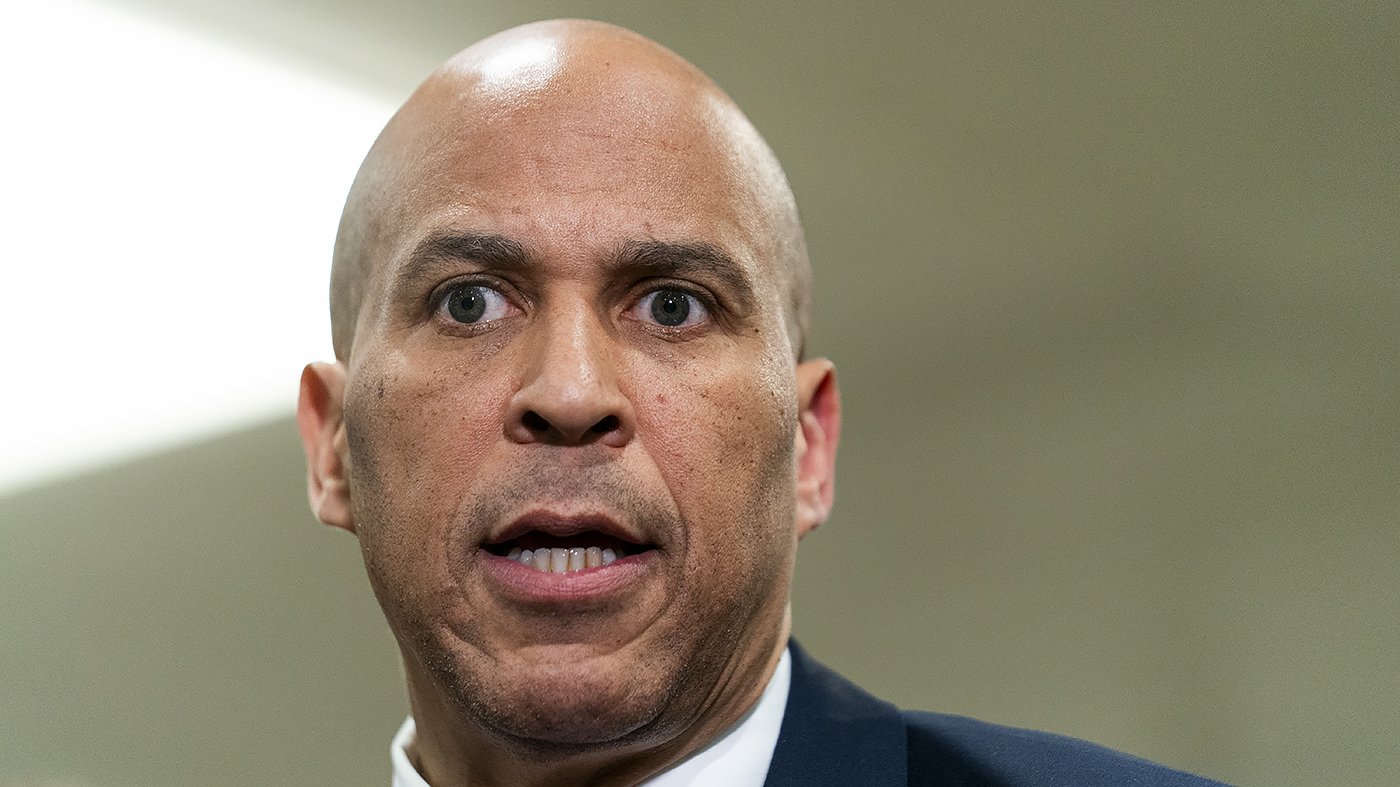
Sen. Cory Booker (D-N.J.) on Sunday launched a blistering critique of the Supreme Court's latest Voting Rights Act decision, arguing it effectively turns back the clock on racial progress. The Court's 6-3 ruling last month struck down Louisiana's second majority-Black congressional district as an unconstitutional racial gerrymander, narrowing the scope of Section 2 of the Voting Rights Act of 1965 to only cover intentional discrimination in redistricting.
Appearing on NBC's Meet the Press, Booker told host Kristen Welker that the decision undermines one of the nation's most pivotal civil rights laws. “The Voting Rights Act was perhaps one of the most important acts in the history of our country in securing our democratic ideals: all are created equal, all are imbued with certain unalienable rights,” he said. “And what [the Supreme Court has] done right now is sent us backwards in time, back to the 1870s and ’80s, where the South and southern legislators, through terrorism, intimidation, and worse were able to stop African-Americans from having representation in Congress.”
Booker didn't mince words, comparing the ruling to two of the Court's most infamous decisions: Plessy v. Ferguson, which enshrined the “separate but equal” doctrine, and Korematsu v. United States, which upheld the internment of Japanese Americans during World War II. He declared the new ruling “as wrong as” those precedents.
The decision invalidated Louisiana's 2024 congressional map, but its impact is already rippling across the country. In Tennessee, Republican lawmakers this week passed a map signed by Gov. Bill Lee that dismantles the state's only majority-Black district, currently held by Rep. Steve Cohen (D). Cohen, the lone Democrat in Tennessee's nine-member House delegation, has vowed to challenge the map in court. This move echoes a broader trend among Southern GOP states rushing to redraw maps after the Supreme Court ruling.
Writing for the majority, Justice Samuel Alito framed the decision as a necessary “update” to the Gingles framework, the legal standard established in the 1980s for evaluating Section 2 claims. Alito cited “vast social change” in the South, the advent of computer-drawn maps, and the Court's 2019 ruling barring federal judges from striking down partisan gerrymanders as reasons for the shift. “In light of these developments, the Court updates the Gingles framework and realigns it with the text of [Section 2] and constitutional principles,” Alito wrote.
But the dissent painted a starkly different picture. Justice Elena Kagan, joined by Justices Sonia Sotomayor and Ketanji Brown Jackson, argued the ruling “renders Section 2 all but a dead letter.” Kagan warned that if other states follow Louisiana's lead, “the minority citizens residing there will no longer have an equal opportunity to elect candidates of their choice.” This dissent underscores the deep ideological divide on the Court and the high stakes for minority representation in Congress.
The ruling has emboldened Republican-led states to pursue aggressive redistricting, as seen in Tennessee and Alabama. Meanwhile, Democrats are scrambling to respond, with figures like Booker and Rep. Alexandria Ocasio-Cortez hinting at broader ambitions to shift the political landscape. For now, the battle over voting rights is set to intensify, with legal challenges expected to multiply in the wake of the Court's decision.