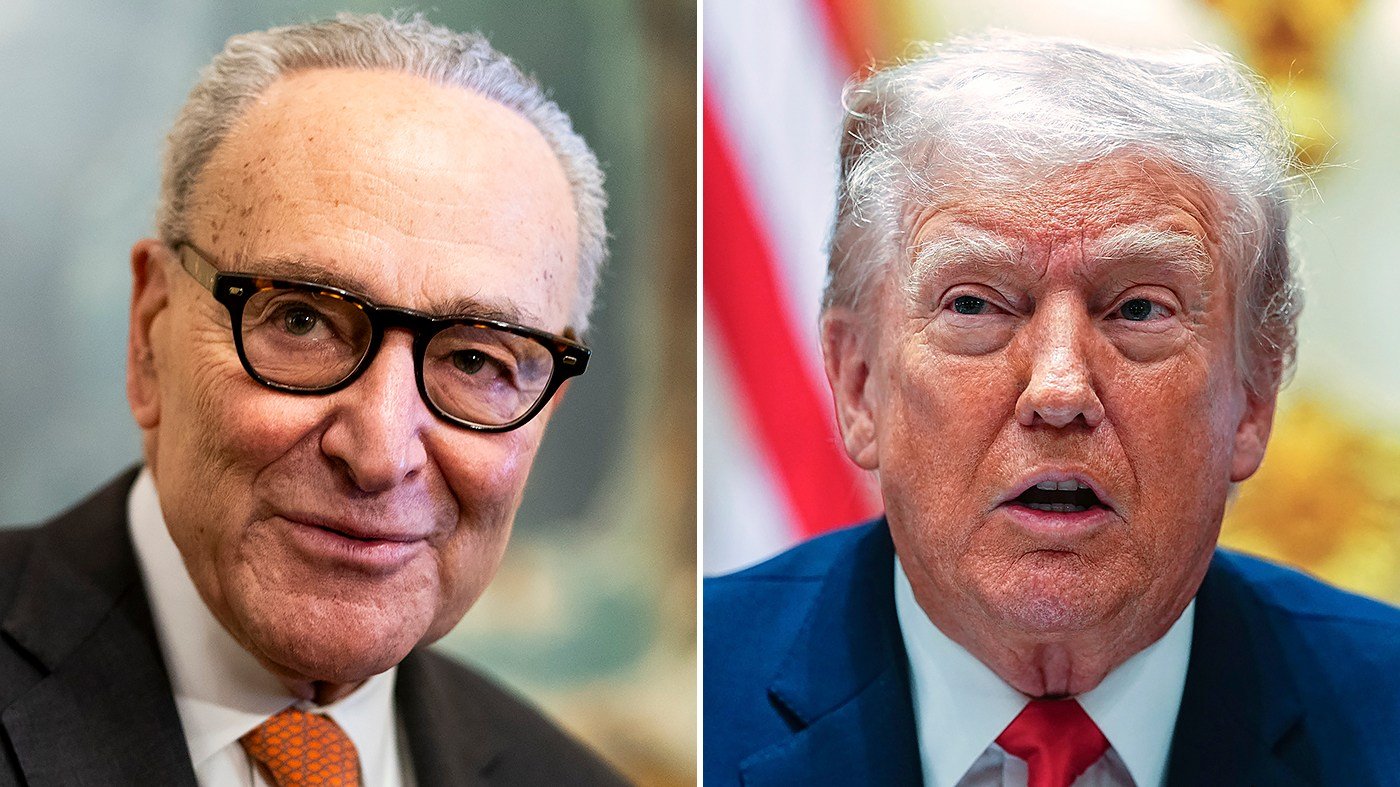
Senate Minority Leader Chuck Schumer (D-N.Y.) on Thursday sharply criticized President Trump's latest attack on Michigan Senate candidate Abdul El-Sayed, calling it "bigoted bulls‑‑‑." Schumer took to social platform X to voice his support for El-Sayed, writing, "Abdul El-Sayed is on the road to being the next Senator from Michigan no matter how much bigoted bulls‑‑‑ a weak and desperate Donald Trump throws at him."
The rebuke came after Trump, late Wednesday evening, lambasted El-Sayed as a "terrible" candidate whose views "are not exactly those of Michiganders" or Americans. In a post on Truth Social, Trump referred to El-Sayed as "Mohammed El-Sayed"—a misnomer, as his full name is Abdulrahman Mohamed El-Sayed—and labeled him a "RADICAL Extremist" and a "Terrorist Sympathizer."

El-Sayed, a physician and progressive Democrat who won the August primary against Rep. Haley Stevens, is running to succeed retiring Sen. Gary Peters. He was born in Michigan to Egyptian immigrants. Trump's attacks have repeatedly targeted El-Sayed's Muslim faith, a pattern that has drawn condemnation from Democrats and civil rights groups.
El-Sayed fired back on Thursday, noting that Trump "knows my name is Abdul" and that the president "says it everyday." In a post on X, El-Sayed argued that Trump's attacks are not just personal but aimed at all Americans: "He's attacking all of us. He thinks so low of us. He thinks he can use my name and my faith to distract us from the suffering his policies are inflicting on us at the pump, at the grocery store, and at the doctor's office. He thinks we don't know any better."
This is not the first time Trump has used El-Sayed's faith to cast him as extreme. In August, Trump posted a split-screen image of himself and first lady Melania Trump alongside El-Sayed and his wife, Dr. Sarah Jukaku, who wears a hijab, with the caption "Two VERY DIFFERENT America's."
Earlier this week, El-Sayed challenged Trump to campaign in Michigan on behalf of his Republican opponent, former Rep. Mike Rogers, arguing that Rogers "can't speak for himself." Speaking on MS NOW's "All In," El-Sayed directed his remarks at the president: "Clearly, you are the answer, and you should tell everybody why they should imagine you on the ballot."
Despite the heated rhetoric, polling suggests El-Sayed holds a significant lead. Decision Desk HQ, a partner of The Hill, gives El-Sayed a 69 percent chance of defeating Rogers. Early voting has already begun in some Michigan communities and will expand statewide starting Oct. 24.
The race in Michigan is seen as a bellwether for the midterms, with Democrats hoping to hold the seat as part of their narrow Senate majority. Trump's attacks on El-Sayed, however, could energize both Democratic and Muslim voters, who have become increasingly vocal in their opposition to the president's rhetoric. Meanwhile, Trump voters lag Harris backers in midterm enthusiasm, according to recent polls, a dynamic that could shape turnout in key states like Michigan.
El-Sayed's campaign has sought to focus on kitchen-table issues, including healthcare, the economy, and rising costs, rather than engaging in a back-and-forth with Trump. But the president's continued attacks have forced the candidate to address them head-on, a strategy that has drawn support from national Democrats, including Schumer.
As the campaign enters its final stretch, the clash between Trump and El-Sayed highlights the broader national battle over identity, faith, and the direction of the country. With early voting underway, Michigan voters will soon have their say on whether Trump's attacks resonate or backfire.