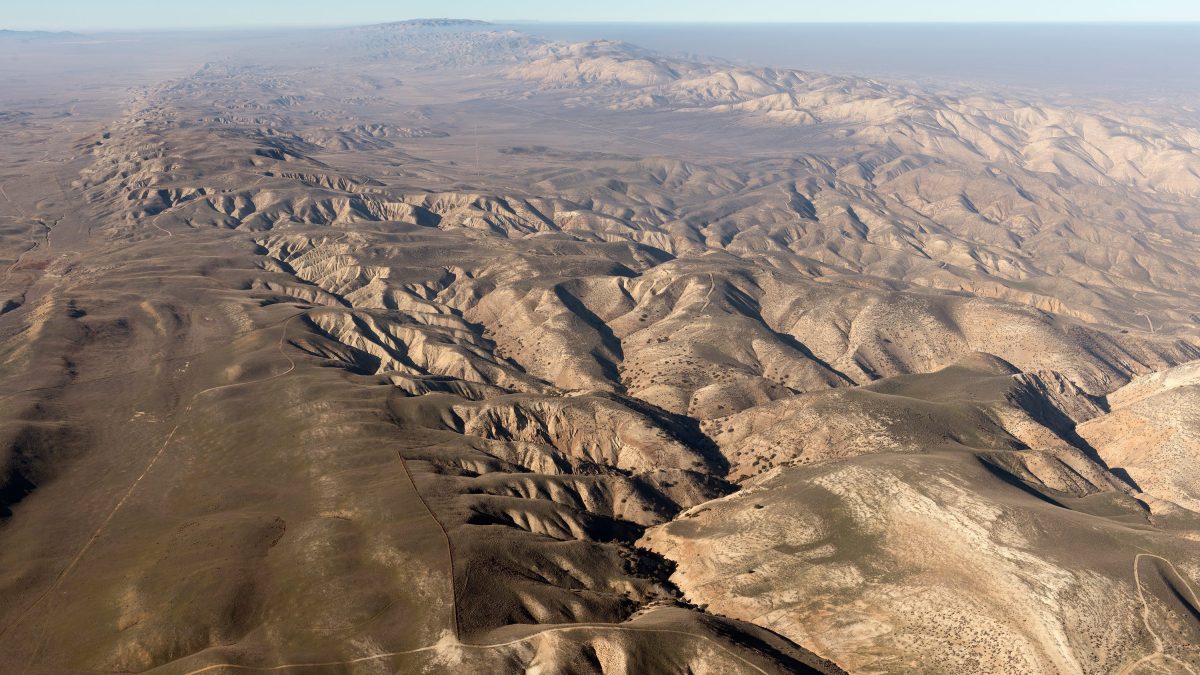
A new study from the University of Hawaii at Manoa has found that the San Andreas Fault and the San Jacinto Fault Zone are under stress levels not seen in a millennium, intensifying concerns about a major seismic event in Southern California.
Published in the Journal of Geophysical Research: Solid Earth, the research reveals that the fault system has entered what scientists describe as a “critically loaded state.” Lead author Liliane Burkhard said stress that is typically released in large earthquakes has instead been building for 160 years since the last major rupture along the San Andreas.

“Our results show that stress levels on multiple fault segments are now at or above the highest values seen in the past millennium,” Burkhard said. “The region may be capable of a large through-going rupture involving both fault systems.”
The Cajon Pass ‘Earthquake Gate’
The study highlights the Cajon Pass in Southern California as a potential “earthquake gate” that could either block or facilitate a simultaneous rupture of both faults. If both break together, the damage would be “significantly more damaging” and could devastate densely populated areas including Los Angeles, San Bernardino, Riverside, and the Coachella Valley.
“The conditions that determine whether the ‘earthquake gate’ at Cajon Pass opens or stays closed appear to be related to how closely the stress levels on the two fault systems are aligned with each other at the time of rupture,” Burkhard explained.
1,000 Years of History in a Computer Model
To reach these conclusions, researchers fed a millennium of earthquake history—reconstructed through radiocarbon dating of displaced sediments and tree-ring records—into a computer model. This allowed them to track stress accumulation over centuries.
The University of Hawaii said the findings can help refine earthquake threat assessments and improve disaster planning. However, Burkhard emphasized the study is not a prediction.
“This is not a prediction of when an earthquake will happen,” she said. “What we can say is that the system is critically stressed, and that physics-based models like this one give us a clearer picture of the range of scenarios we should be prepared for. That information matters for hazard assessments, infrastructure planning, and emergency preparedness.”
Preparedness Urged as Risk Mounts
California officials are urging residents to prepare for the next major earthquake. The state’s website, earthquake.ca.gov, offers tools and information. “If you live in or travel to areas that could be impacted by an earthquake, preparation is vital, as these events can strike suddenly, at any time, with little warning,” the site warns.
The study comes amid broader concerns about national resilience. A recent poll found that over a third of Americans doubt the U.S. will survive the next 250 years, reflecting deep unease about the country’s ability to handle major crises. Meanwhile, as the 250th anniversary of the nation’s founding approaches, questions linger about whether shared national pride can still unite a polarized public.