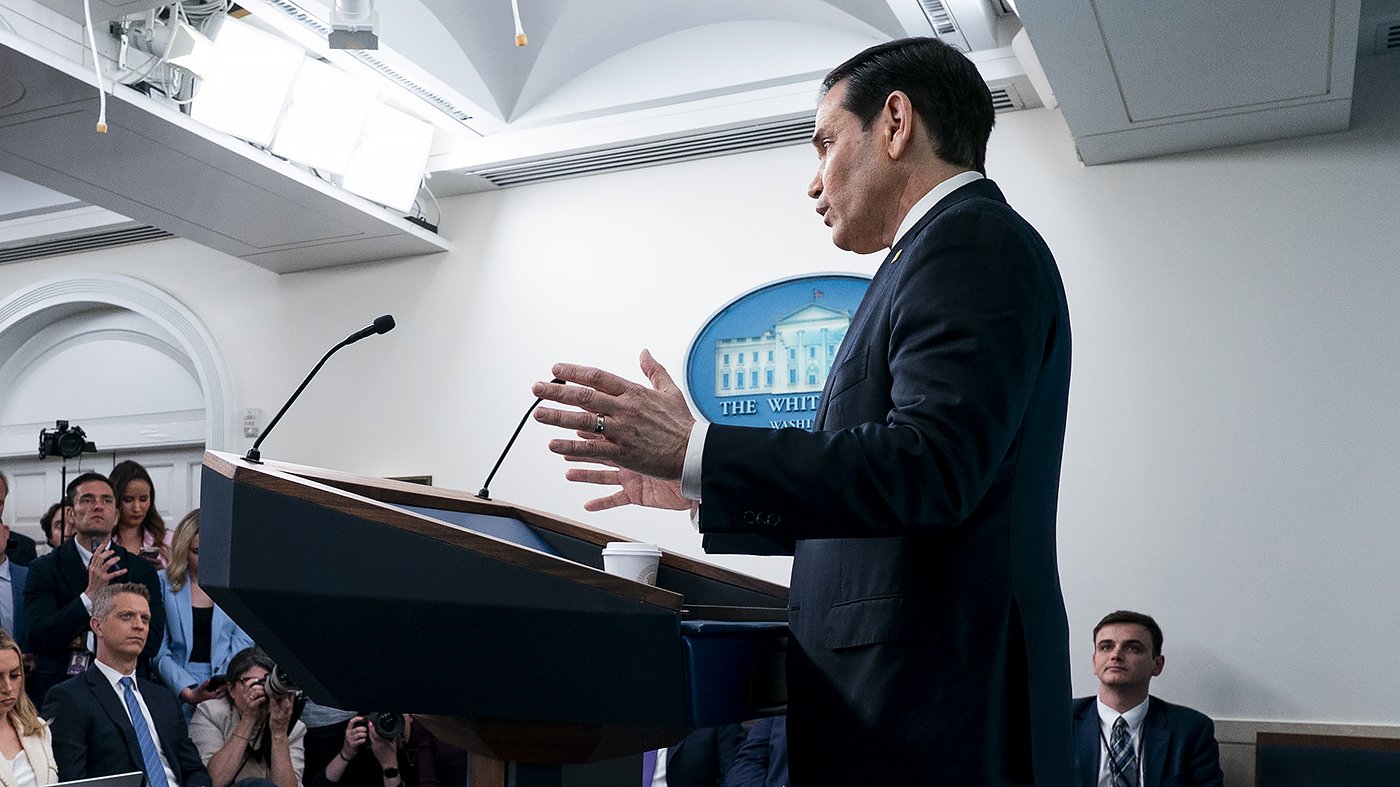
Secretary of State Marco Rubio told reporters Tuesday that the War Powers Act is “100 percent unconstitutional,” asserting that the Trump administration adheres to only certain parts of the law in order to maintain a working relationship with Capitol Hill.
“The War Powers Act is unconstitutional, 100 percent,” Rubio said during a White House briefing, adding that his view mirrors that of “every single president” since the measure was enacted in 1973. The law, formally known as the War Powers Resolution, requires the president to seek congressional approval for military engagements and to notify Congress within 48 hours of deploying troops in response to an imminent threat. It also mandates the withdrawal of forces after 60 to 90 days unless Congress declares war or authorizes the mission.
President Trump launched U.S.-Israeli operations against Iran on February 28 but did not formally notify Congress until March 2. As the conflict passed the 60-day mark last Friday, Trump told reporters the law was “totally unconstitutional” and noted that “it’s never been sought before.” The administration argued in a letter to Congress last week that the War Powers clock stopped when Trump declared a 14-day ceasefire with Iran on April 7, which he has since extended indefinitely.
Rubio stressed that even as the administration performs some acts of compliance, it does not “acknowledge the law as constitutional.” “Now we comply with it in terms of like, notification, because we want to preserve good relations with Congress, right? And we do that,” he said. He reiterated that the view that the law infringes on the president’s constitutional powers “has been the position of every single presidential administration since the day that law passed.”
The administration has faced bipartisan frustration over a lack of transparency regarding operations against Iran, the cost of the conflict, and damage to U.S. bases and assets in the Middle East. Senate Democrats have tried six times to pass a war powers resolution to halt military action without congressional approval, with the most recent vote failing 47-50 on Thursday. Republican Senators Susan Collins of Maine and Rand Paul of Kentucky crossed party lines to support the measure.
Rubio said he has briefed lawmakers repeatedly, including four visits to Capitol Hill this year to meet with the full Senate, the House, and the intelligence committees. “We want them to be involved in this,” he said, referencing the Gang of Eight and other key leaders.
The U.S. and Iran remain deadlocked over the Strait of Hormuz, a critical maritime chokepoint where Iran has attacked vessels trying to pass without coordination. Defense Secretary Pete Hegseth said Tuesday that recent tit-for-tat clashes between U.S. warships and Iranian speedboats did not violate the ceasefire. The U.S. has imposed its own blockade on Iranian oil tankers and commercial ships, and on Monday launched Project Freedom, an initiative to guide commercial vessels through the strait.
Rubio noted that the future of Iran’s nuclear program remains a key sticking point, but expressed hope it could be resolved through negotiations. His briefing debut also signaled potential ambitions beyond his current role. Meanwhile, the ongoing standoff has prompted Rubio to push a UN resolution aimed at reopening the Strait of Hormuz.