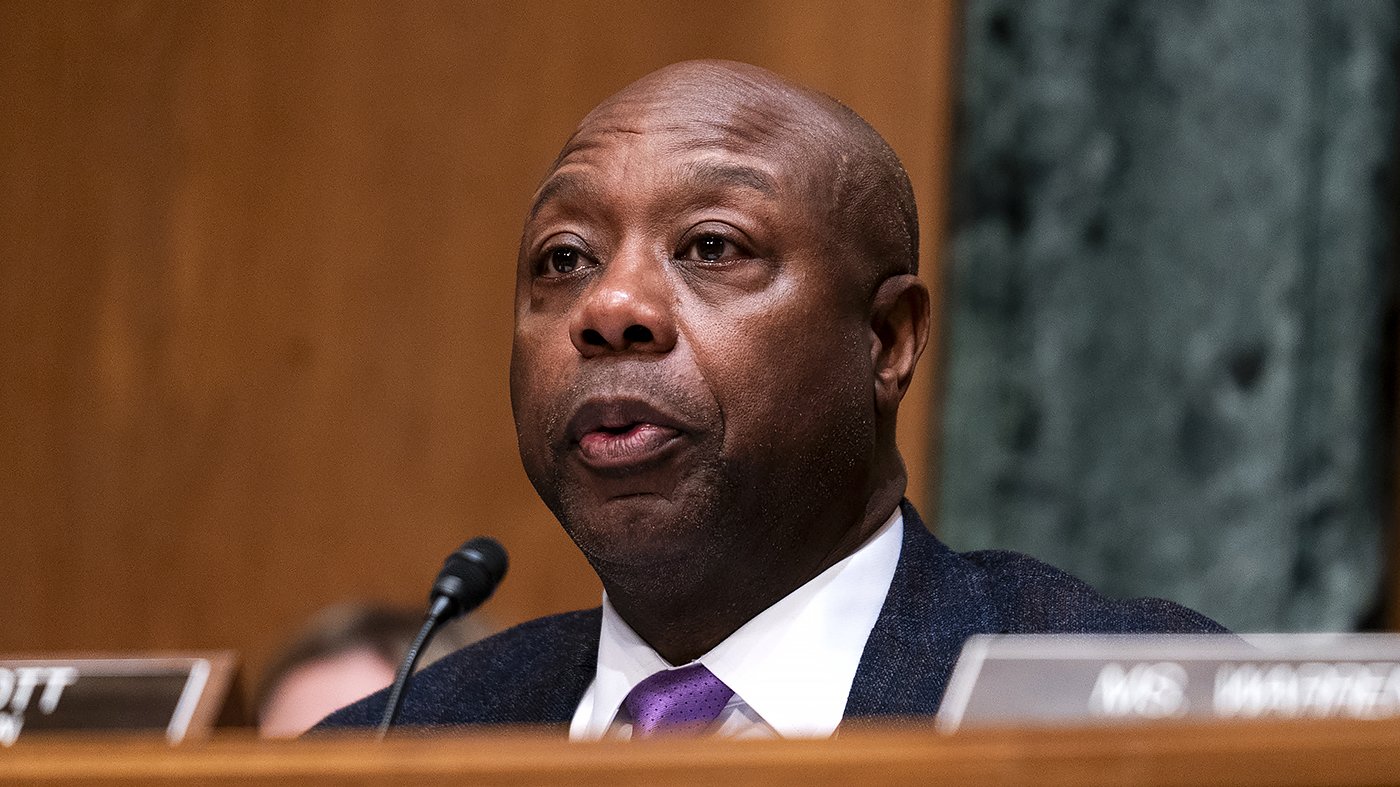
Sen. Tim Scott (R-S.C.) expressed confidence Tuesday that Republicans will retain their Senate majority after the 2026 midterms, but he offered a far less optimistic forecast for the House, warning that internal party dynamics and a tough electoral map could put the lower chamber at risk.
Speaking at the Milken Institute Global Conference in Beverly Hills, California, Scott, who chairs the Senate GOP's campaign arm, told Fox Business Network's Charles Gasparino, “Republicans will stay in the majority.” When pressed on the Senate specifically, he added, “In the Senate, for sure.”
The GOP currently holds a 53-47 edge in the upper chamber. Democrats would need to flip four of the 22 Republican-held seats up this year to take control, since Vice President J.D. Vance would break a 50-50 tie. The nonpartisan Cook Political Report rates only one of those races as leaning Democratic: the open seat in North Carolina, where retiring Sen. Thom Tillis (R) is stepping down.
Scott acknowledged that North Carolina “will be a challenge” but predicted that former Republican National Committee Chair Michael Whatley would defeat former Gov. Roy Cooper (D). A High Point University poll of 703 likely voters from March 26 to April 6 showed Cooper leading Whatley 50% to 42%, a gap outside the survey's 4.3-point margin of error.
In Maine, Sen. Susan Collins (R) is seeking a sixth term. She is expected to face Graham Platner, an oyster farmer and Marine Corps veteran who became the Democratic frontrunner after Gov. Janet Mills (D) dropped out last week. Scott predicted Collins would be “successful” in her reelection bid. He also noted that if Sens. Jon Husted (Ohio) and Dan Sullivan (Alaska) win, and the GOP nominee in Iowa—either Jim Carlin or Ashley Hinson—succeeds retiring Sen. Joni Ernst, then Senate Majority Leader John Thune (R-S.D.) would likely keep his post. “You do that, we’re in the majority,” Scott said.
When Gasparino turned to the House, Scott smiled and said, “Thankfully, I’m in the Senate.” He added, “I think the House is a different story. Challenging story, without any question.” Republicans hold a 217-212 advantage, with independent Rep. Kevin Kiley (Calif.) caucusing with the GOP. There are five vacancies—three held by Democrats and two by Republicans.
History is working against the majority party: in four of the last five midterm elections, control of the House flipped away from the incumbent president's party. The sole exception was 2014, when Republicans expanded their majority. Additionally, of the 16 seats rated as “Toss Ups” by Cook, 13 are held by Republicans. Scott acknowledged the headwinds, saying, “We’ll see what happens there. There’s a sliver of hope, but there’s a lot of firepower right now against [Republicans in] the House.”
Recent reports highlight the GOP's financial edge—the party has amassed a $78 million war chest to defend its House majority—but internal divisions remain a concern. Senate GOP leaders have warned that House infighting could undermine the party's chances. Meanwhile, Democrats are eyeing redistricting battles, with a Supreme Court ruling on Louisiana maps adding new chaos to the midterm landscape.
Scott's comments underscore the GOP's contrasting fortunes: a Senate map that appears favorable, and a House battlefield where the party is playing defense on multiple fronts.