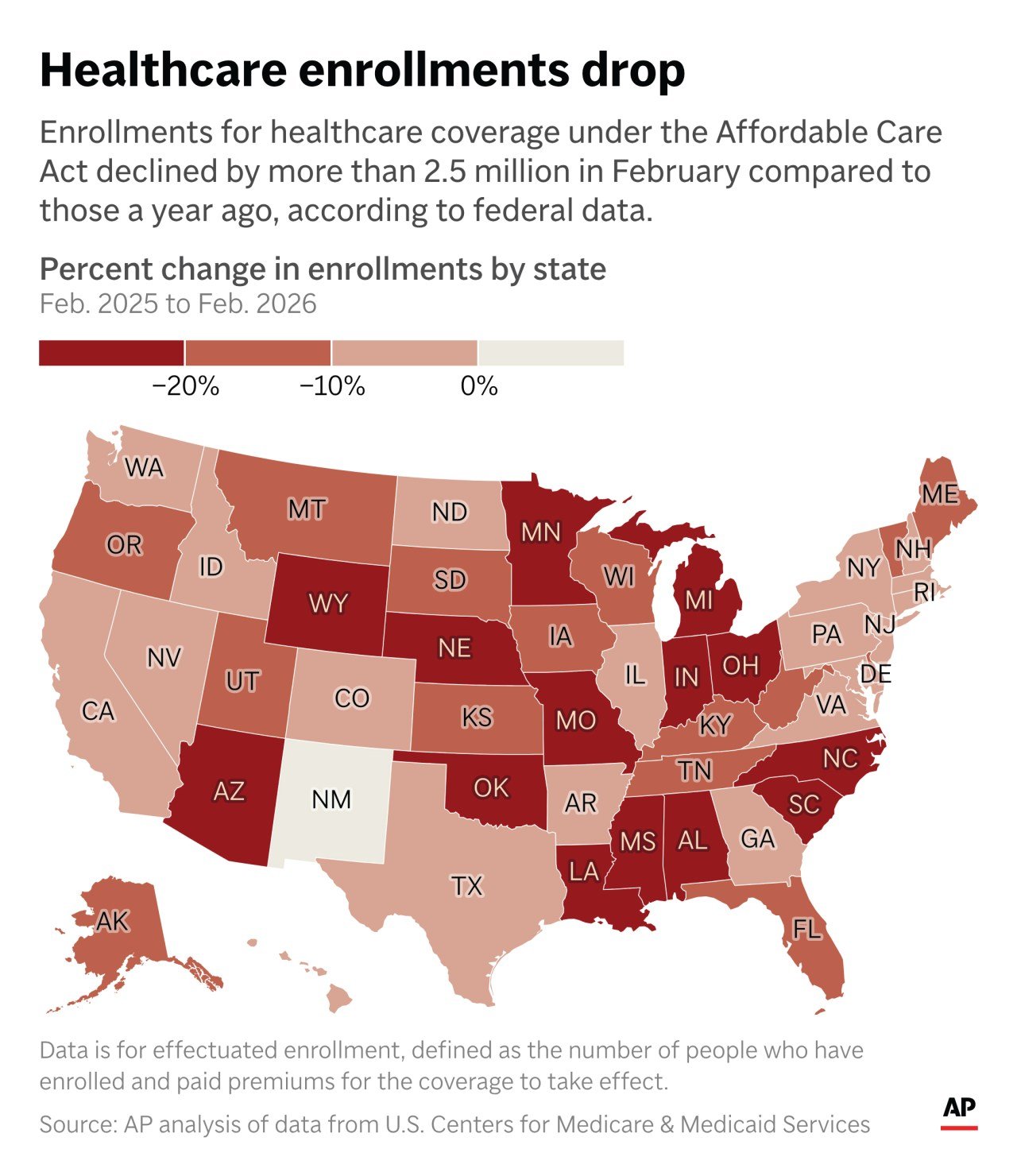
New federal data reveals that Obamacare enrollment fell sharply across the country over the past year, with Ohio and Oklahoma each losing nearly one-third of their covered populations. The data, released by the Trump administration in late June and first reported by the Associated Press, provides the first complete 50-state snapshot of the steep decline following the January expiration of enhanced premium tax credits.
Overall, roughly 2.6 million fewer Americans held Affordable Care Act plans in February compared to the same period last year, according to the dataset reviewed by KFF vice president Cynthia Cox. The numbers reflect not only plan selections but also those who paid their first premiums, accounting for retroactive removals after nonpayment grace periods ended. “This is the first time we’ve seen state-level data that shows how much ACA marketplace enrollment truly fell,” Cox said. “It’s in line with our expectations, but it does show a very steep drop.”

Affordability Crisis Hits Voters
Health insurance costs have become a top concern for voters heading into the November elections, as premiums for many Americans doubled or tripled after the enhanced subsidies expired. The fight over renewing those subsidies dominated Congress last fall, with Democrats and some Republicans pushing for extension, but ultimately failing.
The Health and Human Services Department suggested the drop could be tied to a federal crackdown on fraudulent or “phantom” enrollments. But analysts and state officials point to the subsidy expiration as the main driver. Mike Rhoads, deputy commissioner of life and health at the Oklahoma Insurance Department, acknowledged the fraud crackdown but said, “It’s all about affordability at this point in time.” He expects the problem to persist as insurers forecast further rate hikes next year.
Ohio and Oklahoma Lead the Decline
An Associated Press analysis found that Ohio and Oklahoma each experienced more than a 32% decline in ACA enrollment, the largest share losses of any state. Arizona, South Carolina, Minnesota, Indiana, Michigan, Mississippi, Louisiana, and Missouri each lost more than a quarter of their enrollees. Florida, which relies heavily on ACA plans due to its decision not to expand Medicaid and its large population of gig workers and entrepreneurs, still has nearly 4 million marketplace enrollees, but saw the highest raw number of drop-offs—around 443,000.
The data does not track where those who left ACA plans ended up; some may have found employer coverage, but Cox noted that the marketplace is often a “place of last resort” for those without other options, meaning most are likely now uninsured. Many of the states with the steepest declines were also those that saw the biggest enrollment gains after enhanced subsidies were introduced during the pandemic, underscoring the role of affordability in driving coverage.
New Mexico Bucks the Trend
Only one state saw an increase in ACA enrollment: New Mexico, which gained about 14% more enrollees. The state fully replaced the lost federal subsidies with its own funds, approved in a special legislative session last fall and extended through mid-2027. “In New Mexico, we believe health insurance should protect people against medical debt, not cause it,” said Tim Fowler of the New Mexico Health Care Authority.
The data also shows that states using the federal Healthcare.gov marketplace lost larger shares of enrollees than those running their own exchanges. Many state-based marketplaces took steps to offset costs for residents when the enhanced subsidies expired, while federal marketplace states did not. This disparity highlights how state-level policy choices can buffer residents from federal funding cuts, especially as the broader affordability crisis continues to shape the political landscape.