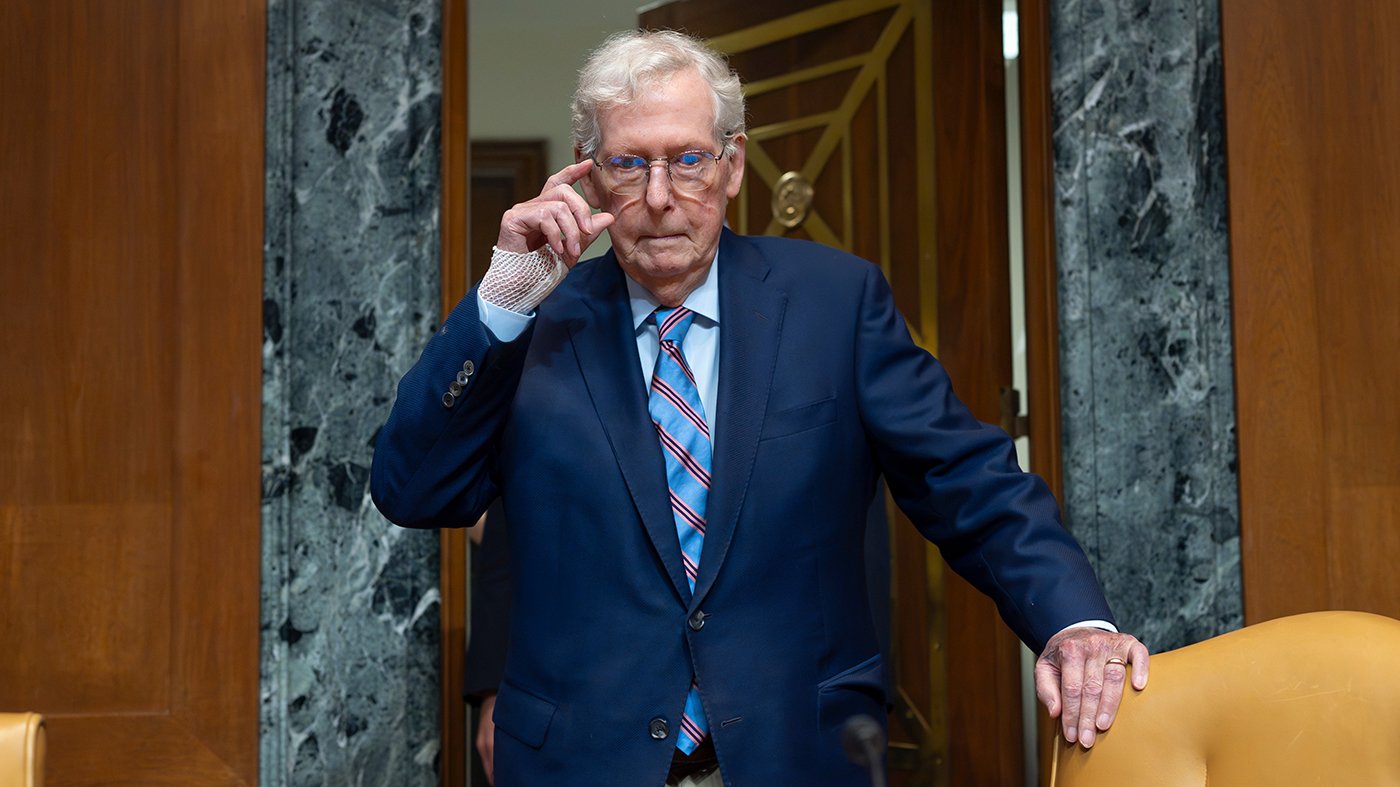
Emergency dispatch audio obtained by journalists indicates that someone at Sen. Mitch McConnell’s (R-Ky.) Washington, D.C., residence suffered a cardiac arrest earlier this month, sparking intense speculation about whether the former GOP leader will ever return to the Senate. McConnell’s office has offered only sparse updates, saying he “appreciates the outpouring of support” and “continues to improve,” but has not addressed the severity of the incident.
The 84-year-old senator was admitted to the hospital on June 14, with his team initially saying he was “receiving excellent care” without revealing the cause. Days later, a recording of an emergency dispatcher described a possible cardiac arrest at an address matching McConnell’s townhouse on Capitol Hill. The audio, first shared by digital journalist Desirée Townsend, has fueled rumors that McConnell’s condition is far graver than his staff has acknowledged.

Al Cross, Kentucky’s longest-tenured political observer who recently interviewed McConnell for a historical project, said the secrecy is backfiring. “They’re causing themselves problems by not saying more about it, but he’s always been very private about his health matters,” Cross said. He noted that McConnell appeared frail in recent months, often using a wheelchair or relying on aides for stability in the Senate hallways.
Conservative activist Laura Loomer, citing a “high level source close to the White House,” posted on X that McConnell is “not coming back” to the Senate. Townsend retweeted that claim, saying she had “heard the same thing from my sources for days.” However, Senate Majority Leader John Thune (R-S.D.) said he spoke with McConnell on June 15 and that he “sounded good,” adding, “He wants to be back.”
McConnell has not voted since June 11. His absence on June 23 proved critical when four GOP senators joined Democrats to approve a resolution requiring President Trump to withdraw U.S. troops from the military conflict with Iran. The measure passed because McConnell and Sen. David McCormick (R-Pa.) missed the vote. Thune faces an uphill battle passing key items like an emergency defense spending bill, which needs 60 votes, and a potential third budget reconciliation package. McConnell’s vote is essential, especially with swing votes from Sens. Susan Collins (R-Maine), Lisa Murkowski (R-Alaska), Thom Tillis (R-N.C.), and Bill Cassidy (R-La.) often defying Trump on key issues.
The health scare comes amid broader debates about transparency from public officials. Many Republicans accused former President Biden’s inner circle of hiding his cognitive decline after his disastrous June 2024 debate against Trump. More recently, Rep. Tom Kean Jr. (R-N.J.) faced scrutiny for a months-long absence that he later attributed to depression, sparking discussion on politicians’ health privacy.
Cross, however, remains cautiously optimistic. “I believe McConnell will return to the Senate,” he said, though he added that reliable information has been scarce. “This cardiac arrest thing appears to have been the supposition of a dispatcher, not somebody on the scene. My gut tells me he’s coming back.”
If McConnell does not return, Kentucky law would require a special election to fill his seat, with the next regular election in 2026. That prospect looms large as GOP leaders push for a defense spending boost and other priorities in a razor-thin majority.