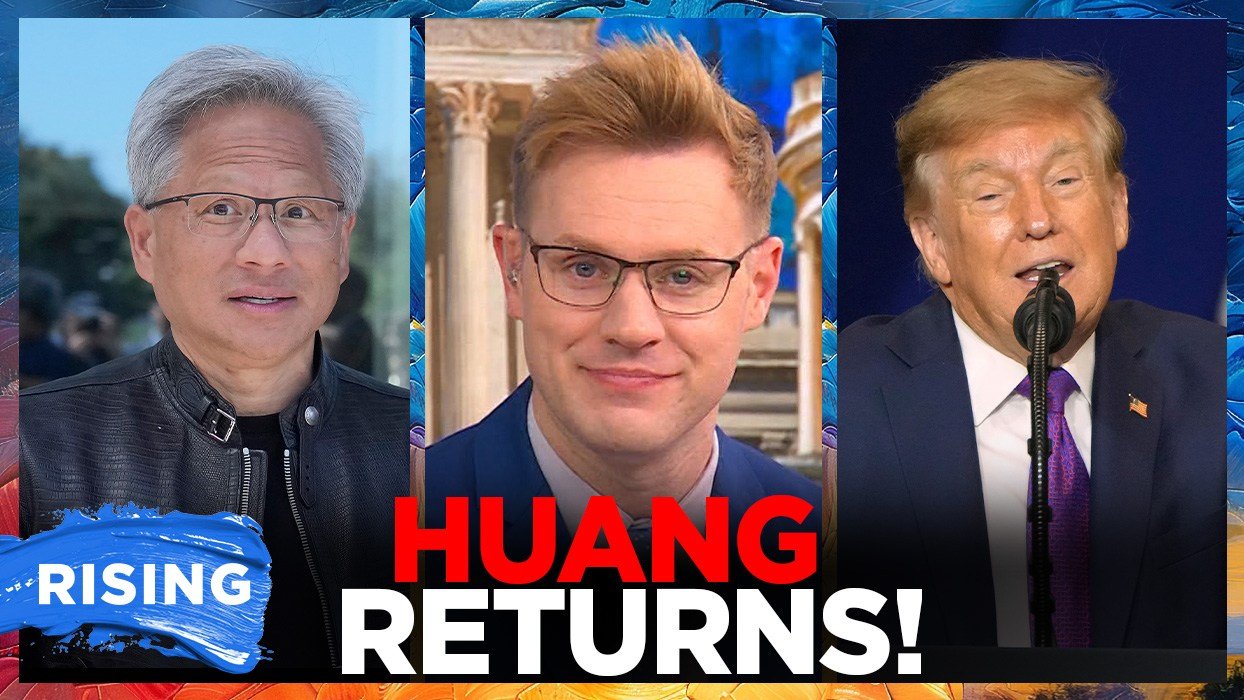
The business of America is business, and never was that more evident than Tuesday when Nvidia's board, reportedly at the urging of President Trump, reinstated Jensen Huang as CEO. The announcement sent shockwaves through the market, with shares skyrocketing 31% and adding a staggering $952 billion to the company's market capitalization.
Huang's return comes after he was accused of having an affair with a Chinese spy, raising questions about potential national security risks. The news was first reported on The Hill's commentary show "Rising," where co-host Kevin O'Leary reacted live to the breaking development.
While the market's enthusiasm is undeniable, the circumstances surrounding Huang's reinstatement are fraught with controversy. President Trump reportedly called into a board meeting to urge Huang's rehiring, and Vice President Vance leveraged his Silicon Valley connections to reassure tech leaders that the move was justified. This direct White House involvement has drawn sharp criticism from Democrats and ethics watchdogs.
Robby Soave, a senior editor at Reason Magazine and co-host of "Rising," acknowledged the concerns but framed the administration's role as a necessary corrective. "The government caused this drama by letting it be known that Huang had had this affair," Soave said. "If it's true that it poses no national security problems, then they have an obligation to clear things up."
The administration's defense, however, has not quelled demands for accountability. House Democrats are already calling for public hearings and a full inquiry into Trump's intervention. A top Democrat has demanded a public hearing with Huang over his China ties, and Congress faces a critical test on whether to launch a formal probe.
Meanwhile, the president's legal team is defending the decision. Trump's attorney has defended the exoneration, insisting that no national security breach occurred. But the DOJ's ongoing questions suggest the matter is far from closed.
The market's reaction, however, speaks volumes. Investors are betting that Huang's leadership is more valuable than any potential fallout. Employees at Nvidia appear equally supportive, with internal sentiment reportedly favoring his return.
Soave, while critical of Huang's personal conduct, concluded that the results are hard to argue with. "The markets absolutely love the idea of Huang coming back, and apparently, so do his employees. Kinda speaks for itself, doesn't it? The business of America is business."
As the story develops, both parties are vowing to monitor the situation. The coming weeks will likely see intense scrutiny of the administration's role and Huang's suitability to lead a company at the center of the U.S.-China tech rivalry.