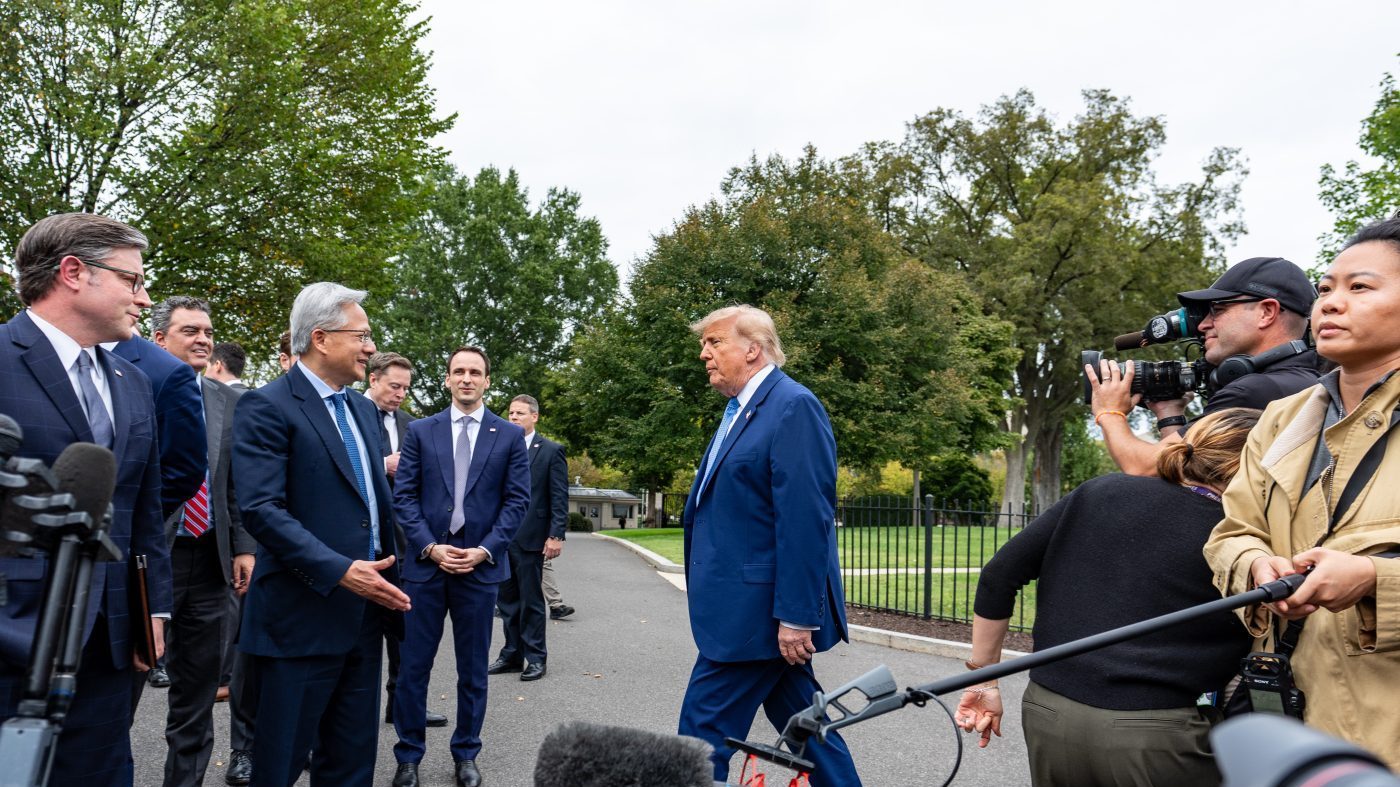
Nvidia CEO Jensen Huang has solidified his position as one of President Trump's most vocal supporters on artificial intelligence, a relationship that has flourished at a pivotal moment for the technology. As concerns about AI's societal impact intensify, Huang stands among a small group of tech executives who fully endorse the administration's go-fast approach, while others call for caution or a pause in development.
Their alliance, formed less than two years ago, has proven mutually advantageous. With the AI safety debate escalating, the partnership is now in plain view. Stephen Witt, author of The Thinking Machine, a history of Nvidia, told The Hill that Huang, an engineer by training, has applied a problem-solving mindset to his dealings with Trump. “He has brought an engineering approach to Donald Trump,” Witt said, adding that Huang recognized the president's “bottomless need for validation” and supplies it through praise and flattery. In return, Huang secures what he wants: minimal AI regulation and continued access to the Chinese market.
Nvidia, once a niche chipmaker, now holds the title of the world's most valuable company. Its graphics processing units (GPUs) are essential to AI development, placing the firm at the center of the industry's explosive growth. The company's fortunes are tied to the future of AI, which faces mounting scrutiny over its long-term effects on jobs, society, and the environment. Recent cybersecurity breaches and dire warnings from researchers have prompted some tech leaders, including Anthropic's Dario Amodei and OpenAI's Sam Altman, to urge a slowdown. However, Trump, backed by Huang, dismisses existential threats as a “hoax” and insists such warnings are unfounded.
Huang has echoed that sentiment, labeling catastrophic risk predictions as “made up” and “not grounded in science,” and calling probability estimates of societal collapse “irresponsible” and “ridiculous.” On Monday, he told reporters that AI development should be “accelerating” for safety reasons, comparing it to test-driving cars. “I think capability and safety are really hand in hand,” Huang said. “The two are not conflicts. Innovation and trust are not conflicts with each other… There's somehow this belief that you have to slow down in order to advance safety. That's not true, I think that's a false choice.”
Huang argues that existing laws, such as those covering cybersecurity liability, are sufficient, and no new regulations are needed. Sarah Kreps, director of the Tech Policy Institute at Cornell University, suggested that Huang's alignment with Trump may not be purely self-serving. “People like to attribute, I don't know whether it's nefariousness or financial motives to Jensen bowing to the Trump message,” she said. “But I think it can be the opposite, which is that Trump has found someone whose perspective on the issue is close and whose company is so important to both economic and national security that it makes sense to ally with him.”
Witt sees a more transactional dynamic. “Trump wants to be close to Jensen because … Jensen is really a big winner, like the biggest winner in capitalism right now,” he said. “And Jensen wants to be close to Trump because he sees a vector to make Nvidia's stock price go up if he has an ally in the president.” The bond was on display at the All-In Summit earlier this month, where Huang took a call from Trump on stage. Trump assured, “the robots are not going to be taking over the world,” to which Huang replied, “We're going to make sure that everybody wins in the AI race in America.”
The administration frequently cites the global “AI race” with China as a reason to maintain the current pace, arguing that slowing down would cede ground to Beijing. Kreps noted that while a slowdown would hurt Nvidia, Huang's stance may stem from genuine belief. “A slowdown in AI would very negatively impact Nvidia, but it might be that he's in that business because he's a believer,” she said. “Those two perspectives correlate closely for good reason.”
Nvidia is investing billions in data center buildouts, which are sometimes financed with debt, including subprime debt, according to Witt. “Jensen's incentives are very much not to give in,” he said, adding, “They can't really afford to slow down.” Meanwhile, Nvidia has expanded its Washington footprint during Trump's second term, with Huang meeting officials and lawmakers, and the company recently launched a corporate PAC funded by employees.
Witt, who interviewed Huang for his book, described the CEO as Trump's “most influential adviser” among tech executives. As the AI policy debate heats up, that influence is likely to grow, with Huang and Trump presenting a united front against calls for stricter oversight. For now, the administration's stance remains firmly pro-innovation, with Huang as a key ally in that push.