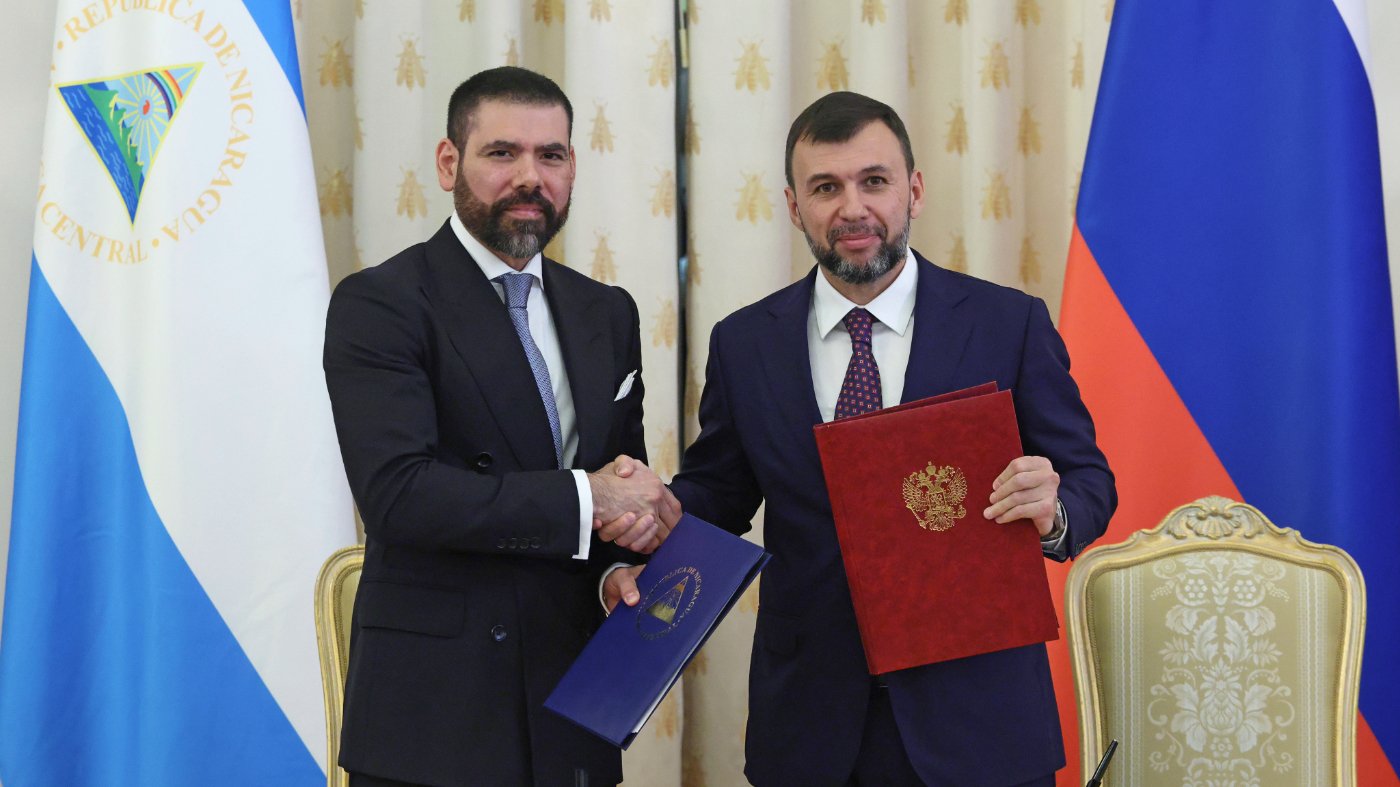
On May 2, Russian President Vladimir Putin signed a federal law ratifying a bilateral military cooperation agreement with Nicaragua, cementing a partnership that extends well beyond traditional diplomacy. The Ortega-Murillo regime, which frames these moves as routine, is systematically exchanging Nicaragua's sovereignty and economic stability for an authoritarian survival package backed by Beijing and Moscow.
Since reestablishing ties with China in 2021, the regime has promised prosperity, but the numbers tell a different story. According to the Central Bank of Nicaragua's 2025 annual report, China accounted for just 1.9 percent of net foreign direct investment—a mere $29.3 million. In contrast, traditional partners like Barbados, Panama, and the United States contributed $382.6 million, $263.6 million, and $196.1 million, respectively. Behind this modest investment lies a mounting debt trap.
Between 2023 and 2025, the regime secured 11 loans from Chinese companies totaling more than $1.4 billion, including an $85 million loan from China's Zhengzhou Coal Mining Machinery Group for the Nicaragua Digital Connectivity Project. This has financed $107 million in contracts to Chinese firms to build a Huawei-equipped 4G network. Framed as a critical upgrade, the project effectively grants control of the digital communications network to a foreign power.
The regime didn't wait for the infrastructure to be built before legislating control. In October 2024, the government passed the General Law on Convergent Telecommunications, obliging operators to grant the Nicaraguan Institute of Telecommunications and Postal Services access to their facilities and hand over user data. This is reinforced by the expansion of the Special Law on Cybercrimes, which now covers social media, mobile apps, and content posted from abroad. Penalties range from three to five years in prison for causing alarm or distress, and five to 10 years for inciting hatred or threatening sovereign security. To enforce these measures, Nicaragua sends 400 police officers to China and 500 to Russia annually for specialized cybercrime and intelligence training.
Repression extends beyond borders. According to a March 10 report by the United Nations Group of Human Rights Experts on Nicaragua, co-President Rosario Murillo plays a key role in a transnational repression network that monitors and harasses exiled Nicaraguans, involving the military, police, migration authorities, and the telecom institute.
This partnership has also enabled extensive mining concessions. In March, a Fundación del Río report revealed that since 2021, Nicaragua has handed over 8.5 percent of its national territory—more than 2.4 million acres—to Chinese mining companies. Thomas Metal S.A., a Hong Kong-based firm, has emerged as the leading beneficiary, acquiring over 564,000 acres. These deals were enabled through five legislative amendments, including 2022 mining law reforms and the 2025 Border Territory Act, which allowed the government to bypass U.S. sanctions against state-owned mining company Empresa Nicaragüense de Minas and extended the interior border area from 5 to 15 kilometers. Residents of the 19 de Julio neighborhood in Rosita were evicted to clear land for the Santa Rita Mining Company, as documented by Divergentes.
While China focuses on digital infrastructure and financing, Russia operates a parallel surveillance network. According to Confidencial, a key hub at the Cerro Mokorón military complex, staffed by Russian military personnel, uses specialized antennas with surveillance software capable of monitoring foreign embassies and detecting dissent. Russian surveillance equipment has been installed in military bases across the country since 2017.
In April, the U.S. Treasury's Office of Foreign Assets Control sanctioned seven companies operating in Nicaragua's gold sector, including Thomas Metal S.A., Brother Metal S.A., Zhong Fu Development S.A., and Santa Rita Mining S.A., for alleged involvement in confiscating U.S. assets. By sanctioning these companies, Washington aims to disrupt the cash flow that sustains the regime. Yet sanctions alone have proven insufficient—the regime has simply granted fresh mining concessions to replace sanctioned companies. These measures must now be combined with aggressive enforcement to prevent rebranding or proxy replacements.
This survival strategy has come at a high cost to the Nicaraguan people. By trading its territory, digital privacy, and economic security, the Ortega-Murillo regime has compromised the country's future while allowing China and Russia to establish a significant foothold in the region. The U.S. should act decisively before other authoritarian states replicate this model.
As the regime deepens its ties, the economic and political fallout mirrors patterns seen elsewhere. The Trump administration's focus on domestic issues, such as narrative wars over Iran and economic pain, may distract from the growing authoritarian alliance in Central America. Meanwhile, the U.S. faces broader challenges, including economic risks from deportation drives that could further destabilize the region.