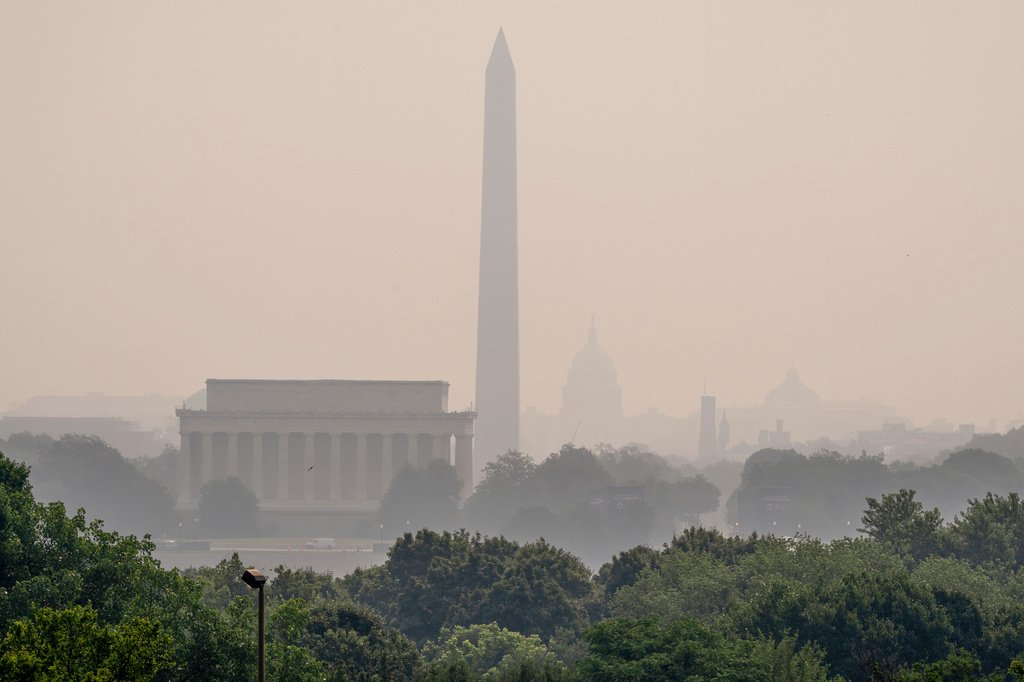
Millions of Americans from Minnesota to Washington, D.C., are enduring hazardous air quality as smoke from Canadian wildfires settles over a vast stretch of the country. Health officials have urged residents to remain indoors as much as possible until conditions improve.
According to Nexstar meteorologist Blake Matthews, the thick smoke is expected to persist for another 24 to 48 hours across much of the affected region. Relief may come this weekend as a storm system moves in, bringing rain and thunderstorms that could help clear the air. However, the reprieve might be short-lived.
Friday's Smoke Forecast
Dense smoke is forecast to hang over a broad corridor Friday afternoon and evening, stretching from Minnesota through Wisconsin, Michigan, and Illinois, then eastward across Pennsylvania and into Virginia and the nation's capital. The worst of it Friday night is expected near the Ohio-Pennsylvania border and parts of Virginia, West Virginia, and Maryland, Matthews said.
Saturday's Outlook: Storms Bring Hope
A trough of low pressure is expected to sweep into the region Saturday, bringing showers and thunderstorms that could push the smoke northward. Matthews noted that Saturday morning will still see smoke lingering over Buffalo, central Pennsylvania, and as far south as Washington, D.C., as well as New York City, Connecticut, and Providence. By Saturday afternoon, the smoke is expected to shift toward Boston and eventually into Maine. Air quality should improve significantly for most of the country by Saturday night, with the worst conditions concentrated near the U.S.-Canada border, closest to the active fires.
This disruption has already forced cancellations and postponements of outdoor events, including a Chicago MLS match and a Mets-Phillies game, as air quality concerns mounted.
Sunday and Beyond: Uncertainty Lingers
If Saturday's rain successfully clears the smoke, Sunday could bring clearer skies. But National Weather Service meteorologist Jake Petr warned that winds from the northwest might not offer lasting relief. “Even if winds from the northwest clear the skies, the smoky air could keep returning until the fires are out,” he said. Officials have indicated that could take months, possibly until snow arrives in Canada and northern Minnesota.
The lingering smoke also raises questions about the FIFA World Cup final scheduled for Sunday afternoon at MetLife Stadium in New Jersey, where roughly 80,000 fans are expected. Mark Parrington, senior scientist at the Copernicus Atmosphere Monitoring Service, cautioned that if fire intensity picks up again Saturday, more smoke could be injected into the atmosphere, potentially following the rain event and affecting the region. He advised minimizing outdoor activity and exercise when pollutant levels are high.
The ongoing crisis has sparked political reactions, with President Trump threatening new tariffs on Canada over what he called “willful negligence” in managing the fires. Meanwhile, Senator Moreno is pushing sanctions against Canada over the smoke crisis, adding a layer of diplomatic tension to the environmental disaster.
For now, millions remain under air quality alerts, with officials urging residents to keep windows closed, use air purifiers, and limit time outdoors. The best practices for maintaining indoor air quality have become a critical public health message as the smoke continues to drift across the country.