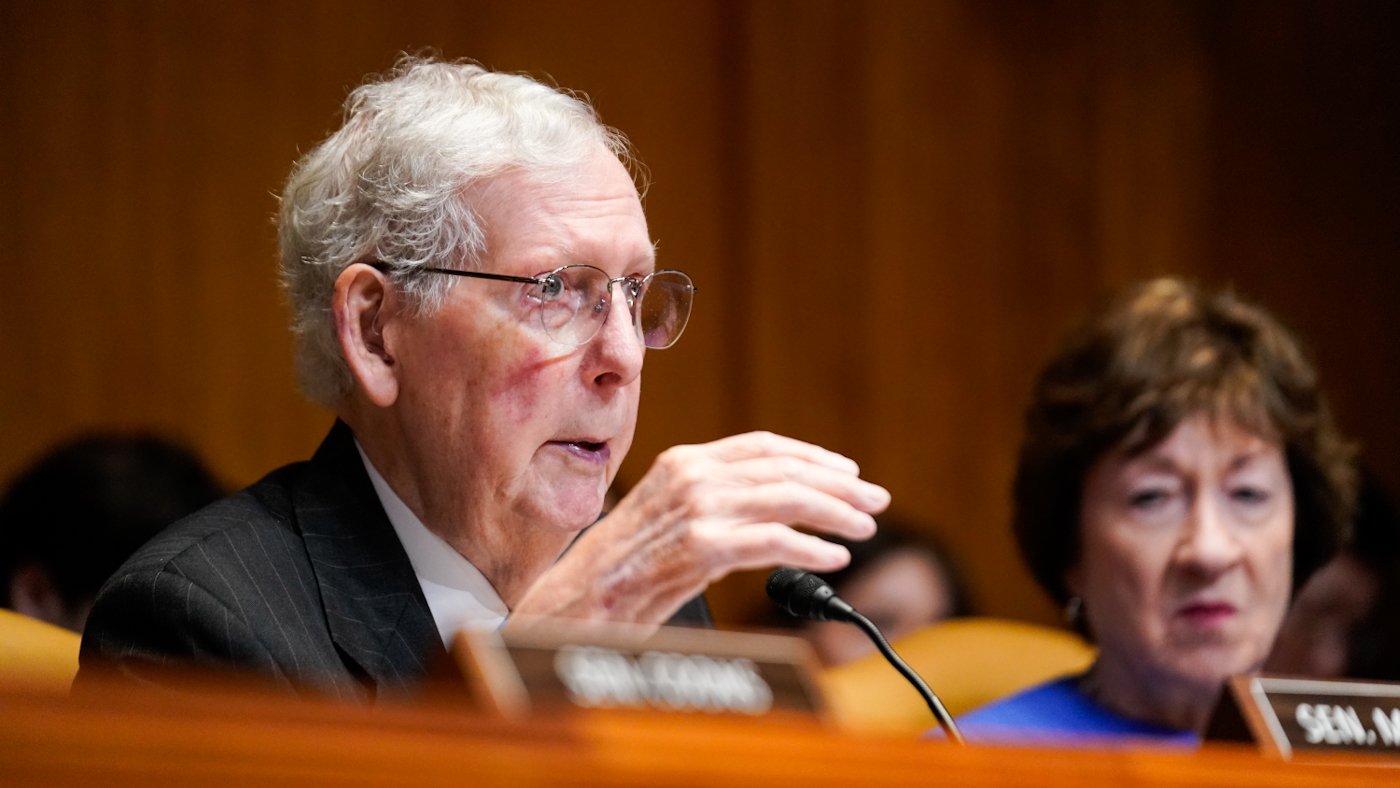
Senate Appropriations defense subcommittee Chair Mitch McConnell (R-Ky.) took aim at Defense Secretary Pete Hegseth on Tuesday, questioning the Trump administration's shaky funding strategy for the Pentagon's $1.5 trillion budget request and its impact on U.S. alliances during multiple global crises.
McConnell objected to the administration's decision to fund critical programs—including the Golden Dome missile defense system, munitions, F-35 fighter jets, and drone production—through a reconciliation bill separate from the annual defense appropriations measure. He argued this approach is too risky given the GOP's narrow majority in the Senate.
“Political realities will not always allow a party-line budget reconciliation, and if the department’s top priorities aren’t built into annual appropriations, we’re actually taking a big risk,” McConnell said during the hearing. “These key lines of effort only work if we put them on solid fiscal footing.”
The Trump administration plans to allocate $1.1 trillion through a traditional appropriations request for fiscal year 2027, with an additional $350 billion via reconciliation—a process that lets the Republican majority bypass Democratic opposition. But McConnell warned that the GOP could lose its majority in the November elections, making this strategy precarious.
Other Republicans have echoed these concerns, noting the difficulty of passing a third budget reconciliation bill this fall after using the second on a narrow immigration enforcement measure. House appropriators also pressed Hegseth on the defense budget structure earlier Tuesday during his lengthy testimony.
McConnell didn't stop at budget issues. He also criticized President Trump for alienating traditional U.S. allies, particularly through recent actions like pulling 5,000 troops from Germany and threatening further measures amid a dispute with German Chancellor Friedrich Merz. Trump has repeatedly attacked allies for not joining the war in Iran or helping reopen the Strait of Hormuz, labeling them “cowards” and hinting at a U.S. withdrawal from NATO.
“Strained relationships with our partners and allies only serves our adversaries’ interests and limits our capacity and deterrent power globally,” McConnell told Hegseth. He demanded clarity on the future of capacity building with committed allies and partners.
The Kentucky senator also pressed for the swift delivery of $400 million in lethal aid to Ukraine that Congress approved earlier this year, accusing the Pentagon of withholding the funds. In a recent Washington Post editorial, McConnell called the delay unacceptable.
“I want to underscore this is not charity. When our partners are capable, deterrence is stronger and the risk to our own service members is lower,” McConnell said. “Wars in Ukraine and the Middle East clearly show we have things to learn from our friends.”
For more on the broader defense budget debate, see House GOP leaders press Hegseth on the $1.5 trillion Pentagon budget and Iran war costs. On alliance tensions, Hegseth testifies as Trump's Germany troop pull fails to sway Europe on Iran war.