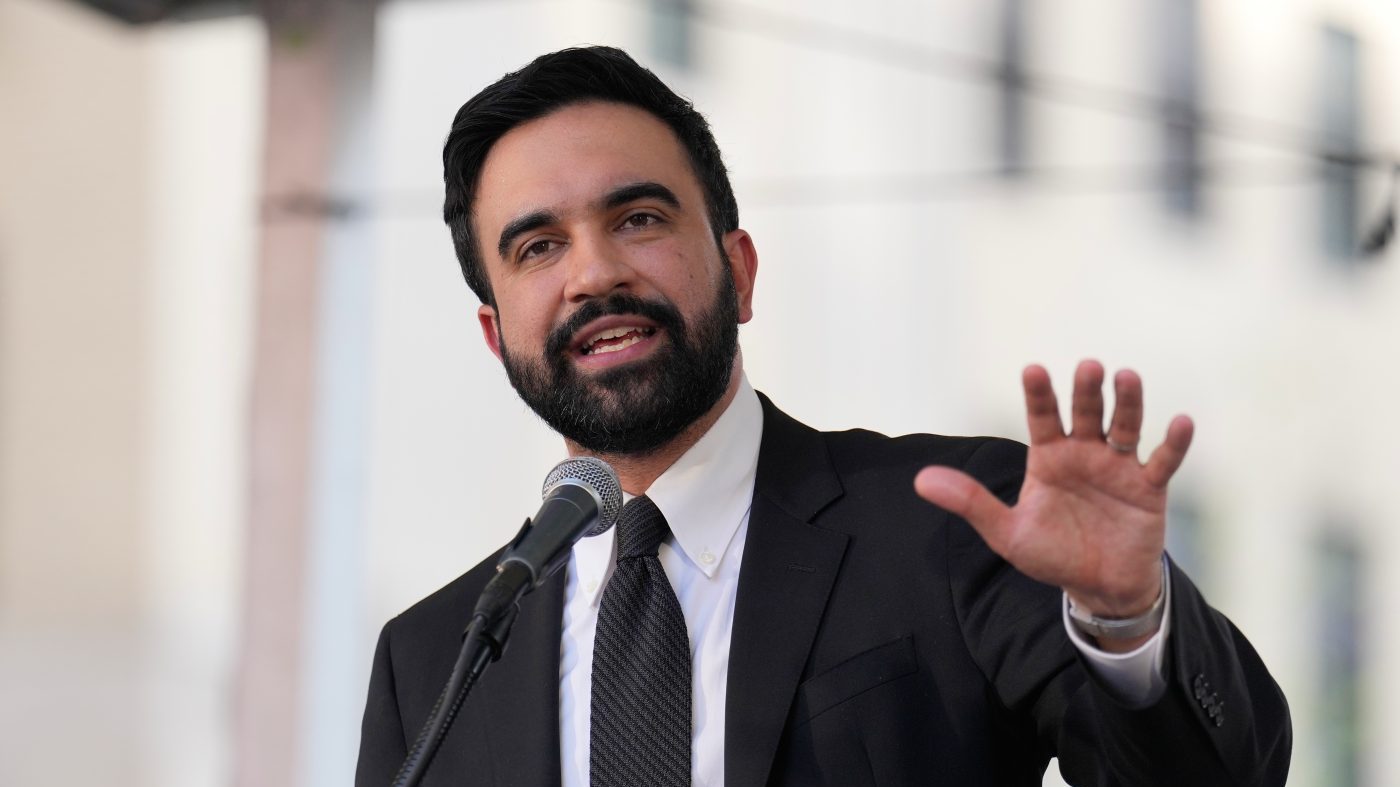
New York City Mayor Zohran Mamdani (D) contends that democratic socialists running under the Democratic banner are not steering the party leftward but rather restoring its historical identity. In a pre-taped interview on SiriusXM's "Urban View" airing Friday, Mamdani told host Clay Cane that the current wave of progressive candidates is reviving the party's New Deal-era focus on working families.
When asked about potential 2028 presidential contenders, both Mamdani and Cane quickly ruled out the mayor himself, noting his birth in Uganda. Mamdani instead pointed to a broader movement, emphasizing that affordability must be more than campaign rhetoric. "What I'm hopeful of is we're seeing a lot of examples of what it can look like to have that focus on the working person," he said. "People who understand that affordability isn't just something you say, it's something you have to deliver."
Mamdani framed this push as a return to the party's foundational principles, invoking Franklin D. Roosevelt and New York's own Fiorello La Guardia. "We're not running away from the Democratic Party; we're going back to what the party used to be," he said. "You think about FDR and La Guardia, you think about the New Deal; that's what the Democratic Party once was. That's what it could be again. And if we want to win, I think that's what we have to become."
Roosevelt and La Guardia championed sweeping reforms during the Great Depression, including affordable healthcare, housing, and poverty relief—policies Mamdani has pledged to pursue in New York. His comments come as democratic socialists have notched a series of primary victories, intensifying debates over the party's direction on issues like Israel and corporate donations.
The recent successes, including progressive Abdul El-Sayed's Michigan win, have exposed deep fractures. Veteran strategist James Carville, a key architect of Bill Clinton's 1992 campaign, has been sharply critical, telling CNN last week that the left is "too hotheaded to know that they're not popular."
Progressives, however, are pushing back. Sen. Bernie Sanders (I-Vt.), a frequent target of Carville's barbs, dismissed the critique last week, saying there wasn't "much of a choice" in Carville's commentary. "If Mr. Carville doesn't want to be in my party, the party I belong to, that Piker, that El-Sayed belongs to, he can start his own party," Sanders said, referencing Michigan Senate candidate Abdul El-Sayed and left-wing streamer Hasan Piker.
Piker's online influence has become a flashpoint, with his reach stirring infighting as Gen Z turns to digital platforms for political engagement. Meanwhile, the GOP has sought to capitalize on the discord, with some analysts arguing the surge hands Republicans a political windfall.
Mamdani's remarks underscore a growing conviction among democratic socialists that their agenda is not an outlier but the party's true inheritance. As the 2028 cycle approaches, the battle over that identity is likely to shape primaries and the general election strategy alike.