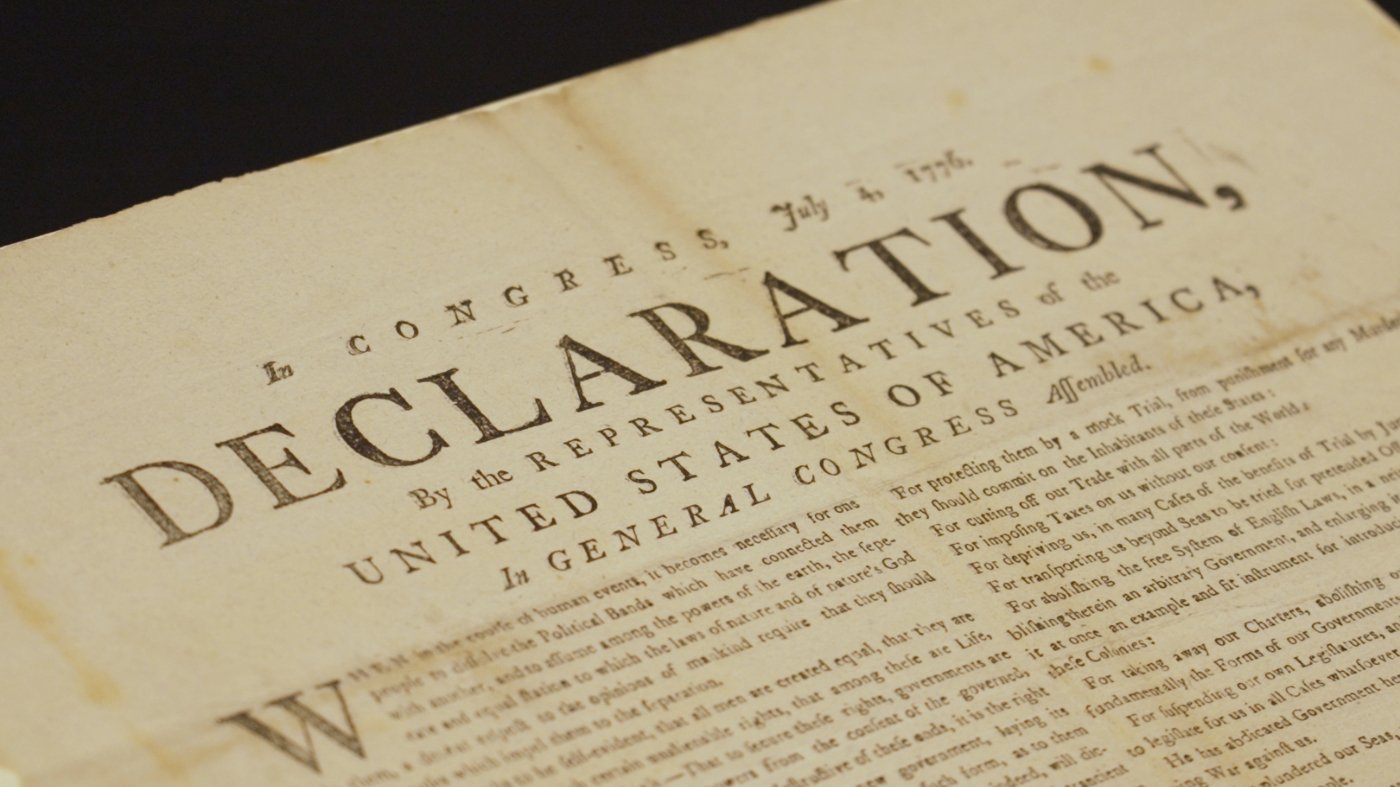
Twelve years ago, during a private tour of the British National Archives as part of a policy fellowship with the House of Lords, a docent handed me an original July 4, 1776, copy of the Declaration of Independence. She coolly asked if I wanted to hold a piece of my country's history. What she didn't mention—and what most Americans don't realize—is that the United Kingdom quietly houses four original copies of our founding document, three of which were taken from the U.S. without consent.
I was shocked when she passed the document to me without gloves. That moment stuck with me, and it underscores a larger issue: these documents are not merely artifacts; they are symbols of American sovereignty and self-determination. Yet the U.S. government has never made a formal claim for their return.
Four Copies, Three Taken
The U.K. government possesses four 1776 copies of the Declaration of Independence. Three are known as Dunlap Broadsides Copies, and the fourth is the Exeter Print, whose discovery came to light only last month. On Dec. 24, 1776, the Royal Navy intercepted the Exeter Print tucked inside a bundle of letters and ship logs from the American privateer ship Dalton.
The Dunlap Broadsides copy I held was the only one to reach London through official British colonial networks, likely arriving in the second week of August 1776. Upon arrival, Lord Germain relayed the news directly to King George III. Meanwhile, one copy was intercepted, and one was seized by military action. To the British government, the declaration was a long “Dear John” letter. To me, these copies were a missing piece of American history.
A 250-Year-Old Oversight
Two hundred-fifty years after the American people declared independence from the British—and put their lives on the line to defend freedom and taxation with representation—don't these documents deserve to come home? Since America's founding, the U.S. government has made no public announcement or legal or diplomatic claim to seek their return. That silence is striking, especially as the nation recently marked its 250th anniversary of independence.
Given that milestone, it behooves federal leaders and the U.S. State Department to formally request the return of the missing copies. This is not just about historical sentiment; it's about reclaiming artifacts that are part of the American story. The U.K. currently displays one of the Dunlap Broadsides copies in an exhibit titled “The Path to American Independence” and plans to display the Exeter Print in the near future. Meanwhile, one Dunlap Broadsides copy is on temporary loan to the U.S. for an exhibit at the Philadelphia Museum of the American Revolution. That particular copy was intercepted from Jonas Phillips and was attached with a letter written in Yiddish.
The case for repatriation is strong. These documents were taken without consent, and their presence in London is a relic of colonial-era seizures. The U.S. has a clear moral and legal basis to ask for their return, much like other nations have successfully repatriated cultural artifacts. As international disputes over sovereignty and heritage continue to shape global politics, the Declaration copies stand as a tangible reminder of America's founding principles.
Some might argue that the documents are safer in the U.K. or that they are part of a shared history. But the fact remains: these are American founding documents, and their unauthorized removal is a historical wrong that should be corrected. The U.S. government should act now, not just for the sake of history, but to reaffirm its commitment to the values those documents enshrine. As public sentiment increasingly favors accountability and transparency, the return of these documents could serve as a unifying moment for the nation.
It's time for the State Department to take up the cause. The documents belong in American hands, available for all citizens to see and appreciate. The U.K. has been a good custodian, but the rightful home is the United States. Let's hope our leaders heed the call and bring these pieces of our heritage back where they belong.