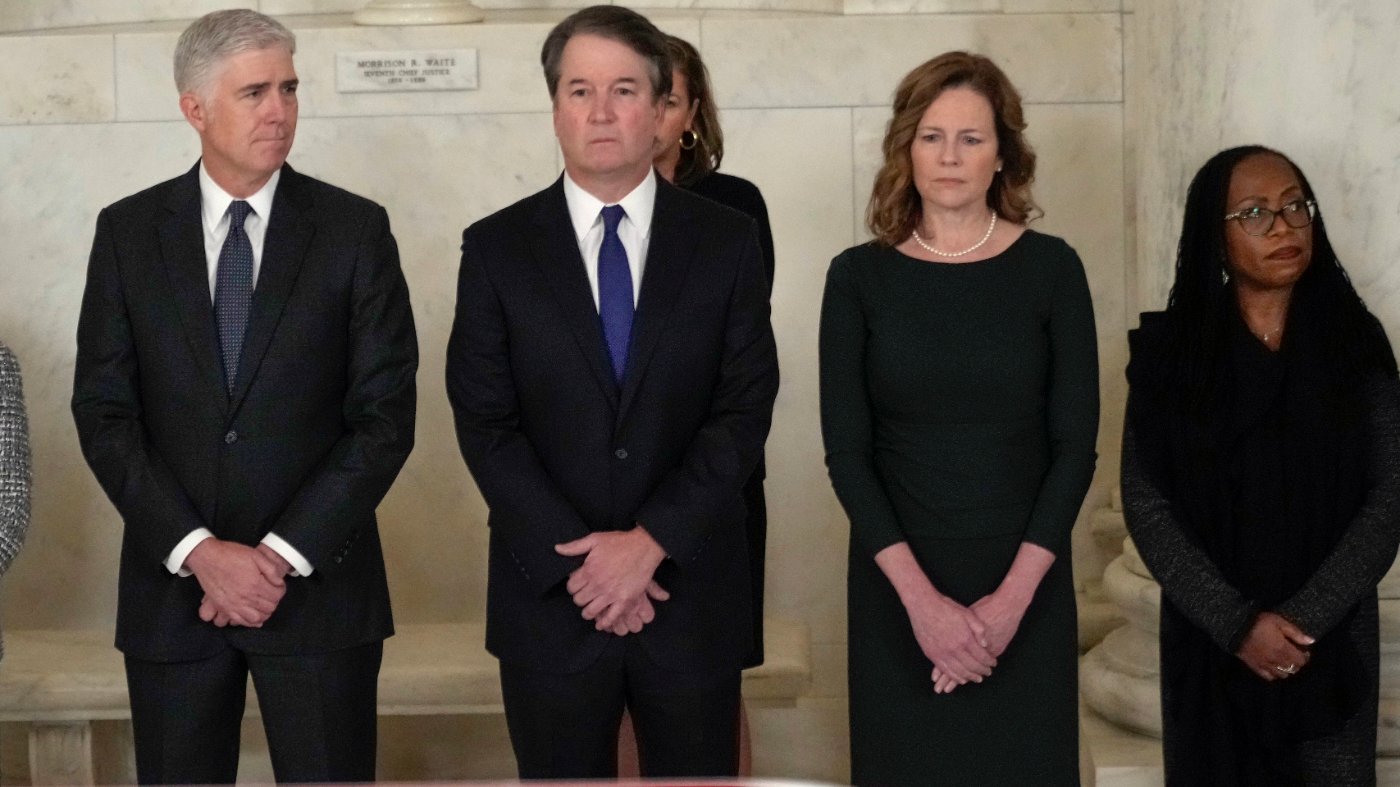
Justice Ketanji Brown Jackson delivered a pointed warning to her Supreme Court colleagues, urging them to avoid the appearance of political motivation. Speaking at the American Law Institute in Washington, Jackson emphasized that courts are “not supposed to be issuing rulings that are in the political realm.”
While her remarks echoed Chief Justice John Roberts’ frequent insistence that the court does not make “policy decisions,” the subtext was unmistakable. Jackson was not simply repeating a mantra; she was signaling that the conservative super-majority may have already strayed into partisan territory, whether intentionally or not.
The flashpoint came last month in Louisiana v. Callais, where six Republican-appointed justices effectively nullified a key provision of the 1965 Voting Rights Act by allowing states to eliminate majority-Black congressional districts. But Jackson’s concern went further: the majority waived the standard 32-day certification period, putting the ruling into effect almost immediately. That move, she argued, had inevitable political and partisan consequences, prompting Southern states to hastily dismantle as many as 15 majority-Black districts, many of which will be replaced by Republican-leaning, white-majority seats.
Justice Amy Coney Barrett, speaking at the George W. Bush Presidential Center in Dallas, tried to distance the court from such accusations, insisting the justices are not “politicians in robes.” She suggested that listening to oral arguments would dispel that misimpression. But Jackson clearly has her doubts. In what amounted to an admonition, she warned her colleagues to be “really, really careful in this environment when we’re dealing with issues that have a political overlay,” adding that they must “be scrupulous about sticking to the principles and the rules.”
Jackson has previously made similar points in dissenting opinions. In Callais, she noted the “strong political undercurrent” and rebuked the majority for creating at least “an appearance of partiality.” By rushing the decision into effect, she wrote, the court seemed “to endorse Louisiana’s efforts to change its congressional map” by hurriedly eliminating a minority-Black district. Justice Samuel Alito, characteristically prickly, called Jackson’s opinion “baseless and insulting.” But Jackson may have been blunt without being inaccurate.
Within days of the Supreme Court’s expedited order, Louisiana Governor Jeff Landry suspended the scheduled primary election for U.S. representatives—with early voting already underway—so the legislature could redraw the map in favor of Republicans by removing a majority-minority district. Other Southern states quickly followed. Tennessee broke up its Memphis-based majority-Black district, dividing its voters among three surrounding white-majority districts. Florida has already drawn its new map, and South Carolina, Alabama, and Mississippi are working on similar changes for this year’s elections.
The sweeping elimination of minority voting power is not an unintended consequence of dispassionate legal reasoning. It is the culmination of more than a decade of steady erosion of the Voting Rights Act, leaving it nearly unenforceable. Intellectual contortions were required to get there. In the 2019 Rucho v. Common Cause decision, the conservative majority upheld politically gerrymandered districts, contritely calling partisan apportionment “nonjusticiable.” Chief Justice Roberts acknowledged that “excessive partisanship in districting leads to results that reasonably seem unjust.”
But in this year’s Callais opinion, written by Alito and joined by the other five conservatives, partisan gerrymandering was elevated to a “legitimate” state interest. As Justice Elena Kagan noted in dissent, it became a “cudgel to diminish the rightful voting influence” of minority citizens. Roberts had earlier reassured that objections to partisan gerrymanders would not “echo into a void” because Congress could act. Congress had already acted—passing and reauthorizing the Voting Rights Act five times, most recently in 2006—prohibiting the dilution of minority voting strength. Alito’s opinion inverted that relationship, holding that enforcing the Voting Rights Act would be dressing political gerrymanders in racial garb, thus sidestepping non-justiciability. The pattern is clear: what was once a problem out of reach has become a principle that outweighs minority voting rights—always to the benefit of Republicans.
For deeper context on the fallout, see our coverage of the Supreme Court redistricting ruling and accusations of racial bias. Meanwhile, the political landscape continues to shift, as illustrated by Letlow’s primary win and the GOP’s hostility to bipartisan dealmaking.