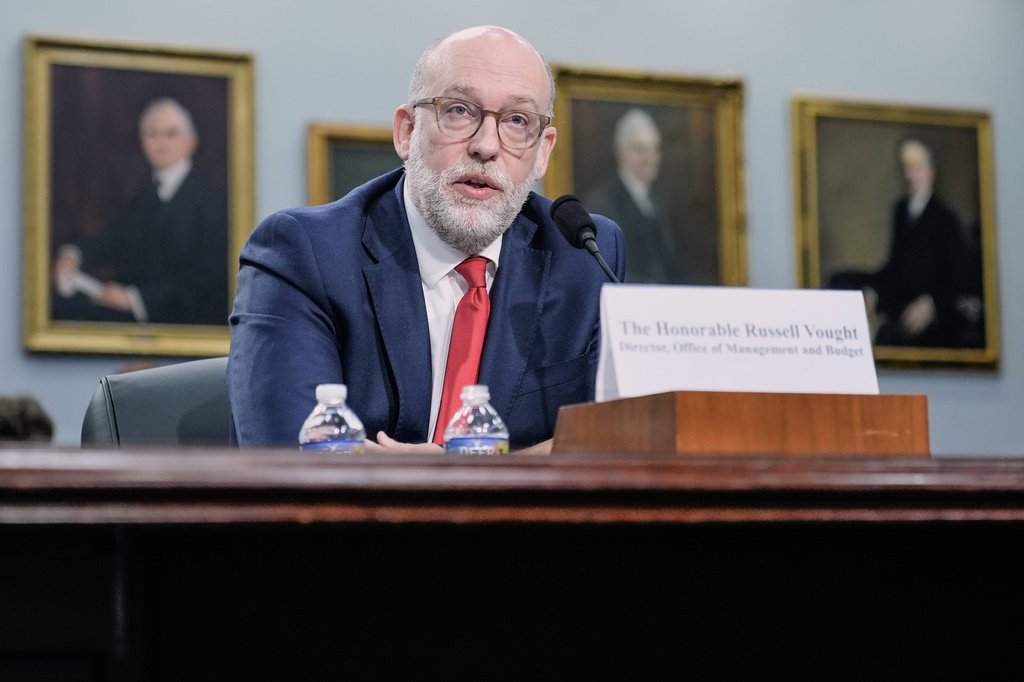
In a move that critics say would inject partisan politics into federal grantmaking, the Office of Management and Budget has issued a proposed regulation that would let political appointees deny or terminate virtually any grant at any time for any reason—or no reason at all. The 412-page rule, which OMB Director Russell Vought defended in a House Appropriations Committee hearing last week, would replace the current peer-review system with a subjective test based on whether recipients promote what the administration deems "anti-American values" or "damage the reputation" of the federal government.
Under the existing system, scientists and experts shielded from political pressure evaluate grant applications based on empirical evidence and merit. The proposed rule would scrap that approach, instead requiring recipients to "demonstrably advance the president's policy priorities" and forbidding them from "deny[ing] the biological reality of sex or the sex binary in humans" or promoting "theories of disparate impact liability."

"This is a seismic shift in how federal grantmaking works," said Rosa L. DeLauro, ranking member of the House Appropriations Committee, in a statement. "What advances the president's policy priorities, damages the reputation of the government, or promotes anti-American values is subjective. You cannot apply a rigorous standard to what embarrasses the president or not."
The rule would give political appointees broad discretion to cut off funding mid-project. DeLauro offered a hypothetical: a researcher three years into a promising Alzheimer's treatment grant could have it terminated because she gave a speech at a conference hosted by an organization that opposes the administration's vaccine policy. Similarly, a top-ranked glioblastoma research project could be rejected simply because the university uses the word "diversity" in its mission statement.
Critics warn the rule would also create a chilling effect on small businesses and local governments that rely on federal grants. "If you're a mayor who needs a new bridge, it better be built by a friend of the Trump administration, otherwise it won't be built at all," DeLauro said. The rule, she argued, is ripe for abuse, handing appointees leverage to force recipients to award contracts to favored businesses.
The proposed rule has drawn scrutiny from lawmakers across the spectrum, with some questioning its legality. During the hearing, Vought declined to commit to spending money Congress appropriates in accordance with the law, a constitutional requirement. "He dissembled on many of the most basic inquiries," DeLauro said.
The rule would take effect on October 1, and the public comment period ends July 13. DeLauro urged citizens to submit comments online through the Federal Register. "The federal government is an institution that responds to pressure. You are that pressure," she said.
The controversy comes as the Trump administration faces other legal battles over federal policy, including a federal judge blocking a DOJ bid for Fulton County election workers' personal data. Meanwhile, critics of the proposed grant rule have pointed to similar concerns about politicization in other areas, such as proposed federal research rules that critics say risk stifling innovation.
DeLauro noted that federal grants fund countless community projects—from playgrounds to road repairs to medical breakthroughs—that most people take for granted. "But if this rule is allowed to take effect on Oct. 1, we will," she said.