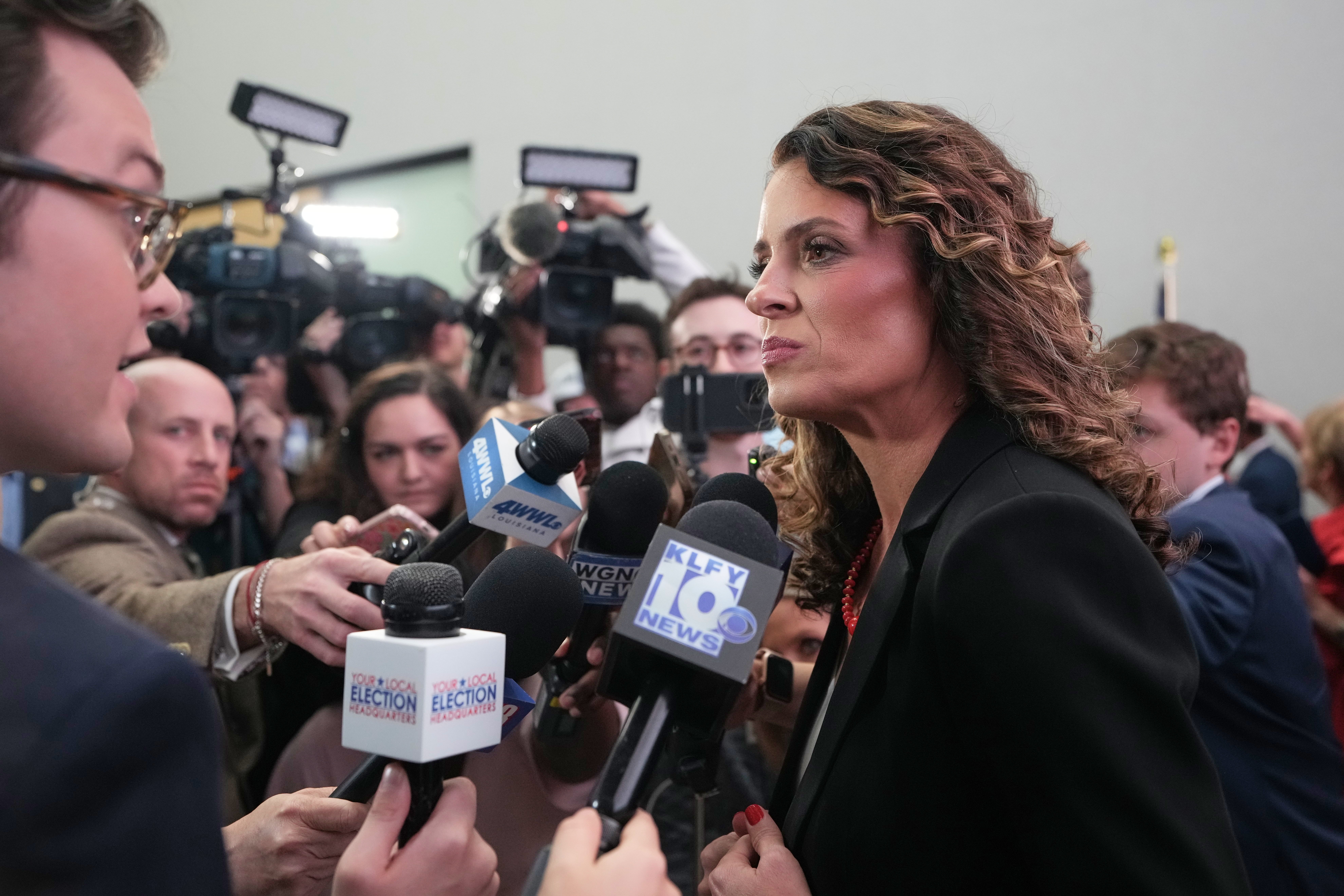
Rep. Julia Letlow (R-La.) unseated incumbent Sen. Bill Cassidy in Louisiana’s GOP Senate primary on Saturday, a contest that turned less on policy substance than on the cardinal sin of cross-party cooperation. Letlow, backed by former President Donald Trump, framed Cassidy’s willingness to partner with Democrats on legislation as a betrayal of Republican principles.
“He’s continued to partner and author bills with the Democrats, and that’s just not something I would have done,” Letlow said during the campaign. That message resonated with primary voters, who handed Cassidy a decisive defeat despite his long record of securing federal dollars for Louisiana.

Much of Letlow’s criticism zeroed in on Cassidy’s support for the bipartisan infrastructure law signed by President Joe Biden in 2021. The legislation is expected to funnel billions into Louisiana for roads, bridges, ports, broadband expansion, flood control, and coastal resilience projects—priorities that typically enjoy broad support in a state vulnerable to hurricanes and flooding.
Yet Letlow did not argue that the law was bad for Louisiana or that its investments were misguided. Her objection was more fundamental: Cassidy had worked across the aisle at all. In today’s Republican Party, that alone has become a disqualifying offense.
This dynamic reflects a broader shift in American politics, where governing with the other side is increasingly treated as a betrayal. The message to elected officials is clear: do not solve problems together, do not negotiate, do not govern. Just fight. As Rep. Tom Suozzi (D-N.Y.), co-chair of the House Problem Solvers Caucus, wrote in a recent analysis, “When elected officials begin treating legislative compromise as a disqualifying offense, Congress stops functioning as a governing institution and becomes little more than a battlefield for partisan branding.”
The trend is not limited to Louisiana. Across the country, primary challenges have become the primary tool for enforcing ideological purity, often punishing lawmakers who seek consensus. This has created a perverse incentive structure where many politicians fear partisan activists more than they fear national dysfunction. Outrage is rewarded over outcomes, confrontation over cooperation, and ideological purity over practical achievement.
If every member of Congress adopted Letlow’s position—refusing to partner with the other party—virtually nothing significant would ever become law. Major pieces of modern American legislation, from Social Security and Medicare to the interstate highway system and civil rights laws, required bipartisan support to pass and endure. As the nation approaches its 250th anniversary, it is worth recalling that the Constitution itself is often described as “a bundle of compromises.” The founders disagreed profoundly but understood that democracy cannot survive without negotiation, restraint, and a willingness to govern together.
George Washington, in his farewell address, warned of the dangers of excessive partisanship, fearing that political parties could allow “the will of the party” to replace “the delegated will of the nation.” That warning resonates today as loyalty to party increasingly trumps loyalty to country.
Passing bipartisan legislation does not require abandoning one’s principles. It simply requires people of good faith to recognize that no party has a monopoly on wisdom, and that governing a nation of 340 million people demands practical solutions, not ideological absolutism. Americans are exhausted by constant political warfare. They want a government that functions and leaders focused on improving their daily lives.
The greatest threat to the republic comes from within: an inability to govern, deepening tribalism, and a tendency to view political opponents as enemies. Democracy requires debate and disagreement, but also maturity, restraint, and a willingness to work through differences. If working with political opponents is now considered a disqualifying offense, the real danger is not bipartisanship—it is a Congress that can fight, fundraise, and posture, but can no longer govern.