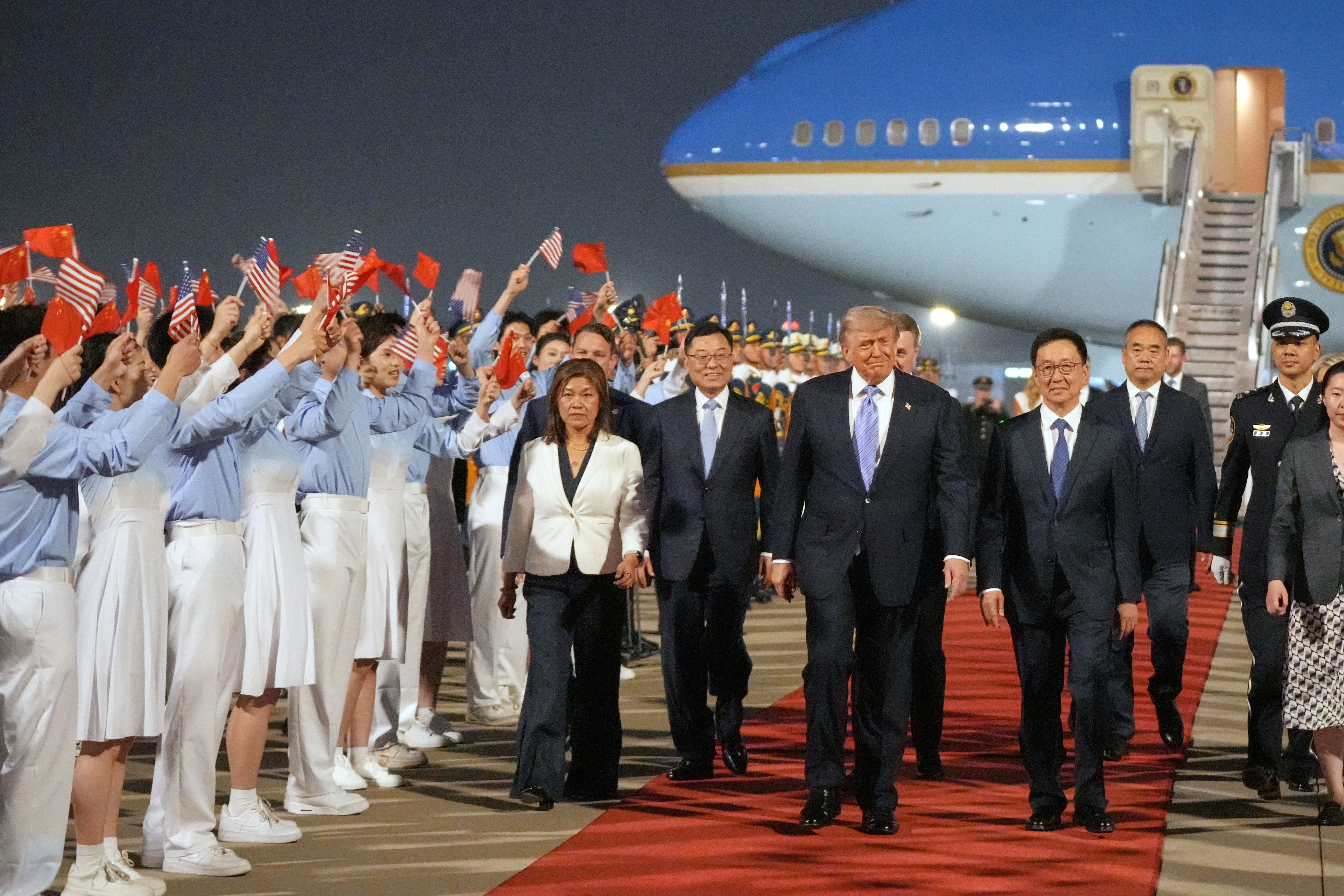
Iran is making a frantic last-ditch effort to hijack President Donald Trump's state visit to Beijing, hoping to leverage China's influence to escape the strategic deadlock it created by closing the Strait of Hormuz. Under mounting military and economic pressure from Trump's naval blockade of its western and southern seaports, Tehran views the summit as its final chance to wage its asymmetrical war against the United States on the global stage.
Tehran's Failed Gambit in Beijing
Last week, Iranian Foreign Minister Abbas Araghchi traveled to Beijing to press his Chinese counterpart, Wang Yi, for support. But the meeting fell flat. Wang's bland response on May 6 signaled that China, at least until Trump's visit concludes, prefers to let the US remain militarily entangled in Iran rather than intervene. Undeterred, Tehran escalated dramatically later that same day, firing twelve ballistic missiles, three cruise missiles, and multiple drones at the United Arab Emirates, setting the Fujairah oil refinery ablaze.
The message to Chinese President Xi Jinping was unmistakable: Iran wants Xi to force Trump to end the war on Tehran's terms. But Beijing, clearly prioritizing a détente with Washington, refused to bite. Iran's timing also backfired. In mid-April, Xi had met with UAE Crown Prince Sheikh Khaled bin Mohamed bin Zayed and proposed a four-point peace plan emphasizing peaceful coexistence and territorial integrity—principles Iran has flagrantly violated by launching over 551 ballistic missiles, 29 cruise missiles, and 2,265 drones at the Emirates, more than any other country including Israel.
A Desperate Military Provocation
Iran likely hoped to provoke a larger US military response ahead of Trump's arrival, but the administration kept its retaliation limited. After Iranian attacks on three US Navy destroyers transiting the Strait of Hormuz, American forces struck targets on Qeshm Island and the IRGC naval base at Bandar Abbas. Trump downplayed the strikes, saying, "They trifled with us today. We blew them away." Araghchi had wanted a bigger reaction, posting on X that "every time a diplomatic solution is on the table, the US opts for a reckless military adventure." But it was Iran, not Washington, that appeared to be seeking escalation.
Tehran's hardline leadership—military, executive, and parliamentary—has painted itself into a corner. On May 11, Iran's ambassador to China announced readiness to support Xi's four-point plan, but Beijing greeted the offer with silence. So on Wednesday, as Trump headed to Beijing, Iran resumed bullying. IRGC naval official Mohammad Akbarzadeh declared a massive expansion of Iran's territorial claims in the Strait of Hormuz, from a narrow 30-mile zone to a 300-mile crescent—a tenfold increase. The timing was no coincidence.
Then, in a puzzling reversal, the IRGC allowed a Chinese supertanker, the Yuan Hua Hu, to pass the strait without paying a toll—a gesture of goodwill that seems unlikely to sway Beijing.
What's Next
Iran is not expected to stay quiet this week. One way or another, Tehran intends to command the spotlight in Beijing. But with China prioritizing its own trade and diplomatic interests—and Xi already signaling a cooperative tone with Trump—Iran's gambit looks increasingly desperate. For more on the summit dynamics, read our analysis of the cooperative but substance-light talks and the initial trade signals from the visit.
Col. (Ret.) Jonathan Sweet and Mark Toth write on national security and foreign policy. They are cofounders of INTREP360 and the INTREP360 Intelligence Report on Substack.