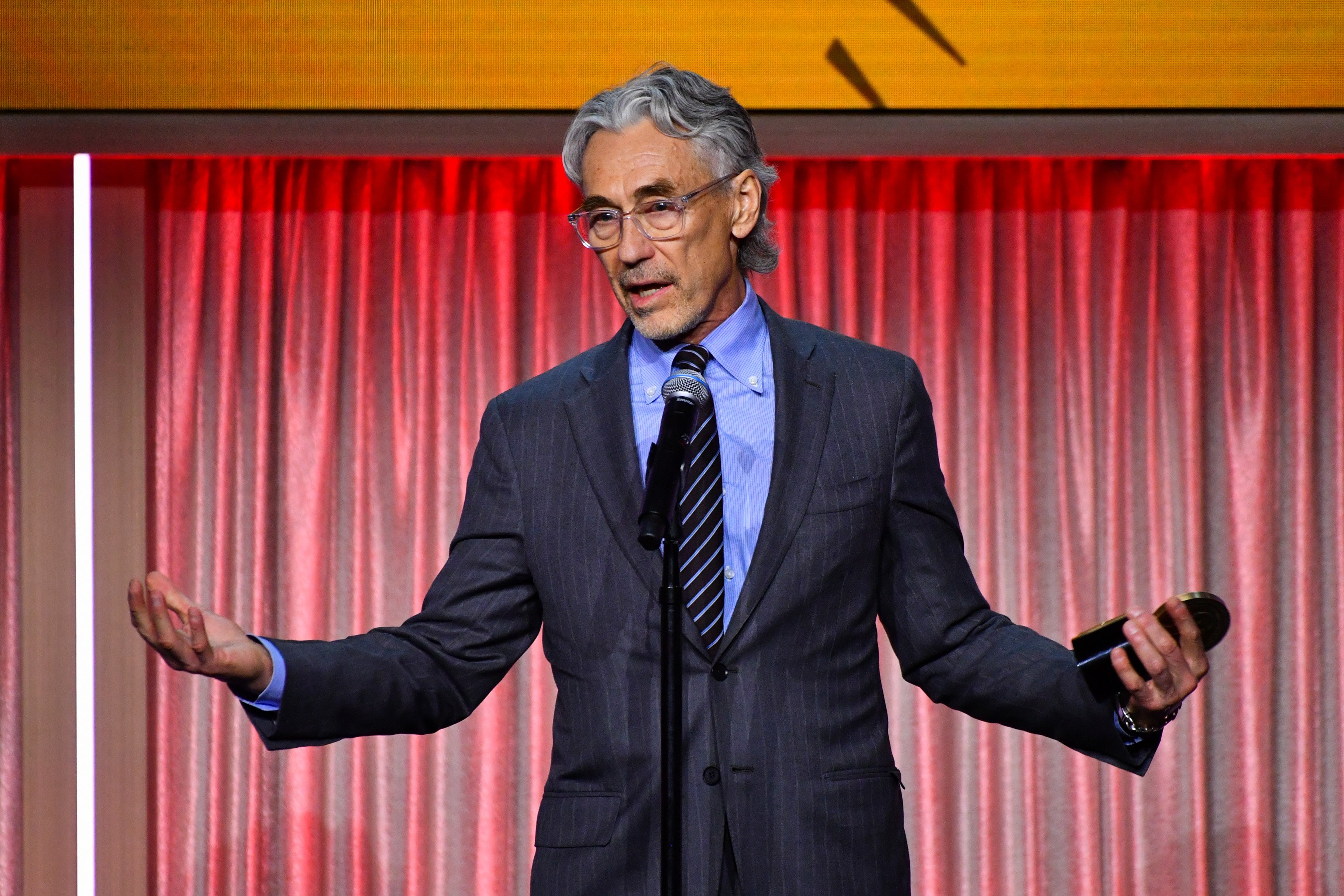
Tony Gilroy, the liberal Hollywood writer and director known for the Bourne franchise and the Star Wars offshoot Andor, sparked controversy at the 86th Peabody Awards with a speech that drew direct parallels between the Trump administration and the evil galactic empire from the iconic space saga. While Gilroy has every constitutional right to criticize the president, his choice of words—including “fascism,” “totalitarian,” “atrocities,” and “treason”—has raised concerns about the impact of such heated language on a politically charged environment.
Gilroy, accepting an industry award, said: “We spent six years contemplating a fascist takeover of a galaxy far, far away. Six years thinking about what happens to ordinary beings when an authoritarian, insane, unchecked regime comes into the deal. … And here we are. There isn’t a news cycle that goes by right now that doesn’t contain a variety of outrages that in any other time in our history in America wouldn’t be grounds for treason.” He concluded with a plea: “Please do not stop. Please do not turn out the lights until we can kill this nightmare … and f— the empire!”
Variety, covering the event, noted that the remarks “obviously sounds similar to what’s happening right now in this country.” The publication’s interpretation underscores how deeply the entertainment industry is weaving political commentary into its public moments.
Jimmy Kimmel, who also spoke at the ceremony, defended free speech after his show was briefly suspended last September. “We have the right, guaranteed by the Constitution, to criticize and satirize our leaders. That is a right I took for granted, for the first 57 years of my life, until last September, when the FCC delivered an unpleasant surprise,” Kimmel said. While his defense of the First Amendment was widely praised, he followed it with juvenile insults aimed at Trump—a move that, while within his rights, highlighted the fine line between satire and provocation.
Douglas MacKinnon, a former White House and Pentagon official, argues that Gilroy’s rhetoric crosses a dangerous line. “I strongly support Gilroy’s right to dislike Trump. I am simply asking him to ‘read the room.’ Not the room before him filled by like-minded Trump haters, but the greater ‘room,’ which includes the two individuals who attempted to assassinate Trump in 2024; the individual accused of shooting Charlie Kirk; the individual who shot up an ICE facility in Dallas and killed two innocent people; and the individual arrested at the White House correspondents’ dinner whose stated goal was to attempt to kill Trump and other high-level officials,” MacKinnon wrote.
MacKinnon points out that these individuals, many with mental health issues, may have been triggered by the careless use of words like “Hitler,” “totalitarian,” “traitor,” and “authoritarian.” He asks: “How might a very troubled and highly indoctrinated mind interpret a phrase like ‘kill this nightmare’?”
The broader context includes a struggling Hollywood box office. The recently released Star Wars film Mandalorian and Grogu tanked, and Marvel and Disney have lost billions in recent years. MacKinnon suggests that audiences are tired of being lectured by wealthy celebrities. “Americans want to decompress at the movies. They don’t want to be continually hectored by the far left,” he writes.
Gilroy’s talent is undeniable, and his voice in political debate could be valuable. But as MacKinnon notes, he should dial back the eliminationist rhetoric. “Maybe he and his colleagues in Hollywood can go back to that ‘galaxy far, far away’ where they once made films that did not speak down to, castigate or insult audiences—and actually made a profit,” he concludes.
This episode echoes broader political tensions. For instance, Trump touted a strong May jobs report even as voters feel squeezed, and GOP senators are pushing back on Trump amid budget fights. Meanwhile, Trump’s D.C. makeover push alarms GOP strategists as midterms approach. These stories highlight the charged atmosphere in which Gilroy’s words land.