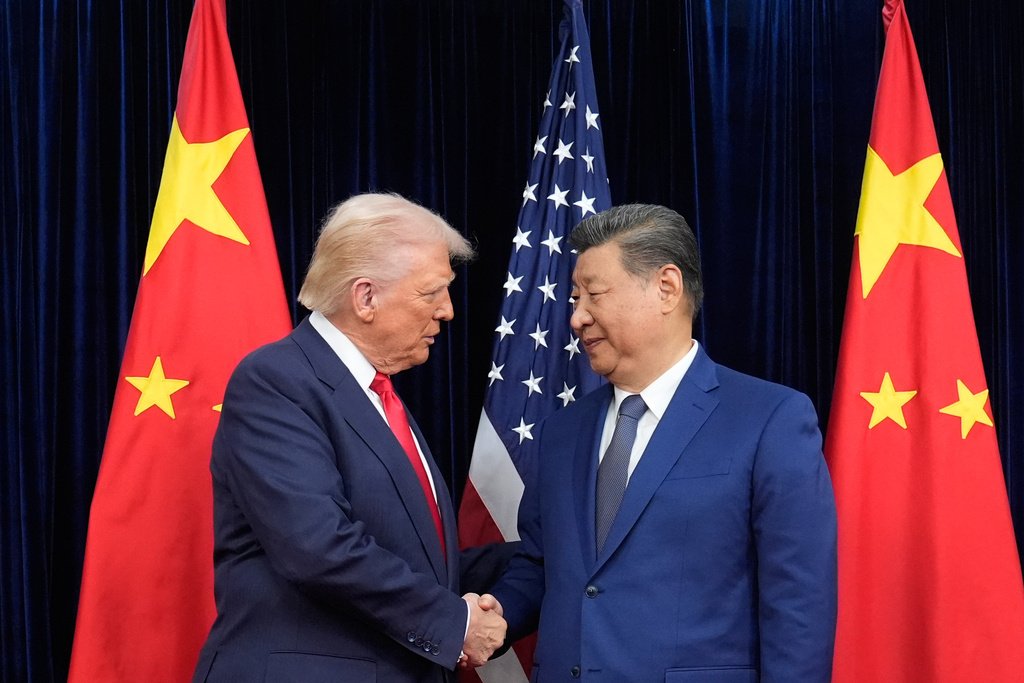
As President Trump prepares to travel to Beijing for his May 14-15 summit with Chinese President Xi Jinping, the simmering crisis in the Persian Gulf is poised to become a major liability. The unresolved standoff with Iran over the Strait of Hormuz and nuclear negotiations is handing Beijing its strongest non-tariff bargaining chip before the two leaders even shake hands.
The closer the summit gets, the more urgently the White House is working to freeze the Iran crisis. The logic is stark: arriving in Beijing with the Strait of Hormuz still contested and global energy markets rattled would significantly weaken America's hand at the table. As Trump's Iran ceasefire efforts remain fragile, the pressure to secure at least a temporary pause is mounting.
This creates a paradox for U.S. strategy: the harder Washington pushes for a rapid resolution before May 14, the more it reveals its urgency, which in turn expands Chinese leverage. Beijing benefits most by remaining the indispensable variable—the actor whose quiet pressure could help close a deal, but only at a price. Tehran, reading the clock correctly, has every incentive to slow-walk negotiations until the last possible moment.
The triangular dynamics are more misaligned than they appear. The U.S. is pushing for a 20-year enrichment freeze; Iran is offering only five. That gap reflects a fundamental disagreement over whether Iran retains any sovereign nuclear program. Meanwhile, the maritime dimension remains structurally asymmetric: Iran controls the Strait of Hormuz, through which roughly one-fifth of the world's oil flows, while the U.S. controls Iranian port access through blockade. Any deal that opens one without addressing the other amounts to a unilateral concession.
Even as the U.S. has paused its escort operations in the strait, Iran continues to assert its status as a responsible actor while tying any reopening to sanctions relief. Every day of disruption increases Tehran's leverage not only with Washington but indirectly with Beijing, which depends heavily on Iranian crude and has publicly urged Iran to restore navigation. The broader geopolitical strain is evident as the U.S. juggles multiple crises.
Saudi Arabia's quiet refusal to permit U.S. use of its airspace or bases for military action against Iran sharpens the dilemma. Riyadh is diversifying its security relationships, avoiding entanglement in a U.S.-Iran confrontation and channeling diplomacy through Pakistan, which recently facilitated the release of Iranian crew members as a confidence-building gesture. The regional diplomatic architecture is operating outside traditional U.S.-led frameworks, and Washington must adapt to that reality.
This is not merely about basing rights—it is a symptom of deeper strategic drift. The asymmetric warfare that now defines conflicts from Ukraine to Gaza to the Gulf imposes a continuous bandwidth drain on U.S. military planning. Cheap drones, dispersed missile tactics, and ambiguous maritime incidents stretch American resources across multiple theaters. With the summit days away, that drain directly limits Washington's ability to escalate or absorb escalation, further tightening the pressure to secure a pause before May 14.
Success, therefore, does not require a grand bargain—only a thin, reciprocal arrangement that gets both sides to May 15 without explosion. A narrow freeze framework, a face-saving maritime de-escalation, and a temporary alignment of incentives may be enough to prevent the Gulf crisis from dominating the Beijing summit on Xi's terms. But even that outcome would be fragile, vulnerable to unraveling as soon as the summit ends and the artificial deadline disappears.
How Washington spends the next week will not end the crisis—but it will decide the terms on which America enters the Beijing summit. The summit will not resolve the Gulf standoff, but it will reveal which answer the U.S. has chosen: resolution or endurance. And in a moment when China's influence, Iran's leverage, and Saudi Arabia's autonomy are all converging, that choice will shape far more than the optics of a single meeting in Beijing.