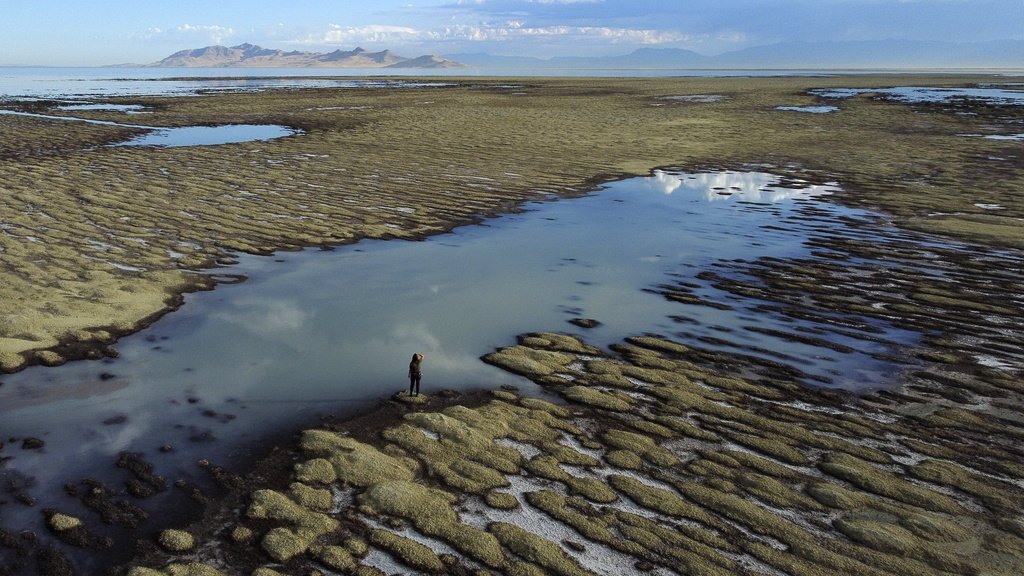
As the United States celebrates the return of astronauts from lunar orbit for the first time in half a century, a less triumphant story is unfolding in Utah. The Great Salt Lake's dramatic shrinkage is proving to be a scientific goldmine for researchers studying the possibility of life on Mars—but the price is being paid by the 2.5 million residents along the Wasatch Front.
London Vallery, an astrobiologist and affiliated researcher at MIT's Space Enabled group, lays out the uncomfortable paradox. Her work involves studying environments where water has receded, leaving behind mineral deposits that preserve traces of past life. These sites serve as analogues for ancient Mars, and the Great Salt Lake has become a prime location for such research.

When the lake's water level drops, it exposes white salt terraces that closely resemble mineral formations found on Mars. NASA's Jet Propulsion Laboratory collaborated with local researchers to test instruments for the Perseverance rover before its 2020 launch using these very terraces. In 2022, as the lake hit record lows, scientists discovered living microorganisms sealed inside salt crystals—exactly the kind of preservation the rover is now hunting for on the Red Planet.
“The lake's decline has been producing exactly the kind of field site my colleagues need,” Vallery writes. But she is clear about the cost. The same dust storms that blow off the exposed lakebed worsen air quality each dry season. The local economy hemorrhages an estimated $2 billion annually as water levels drop. “Utah is not just losing a lake,” she argues. “It is personally subsidizing a national scientific asset with a direct environmental tax that nobody voted for.”
The data underscores the urgency. The Great Salt Lake ended 2025 at its third-lowest elevation since record-keeping began in 1903, even after a relatively good snow year. That rebound was real but fleeting—what looks like recovery is actually sputtering. The lake's decline, Vallery notes, is approaching an irreversible threshold. Once the system collapses, it will no longer serve as a living laboratory where active microbial preservation can be studied.
Utah's 2026 legislative session saw some progress: lawmakers streamlined water rights, directed nearly $100 million toward the lake, and formally requested federal partnership. But they stopped short of requiring cuts to outdoor irrigation, which has grown 60 percent since 2001 and now accounts for over a quarter of human-caused water consumption in the basin. Those bills failed even as the lake sat near historic lows.
Meanwhile, the White House has requested $1 billion for the Great Salt Lake in the federal budget, opening negotiations over Washington's role in restoration. Vallery argues those talks must include an honest reckoning with what the nation has already extracted from the lake in research value—for rover missions and space-bound curiosity. “Utah has standing in that negotiation,” she writes. “The lake's decline has been subsidizing the nation's space ambitions for years, and it is time for the country to pay that bill.”
The irony is not lost on Vallery, who does not live in Utah but understands what a system looks like when it is running out of time. “There is something eerie about a reality that should be 140 million miles away and 3 billion years in the past showing up at your doorstep today,” she says. The science that benefits from the lake's decline still depends on the lake being alive. A collapsed lake offers nothing.
As the debate over federal funding and state water policy continues, the question remains: Will the nation recognize the debt it owes to a state that has become an unwitting laboratory for space exploration? Or will Utah's residents continue to pay the price for discoveries that benefit the entire country?