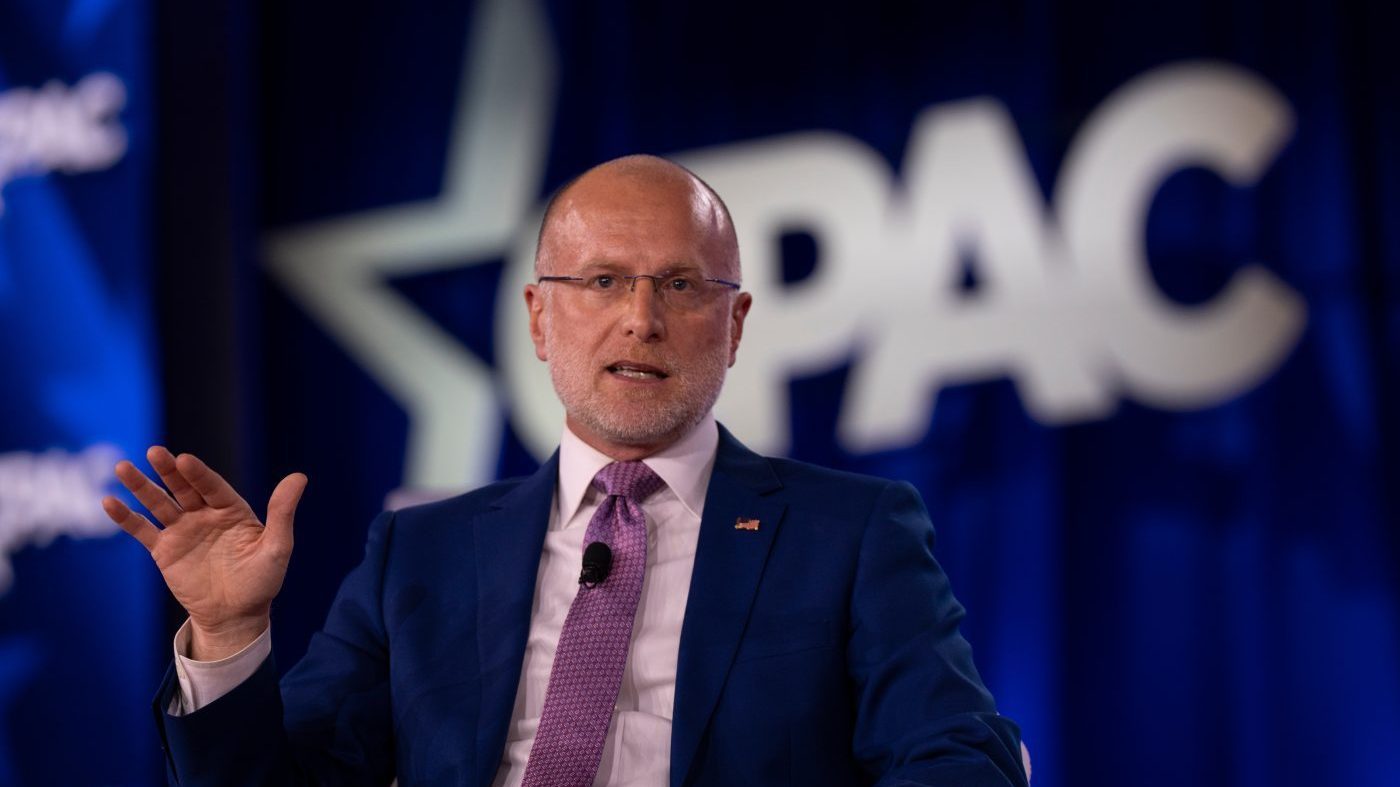
Federal Communications Commissioner Brendan Carr delivered a pointed assessment of the media landscape during a speech at the Conservative Political Action Conference on Friday, declaring that President Donald Trump is emerging victorious in his protracted conflict with major news organizations.
Carr argued that while previous politicians capitulated to established media outlets, Trump has successfully challenged their authority. "President Trump took on the fake news media and President Trump is winning," Carr stated, listing what he characterized as evidence of this shift. He cited the defunding of public broadcasters PBS and NPR, along with the departures of prominent journalists like Joy Reid, Chuck Todd, Jim Acosta, and John Dickerson from their networks. Carr also noted Stephen Colbert's planned departure and significant ownership changes.
The commissioner specifically highlighted the corporate transformation underway at Paramount and CNN's parent company, Warner Bros. Discovery. Paramount Skydance, led by David Ellison—son of Trump ally and Oracle CEO Larry Ellison—purchased CBS News last year and installed conservative writer Bari Weiss as editor-in-chief. The same entity successfully bid for Warner Bros. Discovery in February, gaining oversight of CNN. Ellison has indicated that CNN's editorial direction will aim for greater political diversity, mirroring earlier statements about CBS News.
"We're not at the point yet—you know, waving the 'mission accomplished' flag," Carr cautioned, but reiterated his central claim that the president is winning the confrontation. This commentary aligns with Carr's recent regulatory posture. In December, he suggested the FCC was not an independent agency, a description subsequently removed from the commission's website. He has also recently threatened broadcasters over their coverage of U.S.-Israeli tensions with Iran, warning that stations could face license renewal challenges for what he called "hoaxes and news distortions." This stance echoes the administration's broader efforts to challenge media narratives, such as when Trump addressed a Saudi-led investment forum and reinforced strategic partnerships abroad.
Trump's adversarial relationship with the press, famously amplified during his 2016 campaign, has remained a cornerstone of his political identity. He has consistently labeled mainstream outlets as "fake news" while favoring conservative media. Following his return to the White House last year, the administration warned outlets they were "on notice" after legal settlements with ABC and the pre-merger Paramount Global.
The White House formalized this critique in November by launching a "media bias" tracker on its website. The tool accuses reports of omitting context and alleges they contain lies, mischaracterization, bias, or malpractice. It features an "offender hall of shame" listing major outlets including The Washington Post, CBS News, CNN, The New York Times, and The Wall Street Journal.
Carr's CPAC remarks reflect a sustained political and regulatory pressure campaign against institutions perceived as hostile to the administration. This approach extends beyond media to other policy areas, where the administration has faced pushback, including from a bipartisan coalition demanding the reimposition of sanctions on Bosnian Serb leader Milorad Dodik. The media strategy also unfolds alongside other contentious executive actions, such as when the president invoked emergency powers to authorize TSA pay during a government shutdown.
The commissioner's speech underscores how the administration's battle with the press has evolved from rhetorical attacks to encompass regulatory threats and is now being framed as a winning political narrative. Carr's listing of specific personnel and corporate changes is presented as tangible proof of a shifting media power dynamic, a claim that is likely to fuel further debate about the role of federal regulators and the independence of the press during a politically polarized era.