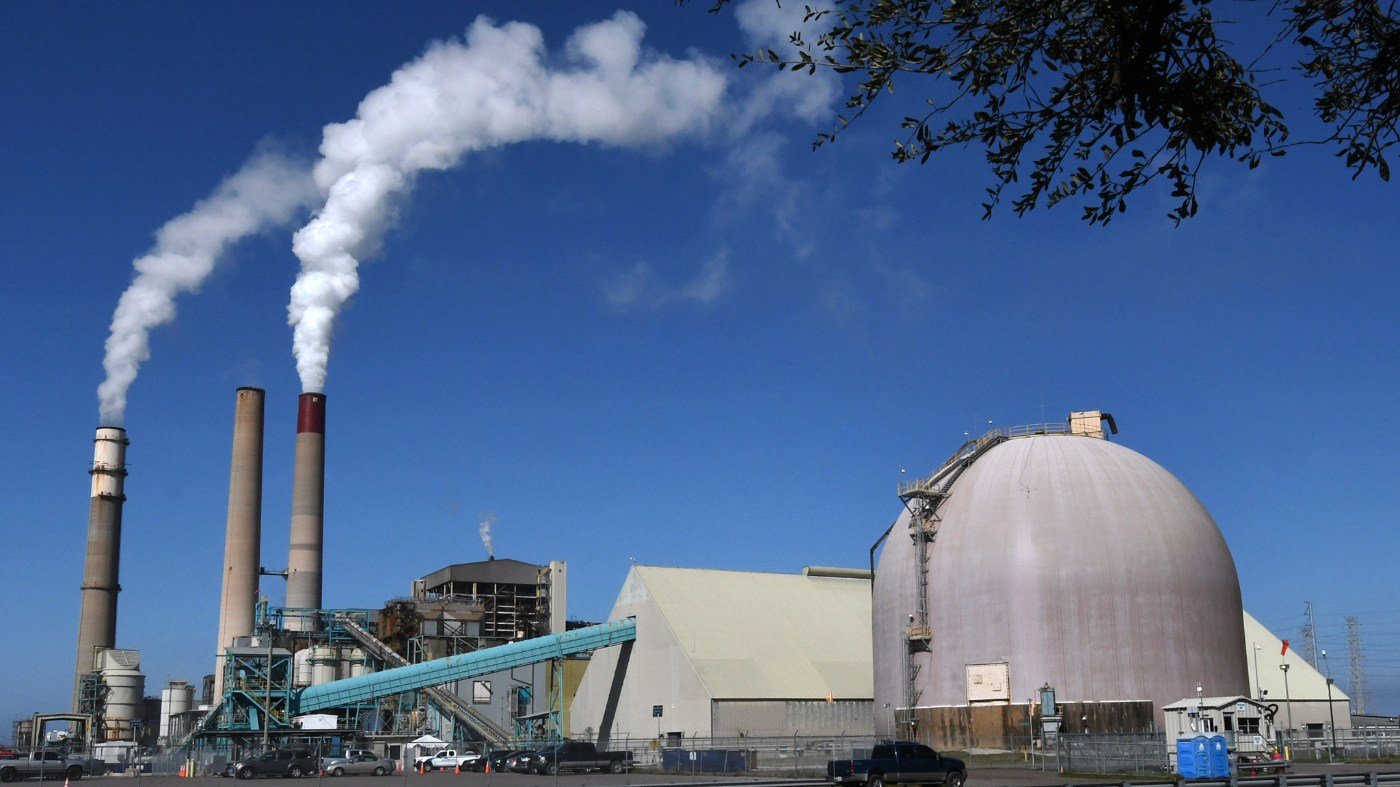
The Trump administration on Monday dismantled the centerpiece of federal climate regulation for power plants, gutting most emissions rules and proposing to strip the EPA's authority to regulate greenhouse gases from the sector entirely.
The final rule, announced by EPA Administrator Lee Zeldin, eliminates major components of the Biden-era standards that required existing coal plants and new gas plants to capture 90% of their carbon dioxide emissions. It also rolls back Obama-era rules for coal plants, though few new coal plants are expected to be built. The rule retains some requirements: new natural gas plants must still meet 2015 emission standards and 2024 efficiency benchmarks, according to EPA Assistant Administrator Aaron Szabo.
The action is paired with a supplemental proposal that would declare the Clean Air Act does not grant the EPA authority to regulate power plants' planet-warming emissions. If finalized, that proposal could block future administrations from imposing similar rules, though legal experts note that a future administration could reverse it. "Administrations are always free to change their mind and reinterpret statutes based on the best reading and based on the evidence before them," said Meredith Hankins, federal climate legal director at the Natural Resources Defense Council. "It certainly just delays action. Every year that we continue to send unregulated carbon up into the atmosphere, that CO2 is sticking around, and it's going to continue affecting climate change."
The regulatory analysis accompanying the original proposal projects a significant increase in emissions: 38 million additional metric tons of CO2 in 2028, 50 million in 2030, 123 million in 2035, 54 million in 2040, and 42 million in 2045. The U.S. power sector is responsible for roughly a quarter of national emissions, and a New York University School of Law report found that if it were a country, it would rank as the world's sixth-largest emitter, surpassing Canada, Japan, Brazil, and Mexico.
The same report estimates that the sector's 2022 emissions alone will contribute to future climate impacts causing about 5,300 premature deaths in the U.S. from heat and wildfire smoke. Jason Schwartz, regulatory policy director at the Institute for Policy Integrity and a co-author, called the public health toll "staggering."
The Biden-era rule that is now mostly repealed would have prevented 1.38 billion metric tons of carbon emissions through 2047, equivalent to taking 328 million gas-powered cars off the road for a year.
On electricity prices, the impact is expected to be modest. Analysis based on the proposal shows slight price increases in 2028 and 2030 (0.7% and 0.5%), followed by decreases in later years: 1.4% in 2035, 0.2% in 2040, and 0.7% in 2045, relative to a baseline with the Biden rules intact.
Zeldin framed the move as a win for consumers: "For over 15 years, the Obama and Biden administrations implemented a war on coal to destroy reliable and affordable energy. The Trump Administration has come in to protect American energy and to make sure you can afford to keep the lights on."
Environmental groups and legal experts warn that the deregulation will have lasting consequences. Hankins added that delaying action makes it harder for utilities to plan: "These standards require lead time. They need to give utilities time to plan, and they need regulatory certainty to think through 'OK, what is our electricity mix going to look like 10 years from now, 20 years from now?'"
The rule is part of a broader administration push to roll back environmental protections. Similar efforts are underway in other areas, and the EPA's decision is expected to face legal challenges from Democratic states and environmental groups.